Jamie Aarons • Mastering Discomfort & Ultra-Endurance
Time: 6hrs 12mins applied listening.
Designed for multi-session study.
Episode Brief
Sustained performance under pressure is rarely about willpower or motivation. It is about how decisions are structured when recovery is limited, uncertainty is constant, and execution cannot pause.
How to Watch
Episodes are not designed for passive or background consumption. Treat the conversation as observation. Pay attention to repeated decision patterns, constraint responses, and moments of recalibration rather than isolated statements.
Also available on
-
This transcript was generated automatically using Adobe Premier Pro. It has been lightly corrected, but may still contain errors.
00:00:00:00 - 00:00:29:16
Unknown
Today's conversation is with Jamie Austin's. Jamie is an accomplished multisport adventure racer and ultra marathoner who in 2023, set a world record as the fastest person to self-propelled up, down and in between Scotland's 282 Munros. She completed the challenge in 31 days, ten hours and 27 minutes, beating the women's record by 44 days and the mains by over 12 hours.
00:00:29:18 - 00:00:54:13
Unknown
Jamie ran, kayaked, hiked road and mountain bike over 3000km and claimed a staggering 140 vertical kilometres, which is the equivalent of climbing from sea level to outer space. And she did it all in less than four hours sleep tonight. But this conversation isn't just about a world record. It's a case study and strategy for lifelong resilience and readiness.
00:00:54:15 - 00:01:24:18
Unknown
Together, we'll deconstruct how Jamie approaches life adversity and challenge, mapping out her underlying strategy for success, which you can apply to your own pursuits, whether in sport, work or personal. Please welcome Jamie Irons. Just to recap, what we're trying to do here today is I'm not interested in just having a conversation around, like a lot of podcasts where they sit and have a chat because something's got a book to promote or whatever or anything like that.
00:01:24:19 - 00:02:10:04
Unknown
What, what I'm really interested in is speaking to people like yourselves, hopefully others across the military, maybe musicians, people at the top of business and, and using that metrics that I sent to try and deconstruct. What if we look at aspects of your life? What are all the things that we can use to populate that model, to find the underlining, the underlying, system that you use, that when you've got something that starts off as an aspiration, which is really going to be really interesting when we get into the moon round, because as far as I can tell, everything that I've read over there is, is I wonder if I could do
00:02:10:04 - 00:02:38:05
Unknown
that after watching something with Johnny. Sorry, Tony. And then I'm thinking like, how? How does that then suddenly, because it seems like, I'm just I'm used to dealing with people or organizations where there's some form of, underlying social thing or something in society that they want to change for the better or whatever that is. So coming down to something is where the essence is.
00:02:38:05 - 00:03:01:22
Unknown
I just want to see if I can do it. I think that's quite a fascinating thing to explore. And then how does that then explodes and become the 202 years of planning in the 202 rounds at 282 Munros? But before we get into all of that, I'm also really curious as to your starting point for all this type of stuff.
00:03:02:08 - 00:03:26:03
Unknown
So because obviously you didn't just suddenly wake up one day, you haven't never done anything like this before and then leap to just say, I'm going to see how fast I can get. Round 282 mentors. So could you give us a little bit of background from your earlier years? And when you first are aware that you took an interest in sport or physical activity or whatever?
00:03:26:05 - 00:03:48:15
Unknown
Yeah, yeah, absolutely. It was not a couch to manoeuvre around. No, no. And I suppose that that is what you're getting at. I mean, everything that we do, no matter what it is, whether it's sport or music or whatever, it is a build up of what you've done before, right? So, yeah, this wasn't on a whim. Yeah.
00:03:48:15 - 00:04:08:01
Unknown
Let's see if I can boost myself for a month. Because previously I tried to be myself for a week and beat myself for a day and beat myself for four hours and. Yeah. But, yeah, I kind of going back, I guess, I mean, I grew up in Northern California. The weather was conducive to being outside.
00:04:08:02 - 00:04:31:13
Unknown
I had parents who were active, if not particularly sporty, either. My mom, my mom was a swimmer. I think she swam while pregnant with me, literally until the day before I was born. Okay. Never competitive. So neither of my parents were, as far as I know, ever particularly involved in competitive sport. But they're both active people.
00:04:31:15 - 00:04:55:20
Unknown
So my brother and I growing up were absolutely encouraged to be active. You know, get outside, get amongst the bugs, be outside with your friends, ride your bike to school, you know, rollerblade to get frozen yogurt, whatever. It was kind of for physical health. So that was recognized, obviously, as being important. And I think we were offered opportunities sometimes maybe.
00:04:55:20 - 00:05:15:16
Unknown
Yeah, strongly encouraged to try new things. And that wasn't always just sport. We had to play a muse, musical instrument for a set period of time when we were kids, we had to do certain things, to try basically to just expand your, to expand our exposure to things that we might then have found of interest.
00:05:15:17 - 00:05:44:15
Unknown
So when I was really little growing up in California, I could I was swimming before I could walk. Loosely speaking, I mean, I was floating in a pool, you know, I was one of those babies that my mom had me in a pool, from Noodle Dam. You know, I was tiny while out swimming with my mom. So that was obviously, like, very early exposure to what later would become sport, but to me was just fun.
00:05:44:15 - 00:06:04:17
Unknown
And there's bonding in that. And, you know, it happened to be swimming, but it could have been riding a bike. It could have been going for a while. It could have been anything. So I think there's a lot wrapped up in my background of sport that it was immediately from infancy, attached to being a bonding experience. It was attached to being social.
00:06:04:17 - 00:06:27:15
Unknown
It was then something I did with friends. It was swimming pool parties. It was birthday party. You know, swimming to me evolved into competition. But that certainly isn't how it started. It started. So is it fair to say then, because everything that you've described sounds very positive experiences of physical activity from an early age. Yeah. That are just continually reinforced.
00:06:27:17 - 00:06:50:09
Unknown
Yeah. Yeah, I'm sure that's true. And I guess my mom, both my parents. So swimming with something, I obviously had an affinity toward. Yeah. So then they got me and enrolled in the Summer League Swim club. My mom still tells the story of how probably one of the, you know, if you look at key moments, to hang my hat on.
00:06:50:11 - 00:07:09:17
Unknown
So growing up where I did, I don't know, this is still the case, but the first sort of age group of competition in summer league was eight and under or under eights, and I was swimming when I was four. I think I was probably rolled in my first competition for four years old, probably the first competition at the age of five.
00:07:09:18 - 00:07:27:02
Unknown
Just doing one length, you know, with the eight and under, whose idea was that? Was that something that you expressed an interest in, or was that your mom and dad kind of nudging you to try again, that kind of try something new to see how you get on or I think it was part and parcel of being part of this summer league swim team.
00:07:27:02 - 00:07:50:00
Unknown
Everyone got involved. We probably all got ribbons for finishing. But I know, I mean, I was, you know, clearly the tiniest, clearly the worst swimmer by far, because I was potentially four years younger than some of the other kids three, three, eight, maybe as 5 to 3 years younger than some of the other kids, which at that age is obviously a huge discrepancy in size and ability.
00:07:50:02 - 00:08:13:07
Unknown
And, my mom tells me stories of how I was last in a heat by so much, by such a huge margin that by the time I finished, you know, I was that kid that the entire pool cheered for because everybody was probably sitting around twiddling their thumbs waiting for this little toady, you know, toddler, very young kid to finish.
00:08:13:07 - 00:08:36:11
Unknown
So I would finish last by miles, but apparently got lots of cheers and I had lots of fun. And it was just an all around positive experience. Did it? Did you experiencing, experience as a competition? Or if you think back to when you were that age where you just. Was it just an enjoyable experience to be in the pool with other people?
00:08:36:13 - 00:09:00:09
Unknown
Don't work out if there's a competitive element starting to appear or if it's just us. Continued positive reinforcement because you talked you've talked about you've talked about community and you're talking about all this external support and encouragement. And I can see a lot of I can see a lot of links from that straight up to, to now. Yeah, yeah.
00:09:00:09 - 00:09:25:21
Unknown
And the social aspect of all your adventures and endeavours. But but we'll get to that. But it's just I can already see the seeds of that. Yeah I mean I couldn't, I can't remember that was 40 years ago. But I certainly don't want to underestimate that. I'm a competitive person. And I think there was probably something there that like, I probably liked the idea.
00:09:26:21 - 00:09:47:03
Unknown
I think I liked the idea of pushing. I've always liked. And we will come on to this. You know, there is no one who motivates me more than me, and no one whose record I want to break more than my own. And I think swimming is a sport that's really conducive to personal bests. And there happens to be people around you pushing you.
00:09:47:03 - 00:10:08:17
Unknown
Absolutely. You know, being able to see people as I got better and, you know, I wasn't the last person by miles, maybe the last person by just a couple seconds. Even so, the people around me were externally motivating for me to try. And, you know, they were competitions. I did want to be as good as I could be, but that was the crux of it.
00:10:08:17 - 00:10:30:09
Unknown
It was like, I'm racing the clock, I'm racing my own time, and there's people around me who are doing exactly the same. Yeah. And if my best can be even better than their best today, in this moment, then that's the icing on the cake. But actually, me being the best version of a swimmer or of what?
00:10:30:10 - 00:11:05:00
Unknown
Of a whatever that I can be. That's always been the kind of real driver. But I think there's lots of factors at play there. And so while I always have focused on being the fastest, best, whatever version of me, the external forces definitely contribute to that. There's a nice balance there. Yeah. And yeah. And I suppose, you know, I would be lying if I said that there weren't races that I lost or, you know, thought I could have done better and I didn't.
00:11:05:00 - 00:11:39:21
Unknown
And I was upset. There's no denying that. But equally, I was never probably more upset than when I thought I was going to improve my time and didn't. Interesting. Yeah. So what? I was racing me, I was always racing me. But but in any, in any with maybe the exception of team sports. I think when you're an individual, athlete or sport is person, I think that's the reality of everybody is only ever racing themselves.
00:11:39:23 - 00:12:04:19
Unknown
Does that do you know, I think I think some people are more competitive with others than others. I think for some people, being the best. So something is not the driver. And don't get me wrong, I mean, being nobody's going to deny that they want to have that accolade, but that's not my forte, okay? That's not my pride.
00:12:04:19 - 00:12:28:00
Unknown
Yeah. Okay. That's that's fair. Yeah. Okay. Okay. And I think because I also play tennis a lot growing up. So we'll go back. So swimming was something else I didn't know was doing. That's my like main sport. Yeah. That I was absolutely kind of, most consumed by growing up. But before that, you know, we tried lots of sport, so I tried gymnastics.
00:12:28:00 - 00:12:50:01
Unknown
I tried ballet, I tried soccer, I was doing swimming, tried tennis, I'm sure skiing. There were multiple things. And I think when I was about nine, you tried all of this by the time you were nine? Yeah. As a as a lot of. I don't think that's about as usual. Can, can we, can we just put a pin in that for a second to come back to that?
00:12:50:03 - 00:13:23:04
Unknown
Because if you're being exposed to so many different disciplines. How how is that a competitive streak in your your parents. No, no, no. Just untainted. Yeah. No, I think our parents so we grew up in a household where I think two things were valued above all else. One was striving for your potential and trying your best. So there wasn't.
00:13:23:06 - 00:13:46:00
Unknown
I guess I personally interview my brother separately. I personally never felt a massive. I've never feared failure. The same. The failure in our family would be not trying something or not trying your best at something, and your best was always trying your best was always going to be good enough. And that might have meant you were last in something.
00:13:46:00 - 00:14:05:00
Unknown
It might have meant you on paper failed at something. But if you tried your best, if you left it all out there. Yeah, but I mean that in, in academic I mean, academia was really important in our family. Our education is critically important to that because that's that's been an untested discovery over the past, not least discovered as well.
00:14:05:02 - 00:14:37:10
Unknown
Yeah. So trying your best and and I guess we had the as I appreciate not everybody has we had the huge huge benefit of I think knowing that our we had our parents support. So you know that if you fail at something that doesn't change the love they have for you, it doesn't change. You know, none of that was a scary proposition because you knew that you had parents who loved you, that we're going to protect you and they pride you and, you know, all of that.
00:14:37:12 - 00:15:12:05
Unknown
The other thing that I think was paramount to all of that was, this is going to sound really cheesy, but it was kindness. If we weren't nice people. That was what would have gotten us in trouble at home. So I think in my sport, that thing came through and I think probably no more so than probably in tennis and in any other kind of more multi person, more so than swimming, you know, being a good sports person was valued far more than whether you want to match or won a race or.
00:15:12:09 - 00:15:38:06
Unknown
Okay. Were you a good teammate, were you supportive of your friends? Were you supportive of people on the other team or something went wrong? Did you, you know, recognize when your opponent hit a good shot? Did you you know, yeah. Kindness went a long way. Yeah. Okay. So I suppose for both of those things and to come together, you know, sportsmanship was more important than being good at sport.
00:15:38:08 - 00:16:01:21
Unknown
Okay. So. Okay, so, okay, so I just curious to see if this is generational and if you've, if you've got any memories of your grandparents and or any stories from your parents about how they were raised to figured out where they got the parenting model, if you like, for raising yourself and Kyle so I think it's just the two of you is.
00:16:01:21 - 00:16:39:19
Unknown
Yeah. Yeah it is. Yeah. So and so I'm just curious to see how the hate how did they land. This is the best way to these are to kids. Yeah. Yeah, yeah. So I think both my parents grew up in households where education was also very, very highly valued. I think and I don't want to put words in her mouth, but I think my mom would say, but something that was important to her was to make sure that I, as a girl, had every opportunity to be whatever badass version of a girl I wanted to be.
00:16:41:09 - 00:17:03:17
Unknown
And I don't think that necessarily meant I was going to be super sporty or that she was pushing me into sport, but I think she was very much about exposure to all sorts of opportunities, even things that maybe in her generation or in her parents generation would have been perceived to be male only spaces. But that was one of the things that are just about to jump on is to make the that contextually relevant.
00:17:04:11 - 00:17:26:04
Unknown
I'm not sure if you were a child of the 70s, early 80s, late 70s, late 70s. So I'm very much aware. Yeah. Okay. So so I'm very much aware of the differences of what women, that didn't have access to or what they were encouraged. I can even remember my own experiences when I was working at Glasgow University.
00:17:26:06 - 00:17:50:11
Unknown
And this would be going back to just the early 2000, and as part of some of the work that went that there was, but we did a sports camp for kids during the holidays, and I remember how distressed, one of the little girls was that turned up so bad. So this would be almost 20. Yeah, just over 20 years ago.
00:17:50:13 - 00:18:08:18
Unknown
And we were teaching everybody how to play soccer that day. So every day was a different sport, that kind of thing. And this girl was so distressed and hiding in the corner, and eventually managed to tease out of the reason that she didn't want to play is because I dated, convinced of the only boys play football. So she was.
00:18:08:20 - 00:18:28:10
Unknown
I mean, she must have been somewhere between trying to think the ages of the kids, somewhere around between 6 and 8 or something like that, and they're just like, oh my goodness, that's. So if you compare that experience of or support whatever you want to call it for going into sporting, you compare that to when parent starts. It's like night and day.
00:18:28:10 - 00:18:48:12
Unknown
And they were doing that 20 odd years before that again. So that's yeah that's quite something. Yeah. So so I think they I mean I can say their actual kind of pedagogy of the decisions about parenting, but I think exposure to new things, I think there was a recognition, you know, they're intelligent, highly educated people who knew this.
00:18:48:12 - 00:19:14:21
Unknown
For example, exposing young minds to music is healthy. Exposing new minds to different languages is healthy. So, you know, I suppose the and neither of our parents are musical or particularly arty, but they are, as I say, they are very active. So I guess also the apple doesn't fall far from the tree, does it? So their activity, wanting us to be physically healthy, I think, albeit they were probably a little bit ahead of their time.
00:19:14:21 - 00:19:37:13
Unknown
A mom, I suspect, you know, recognized and I'm sure they both did the value on mental health that wouldn't have been referred to that in the 80s. But I suppose, you know, things like encouraging me into soccer or, you know, allowing me to play soccer, whatever. If I'd asked to do it, I don't remember. You know, that's not about sport.
00:19:37:15 - 00:20:02:22
Unknown
That is about in terms of like athleticism. That's about teamwork. That's about camaraderie. That's about hand-eye coordination. It's all this of yeah, even even the social skills, all of that. Exactly. It's about losing socialization as. Yeah absolutely. So call that. Yeah. Absolutely. So I think you know there's there's lots of life skills to be gained from sport at any age.
00:20:04:12 - 00:20:25:21
Unknown
It just happened that. Yeah, I tried different things. I mean, I'm sure I asked to try gymnastics because I probably had little friends who were doing it. And then I would stone say, so then when I was nine and I had had, you know, a summer camp as this and a one night a week at that, as I think it's not uncommon for kids these days as well.
00:20:27:11 - 00:20:54:01
Unknown
Swimming was clearly becoming something that was more and more of interest to me. And I did express an interest, and I'm sure I would have done this. My parents maybe had done some research and shared ideas with me, but they never would have pushed me into anything. But my mom told me about a year round swim team, but it was basically like, if you want to do more than just summer league swimming, something has to give you meat.
00:20:54:02 - 00:21:13:15
Unknown
You mean when you say your range? You mean like joining an actual swim club? Yeah, exactly. Yeah, exactly. Yeah. So five, six days a week of training? On a year round basis. Not just because what I would have done up until that point would have been during school summer holidays. Right. So it would have been like a swim team.
00:21:13:15 - 00:21:43:09
Unknown
And there were lots of swim teams that all competed against each other in my area. But it would have been confined to summer, summer swim meets, summer training practice. So this was basically an offer that if I wanted to swim more frequently, they were totally there to support me. My mom would for years, as it turned out, you know, be my chauffeur back and forth to to practice.
00:21:43:11 - 00:22:09:06
Unknown
But something had to give. So I was pretty crappy at gymnastics. Which is unsurprising to no one. Now that I'm one of the least agile people I know. Soccer. I had fun, but I didn't love it. I didn't really love tennis, so I did stick with that. I mean, I think I did, like one session of ballet when I was really little, and that clearly didn't stick.
00:22:10:19 - 00:22:30:23
Unknown
So I tried lots of things. And, you know, my parents were very much open to us or me continuing to have smatterings of all these things, or if what I was demonstrating was a really keen interest in swimming, then that was fine. They would support me to do that. But they also needed me to be realistic about what a nine year old was capable of doing with 24 hours in a day.
00:22:31:05 - 00:22:54:06
Unknown
Okay, so one of the things that jumps out at me there is so you've been exposed to all these different activities up until, you know, talking that your own about at the age of nine, 19, and it's as if you're just discovering your funnel that's becoming self-selecting and you've referred to swimming just there is something that you loves.
00:22:54:08 - 00:23:29:12
Unknown
Are you able to articulate, or is a way that we can pinpoint the point of separation that what is it that you gain from swimming intrinsically that you weren't gaining from, say, soccer or Ali, that kind of thing? What what's up? What's absent in one and present and then the other? Yeah. One takes the box. So I think I couldn't say this for gymnastics because it's probably similar in terms of being a very individual kind of level sport, probably unlike the other things, soccer in particular.
00:23:30:18 - 00:23:51:13
Unknown
I think still to this day, I carry a lot of anxiety when thinking about team sports. I have real fears of letting other people down in a team. And actually swimming was a great way to be super active, push myself, and if I let anyone down, it was just on me, with the exception of an odd relay.
00:23:51:13 - 00:24:28:22
Unknown
And I did love doing relays, but for the most part, you're your own worst enemy, or your own best champion is a pretty finite, because it is one of the things when I had the chance to speak to professional rugby players, there was a I had the privilege of meeting a couple of the women's Scottish national team at Edinburgh, and it was one of the, one of their personal frustrations when they express this idea of when you're part of the team, I could go out and play the best game of rugby that I've ever played and be high fiving myself and save my head, and we still get hammered.
00:24:29:00 - 00:24:51:15
Unknown
And equally, I can go out and play the worst game of rugby that I've ever played and just it feels like a hollow victory because I've done so bad. But we won. So it's it's an and so. Yeah. So it's I think it's, it's interesting that you're starting to figure out that individual sports is definitely the way ahead for you.
00:24:51:15 - 00:25:15:09
Unknown
Yeah. Yeah. So so is that so? So did you eventually get to the stage where swimming was their thing and and everything else fell by the wayside, which then kind of brings it into high school and your collegiate years. So I was still playing tennis. Or. Okay, not as seriously as I was swimming, but I still had.
00:25:15:11 - 00:25:36:20
Unknown
So I taking lessons. So I have tennis lessons, like once a week. And then during the high school sort of season, I was part of the high school tennis team. So if memory serves, I mean, I was probably so thick when I was a teenager because I would have been swimming in the morning before school. And then I think I went to tennis practice straight after school.
00:25:36:20 - 00:25:53:13
Unknown
And then there's like, I'd need to double check for my mom. I might have gone swimming after that, although at some point I had lots of homework to do. But, yeah. So I was still playing tennis, but mostly doing. I like high school. I don't know how long the season was, like a semester long. And then.
00:25:53:13 - 00:26:14:02
Unknown
Yeah, skiing was a hobby that we did as a family in the winters. Okay. I would never have considered. Yeah, we never had considered that sport. I didn't train, and you know that was just a fun thing that we did. Okay? It's the family on weekends or whatever. But then still just generally active. So in the summers, I would swim in the morning.
00:26:14:03 - 00:26:36:10
Unknown
So during school holidays I'm thinking about in high school, I would swim in the morning at practice. Then one of my mates and I would really blade, in hindsight, a fair distance to go get frozen yogurt. And then we would rollerblade back to my parents house where we'd have a little bit of downtime. Usually we then go swimming for fun because we had a pool in our backyard.
00:26:36:10 - 00:26:55:17
Unknown
So we'd like make up, synchronized swimming routines and be really silly. And then we'd go to swim practice. So yeah, I mean, there were points in my high school life where I was swimming five hours a day, which isn't, again, uncommon for swimmers. Swimming is in Australia. It's not a sport that I know a great deal about.
00:26:55:19 - 00:27:21:06
Unknown
It's it's very common. A double double session per day. So also so this is interesting. So is this. So starting to get some insight into why I can't get up. No. Well I guess I can understand if I am maybe not a morning person. Maybe if you post all of that. But I'm thinking along the lines of, I wonder if that's sowing the seeds for resilience.
00:27:21:08 - 00:27:50:22
Unknown
Because if you think about if you're out in the morning and you're training in the morning, you've got your academic work during the day and then more, training in the evenings and whatnot. At that age, you're already starting to learn to be on your feet and operating, for an incredibly I mean, I'm competing as to some like myself that was born and raised in the west coast of Scotland and isn't necessarily known as the more sport is part of the world.
00:27:51:00 - 00:28:11:15
Unknown
So to me that's quite a contrast. But I can't I can't help thinking that that you're actually developing the skills and the coordination, to coordinate all these activities and be on the go for extended periods of time, day after day after day after day. And it's already happening. And you were for each. You have been at that point.
00:28:11:15 - 00:28:32:07
Unknown
Double sessions didn't start since I was 13. Okay. So you're into your teens. Yeah. Which is also interesting because if I've got my data right, that's also the age when a lot of girls actually start to drop off in sporting activity. And I think it's that the boys and girls, when they hit that age, hormones kick and they start to discover other things.
00:28:32:13 - 00:28:54:00
Unknown
So the likelihood of somebody sustaining that through the teenage years drops quite dramatically. So yeah, I had never considered the ex and kind of the other life skills gained from that. But yeah. Absolutely. Right. So it's the resilience. But that in and of itself isn't just one thing is it. So no, it's it was time management which I have.
00:28:54:05 - 00:29:10:06
Unknown
Yes. You know hugely to thank for making sure that I was, you know, but I had to do a lot of that, presumably on my own too. I had to be able to say, you still have to show up, still have to show up at the right place with the right kit. So, yeah, there's organization, there's time management.
00:29:11:20 - 00:29:45:14
Unknown
There's still having, you know, the there's something there about nutrition as well. So you got to feel all thinking about all the food, but then wrapped up in all of that. And I think you can't underestimate the value as, a high quality coach and a good team around you. And, and I don't doubt that, you know, besides my own inner drive to continue swimming and to try and push my limits and push my pace and get better at swimming, it was also my social life.
00:29:45:14 - 00:30:15:12
Unknown
And those things snowball. So the friends that I had had from when I joined the team at nine were still my friends when I was in the team. And, you know, I'd like to think that if a core couple of them had bailed, I would have stuck it out. But I couldn't say for sure. Yeah. And I couldn't say for sure that if my coach had been someone different or he had been less paternal, less supportive, you know, who knows what might have happened.
00:30:15:12 - 00:30:35:01
Unknown
But those those core elements, it all kind of come together. And, you know, our coach was, as any good coach is, I think obviously he was teaching us the the sports. We had thoughts around technique. We then once we were certain age and we were allowed to kind of lift late weights, we had weights programs and things.
00:30:35:03 - 00:31:00:02
Unknown
So we did all of the like athletic piece that you would expect a sports coach to do. But then, you know, for that age, he was very, influential in many of our lives around, you know, this is someone that we spent upwards of five hours a day with being realistic. I didn't spend that much time with most members of my family in a day.
00:31:00:02 - 00:31:31:14
Unknown
Right. So obviously a lot of that was with my head underwater. But, you still have the elements of someone who is a disciplinarian, someone who is a role model, someone who is going to, kind of be thinking about your life or should be, I think, a good coach thinking about your life holistically to be able to, to influence your best swimming self.
00:31:31:14 - 00:31:54:07
Unknown
You can't do that in isolation of knowing how are things going on at school? You having any issues? You know, if I catch you, if I hear that you've been drinking your your toast, if I dare, you know, catch wind that you've smoked a cigarette, that you've had a drug that you use, you know. Hell yeah. Okay, so.
00:31:54:08 - 00:32:03:22
Unknown
And he would never have said that he was a very kind of calm, religious man. But, you know, the you knew where you stood.
00:32:04:00 - 00:32:28:21
Unknown
And that was, I think for me, really, really healthy because I, I'm a rule follower. I like knowing, you know, those boundaries. My parents would have set those as well. They wouldn't have been any different to what our coach was saying. But actually, yeah, you know, I remember I mean, I'm such a rule follower, I would never have broken rule.
00:32:28:21 - 00:32:52:09
Unknown
But I remember kids who got caught, who had and I remember, you know, them having to run laps around a pool or them having to do extra stuff with consequences because yeah, yeah, consequence of the significance. And then that wasn't, you know, it, it wasn't maybe the same kinds of discipline that some kids get at home, but it, it clearly had, probably the best effect.
00:32:52:11 - 00:33:19:02
Unknown
Okay. It wasn't corporal. It was, you know, it was a, let's not do that again, because actually, someone there, especially at that young age where it's so easy to be distracted by peer pressure, it's so easy to be distracted by so many other I mean, I, heaven forbid, like, I can't imagine being a teenager now with the influence of social media.
00:33:19:22 - 00:33:51:15
Unknown
Yeah. I didn't have that growing up. But the influences, you know, from from peers, from, yeah. External sources to stray from the goal of being the best version of yourself you could be, to have other people who weren't my parents around. And I think my peers in swimming were, were also influential in that. So, you know, you didn't want to let your team down.
00:33:51:15 - 00:34:19:02
Unknown
You didn't want to let your teammates down. You you didn't want to let your coach down, just as I didn't want to let my parents down. So I was a rule follower for lots of reasons. But I think having all those kind of angles of different people, different voices, different influences. Emphasizing probably non-verbally, it was just the culture of to be your best self.
00:34:19:04 - 00:34:45:08
Unknown
These are the these are the things that are really helpful to being your best self. Okay. These are the things that actually I really highly recommend you avoid at the age of 15, 16, 17 to be your best when you're very impressionable and curious. Yeah. So it seems to me, because there's a couple of things that jumped out from the being being able to move from different activities throughout the day and all the planning I can.
00:34:45:10 - 00:35:10:06
Unknown
I can see a link there to transitions and multi-sport adventure racing. But also it sounds like through your sort of form, they're not really formative years of being a teenager, but it sounds like whatever you want in life, there was some form of mentor providing guardrails and everything that you do throughout your day. Every day. Is that or is that?
00:35:10:08 - 00:35:53:22
Unknown
And I oversimplifying that? No. I mean, I suppose it's it's fair to say that I did have a lot of really positive role models in my life. Okay. And I suppose moving me, I think those are formative years. And I think the goal of any good parent coach, adults in young people's lives is to be those guide rails, as you say, but then to be able to pull back and know that that person can apply their own rails to themselves in the absence of external, so that gives you a model to but you can that you've been given a model that you can then modify to make, make it your own, so to
00:35:53:22 - 00:36:28:21
Unknown
speak. Yeah, yeah. And you can also self impose it rather than needing it to be externally provided I guess. So. And I probably only needed that external bit from quite a young age. And it was there always. But I guess that's like as I was saying earlier, that comes back again to those reinforce messages explicitly and implicitly that there is no there is no failure that is going to let us down right where.
00:36:29:01 - 00:36:51:18
Unknown
And that would be my coach, my teammates, you know, there is nothing you can do if you are trying your best that we will ever criticize you for. There is nothing. And having that just constant culture, I think, to say, you know, we expect a lot of you, but, give it your best. Yeah. And we're here for you.
00:36:51:20 - 00:37:22:01
Unknown
And not every young person has that. So those guide rails of, you know, are leading you, supporting you, influencing you to take a path towards your best self. But knowing that if you stray from that, they're either they're to catch you, but they're certainly not going to let you down even if there's. Yeah. So having that, I felt and in hindsight, you know, a fairly constant culture of that.
00:37:22:01 - 00:37:46:20
Unknown
Yeah. I was very fortunate and certainly influenced okay. My ability now to be able to say, okay, I don't I don't have an external, I don't have a coach, I don't have a teacher, I don't have, you know, people telling me what to do. But I think that that culture is now part of who I am. It's embedded.
00:37:46:20 - 00:38:10:15
Unknown
Yeah. So all this training that you've had from all these external sources and now it's something that's really interesting because when I were getting into like self-determination and all this stuff and the intrinsic extrinsic rewards and oh, okay. And there's something and so I mean, this all comes into, you know, I'm from other interviews, you know, I'm really, really interested in the concept of flow.
00:38:10:17 - 00:38:38:22
Unknown
And I think there's, there's that thing about sport as well. And thinking about, you know, those times where I was, you know, at the end of a race crying my little heart out because something hadn't gone according to my master plan. Okay. And people being able to say, kind of really be quite clear to say, you know, not the end of the world.
00:38:39:00 - 00:38:50:19
Unknown
You can still try again. These are some things we're going to do differently next time, or we're going to do exactly the same, and it might have a different outcome. I do think that can be a thing sometimes.
00:38:50:21 - 00:39:34:21
Unknown
And I guess having those voices when I was really, you know, hard on myself, that voice eventually became internal rather than external is turning that adversity into something positive, turning that devastation into something, motivating. And I think that does need to start, and certainly it did for me. You know, you needed to hear I needed to hear that from people I trusted, from people I respected to say, I still hear from you here for you, world didn't fall apart because you came second or because you, you know, didn't prove your time or whatever.
00:39:36:07 - 00:40:12:22
Unknown
Let's have some perspective, first of all, and then, you know, come back to the drawing board and, and think of how we problem solve this and how do we turn this into something positive. So we're getting into the world of learning how to create constructive feedback loops. Yeah okay. This is awesome. So this is one that I nearly I nearly jumped on to the concept of flow because from how you described all the the support network around you, it's like just enough to challenge you to stay a side or to nudge you outside the comfort zone one step at a time.
00:40:13:04 - 00:40:45:15
Unknown
So you get incremental gains. Yeah, yeah. But also making sure, excuse me, that you've got just enough resources to to kind of help you to the finish line, if that makes sense. Does that. Yeah. Well, and I think there's I think there's resources are I think again that's, that's that confidence that comes from knowing that. People who have maybe it's just one person in your life.
00:40:46:12 - 00:41:15:11
Unknown
And it doesn't need to be a parent. That would often will be there still going to be there for you when it all goes pear shaped? And I think so, yeah. That sort of balance between, you know, is a spectrum, isn't it? You're bored. On the one hand, you are totally overwhelmed with anxiety on the other, and somewhere in the middle or somewhere along the line is that sweet spot of, being just in wrapped in what you're doing.
00:41:15:11 - 00:41:52:02
Unknown
And you know, whether it's a, yeah, that's problem, whether it's a challenge or whatever. And I think that that point along that spectrum, it moves because as you've solved increasingly difficult problems, are you achieved increasingly difficult goals or whatever, then that. Yeah, your slow points does change. Yeah. And it becomes perhaps more and more genuine, say audacious or outrageous, the things you have to do to get away from boredom, but to still keep you safe, some overwhelming anxiety.
00:41:52:04 - 00:42:30:05
Unknown
That's a really interesting thing. And I've never had to put quaintly, that I just made that up. We might have to listen. No, no no, no, it's it's really good because it's because what essentially a tapping into something there. So we're looking at this in a sports context or an activity context. But if you think about even from if we take it into a biological context and we talk about drug addiction and the fact is and build up the tolerances and therefore to get the same thrill or high or whatever it is that that an individual's achieve is seeking from that.
00:42:31:09 - 00:43:15:00
Unknown
The dose has to keep going up. So does doesn't. I'm hesitant to just suddenly leap to late the last ten years because you can now start to see and see the trajectory. Yeah. Yeah. You can. So yeah. So, so because it's interesting because but for we are just now we're still in your teens. But you can already see the path to it's almost like the 282 mono challenge, as inevitable as it's not even something like when you look back in hindsight, because I'll throw in some of your accomplishments as we kind of move out once you're outside of university and whatnot, because some of that's insane.
00:43:15:02 - 00:43:48:08
Unknown
But I think I think interestingly so the key to this conversation. So I think you might like through my swimming career, for lack of a better word, the that move that, that point that was moving along the kind of flow spectrum was more about my personal bests. So me constantly raising myself and needing to push, push my training, you know, push the intensity of certain things, push whatever it was to, to improve my times.
00:43:48:10 - 00:44:19:04
Unknown
But through all of that, you know, you spoke about all of this form, all of these formative years. It's about developing resilience. It's also very much about developing endurance and discipline and a host of other things. Yeah. But yeah, yeah. But I think in terms of. Absolutely. But I suppose looking ahead, jumping ahead to, to me in my kind of later years, it was the endurance piece from that, those years of sports that endured, the endurance that it gets.
00:44:19:08 - 00:44:58:02
Unknown
Right. Yeah. That's good. I mean, so that's the thing. So it became less about, beating my time and more about pushing a different kind of limit. That was more about pushing my endurance, pushing my self-sufficiency, pushing my resilience. Than it was about doing the same thing over and over and over again to improve by, very, very small margins because there's very little that I have done since I've been an adult multiple times.
00:44:58:08 - 00:45:24:01
Unknown
There's a handful of races that I've done more than once. Right? Whereas swimming, I think there's like three races I've done well with four races, maybe I've done more than once. You've got the two De, which is you've done three times. I'll get into that later. That's like that's, that's yeah. That's, that's a really interesting, character arc radio.
00:45:25:06 - 00:45:49:02
Unknown
And then the West Highland Way yet. You've done that three times. The Snowdonia 100 miler. Oh yeah, I've done that twice and taken first place both times. I can't see anything else that really jumps out. Yeah, there's a few. I mean, I've done a handful of road marathons. Not the same one over and over again, but I did a few.
00:45:49:20 - 00:46:10:11
Unknown
I've done. Yeah, there's a handful, but yeah, you've named most of them. So I guess my point is in swimming, I was doing 100 yards of breaststroke and 200 yards of breaststroke months and months out trying to improve, and that was my, you know. Yeah, I had a couple of other, races to shave off, like quarter of a second.
00:46:10:13 - 00:46:34:01
Unknown
Yes. I mean, a quarter of a second would have been mega at one point in my swimming life. So, yeah, looking for really small, relatively small gains, doing the same thing day in, day out. Whereas then as an adult, I think I, I clearly needed more novelty. And to be fair, swimming indoors in Scotland also makes my brain hurt.
00:46:34:01 - 00:46:56:00
Unknown
So, there were lots of factors then that led me to, you know, doing other things that weren't about repetition of the same activity to push that one things pace. Well, that's interesting because that that's a nice little segue into your time at northwestern and Chicago and am I right? You attended the Feinberg Medical School is premed. Is that right?
00:46:56:00 - 00:47:29:03
Unknown
Yeah. No, not not that not quite right. Oh. I started this premed. And that's the point where you decided to have a go at rowing through in my first year. Yeah. So, so so this is that's where I think it's interesting because we've got we've gone through all this time was swimming and then I'm very I'm aware there's a, a specific moment in your kind of late teens or early 20s whenever you're at Chicago, where you took up rowing and as am I.
00:47:29:03 - 00:47:58:02
Unknown
Right. And seeing that swimming just was it something that you kept up or did that just kind of did you put a pin in that for the time being to, to then take on this new challenge? I y y yeah. So the y so when I was in my, at whatever point, my mom and I did a big tour of universities across the United States, to help me decide where I wanted to go, if the choice is up to me.
00:47:59:13 - 00:48:31:09
Unknown
And throughout the university process, I have a vague recollection of having had the potential to swim for a university to be part of their swim team, and I made the very conscious decision at that point. I think knowing that any Olympic aspirations I had had or kind of really, really big, super fast, speedy goals that I might get younger, well, okay, that's something else.
00:48:31:09 - 00:48:49:23
Unknown
Yeah. Just true. Yeah. So so was was an Olympic. It was never on the cards but I think was it something. Did you have an aspiration there for a while and, and how did, how how did that end up with or am I, am I reading too much into it. Yeah. I mean, I think reality was that I was just not that good.
00:48:51:04 - 00:49:24:12
Unknown
But, okay. But I suppose. Yeah, I mean, as a young leaf, but as a young, you know, nine, ten, 11, 12, you know, my it's funny looking back to my, they weren't even considered celebrities, my idols, my inspirations were athletes. Mostly swimmers. But also, I loves watching gymnastics in the Olympics. I remember watching Mary Lou Retton, like.
00:49:24:14 - 00:49:49:06
Unknown
And I remember. So. Yeah, I mean, my, my heroes were swimmers, mostly, watch the sport on TV as well, but like, I couldn't have told you. And I remember my mom still jokes about how my little girl friends apparently would soon after school, talk on the phone, and I was like, just been with you all day.
00:49:49:06 - 00:50:14:00
Unknown
What is it you talk talking? You know, I never got the talking on the phone things. And I never could have told you who was in a boy band or who was on a television show. Those weren't my heroes. Those weren't my legends. I was very much, you know, who's getting who's doing breaststroke at the Olympics, who's, you know, what?
00:50:14:00 - 00:50:32:13
Unknown
Swim camp. Can I go to for a week in the summer? I was intrigued. They were my role models. They were my heroes. Absolutely. So to say I had Olympic aspirations, I mean, I was really little. It didn't take long. You know, I was quite young when the penny dropped that I was probably never going to be at that level.
00:50:33:17 - 00:51:00:20
Unknown
But so then when it, it's not for then to, to go to university and I suppose being, having potentially had the opportunity to swim for a university team, I took the very conscious decision that swimming had been so much of my life up to that point, and that I guess I saw university as a potential change in that path.
00:51:02:11 - 00:51:20:16
Unknown
And an opportunity. You know, I grew up in California. I was going to ultimately went to university outside of Chicago. This was not like a fresh start or anything, but a chance to try different things. And not that I didn't love swimming, but I guess at that point I was kind of ready for something different.
00:51:20:16 - 00:51:54:02
Unknown
Yeah. And through rowing. Yeah, it was one of those sports that I think a lot of swimmers gravitate toward. We've got big shoulders. We've got strong legs like anatomies. Very similar. Yes. For certain certain, types of rowing in certain positions in the boat. Anyway, I was never going to be a coxswain. So yeah, it kind of was a natural, evolution of something I'd never tried.
00:51:54:02 - 00:52:13:12
Unknown
I'd never heard of crew before. I was kind of going to university, but, I think, like so many of these things, I can't remember the timing of it all. I think I was we probably got like a list of the potential, like, club sports that you could try before I went. So I think I knew on arrival that I was going to at least try it.
00:52:14:08 - 00:52:52:12
Unknown
But then like so many of these things, it. I suppose they take on not a life of their own, but they self perpetuate. And as much as other people who I came to know and love and become friends with were also doing it. And so then and I think that's we can unpack this as well, you know, consciously or subconsciously, I think I'm incredibly fortunate that I have surrounded myself with people who I find incredibly inspirational in my life and who are incredibly supportive.
00:52:52:14 - 00:53:19:01
Unknown
And when you have those, that combination in your closest friends, you can't help but try new things and take risks and have some adventure, and also learn about activities or races or things that you never would have known about. But over here is this new person I've just met, and she's so cool and so inspirational, and she's doing this thing, and I want to know more about that.
00:53:19:01 - 00:53:44:16
Unknown
And I want to support her to do that. And when I say that, I'm going to try this new stupid thing, she's going to have my back. And I think crew became that to some extent. I really loved it as a sport, but I also loved the people who were doing it. Okay, so it sounds like whatever you as a temperament or a personality or something that is creeping in, that means that you have or does that mean that you're continually gravitating towards.
00:53:44:18 - 00:54:07:15
Unknown
So regardless, like I always think about coming from the military and you've got the Marines, part of this is I know and everybody's always there's the who's the best and always that. And so regimental rivalry. But actually when you get into the psychology of them, regardless of what path they go down, that actually all cookie comes from the same temperament and psychology and all that kind of stuff.
00:54:07:17 - 00:54:31:22
Unknown
So I wonder, regardless of what discipline you go into, that this the mindset, the underlying mindset, resilience, the interest in the sport or whatever, is that the same? And that just means that your tribe. Does that make sense. Yeah. I mean I guess to some extent is how is is the question of how any of us make the friendships that we do.
00:54:31:22 - 00:54:58:00
Unknown
Yeah. So there'll be things there. You know, whether you believe the opposites attract or like attracts like or you know, there's some affinity there. Yeah. And you then kind of realize that you hopefully bring out the best in each other. Yeah. And that to me is what makes us stick. You stay together as friends. Because for me, because I am a better version of myself.
00:54:58:00 - 00:55:21:14
Unknown
Because I am friend. And by you. Yeah. And I hope to be that for you as my friend. I hope that, you know, I always take journeys as prime example. And you'll have heard me refer to her as a spreadsheet. Journey spreadsheet. Jenny. Jenny. Okay. She did have a name before. Yeah. You, but, you know that that concept of, a silly idea enabler.
00:55:21:15 - 00:55:39:11
Unknown
Yes. That person in your life or those people in your life who wouldn't you do that? Give it a bash. Why? Why wouldn't you do that? Someone should do that. And more importantly, I am here to support you. And then when I have a silly idea, I really hope and expect that you're going to do the same for me.
00:55:39:11 - 00:55:58:04
Unknown
And that's, I think, the basis on which so many of my longest, strongest friendships, you know, that's the basis for those, it's to know that when the going gets tough, we get tougher together. And to know that some of the parts are greater than the whole, that all of these cliches. Exactly. I mean, they exist for a reason.
00:55:58:04 - 00:56:19:16
Unknown
Yeah. So crew was one of those things that I actually intrinsically really enjoyed. I enjoyed the physicality of it. I loved that it was something different. We did have to be able to swim. And in fact, there were a couple of girls that first year who wanted to join the team who couldn't swim. So another girl and I did their like, swim lessons, swim coaching to help them pass the swim test.
00:56:21:05 - 00:56:44:10
Unknown
So and yeah, it was a, a really strong team of like minded young women who were all the way from home. So, you know, for the first time, really, so, yeah, I mean, there was a lot of bonding through sport. And I think that is, again, kind of a consistent thread through so much of my life.
00:56:44:10 - 00:57:11:23
Unknown
It's that my my sport becomes my social life, and then my social life takes on a life of its own that is inextricably linked to the sport. Yeah. That we're doing, or the activity and then. Well, I can't leave the sport. Oh, my God, this is this is my time. Yeah, yeah. That said, I did actually only do crew for a year because in the first year, training was off.
00:57:11:23 - 00:57:45:08
Unknown
It was in the afternoons, with the exception of the odd morning. But then from the second year at uni, through practice was before school, before uni, I think practiced the van left to go to the river at something like five and we had to be on the water side or something like that, and I, I stuck it out for the first week or two of my second year, having trained through the summer and stuff as well, I would have been conscientious to keep my fitness up and stuff to to come back in my second year.
00:57:45:10 - 00:58:12:09
Unknown
But I'll never forget my, my second year. I had an 8 a.m. calculus class. This is when I was still thinking I wanted to be a doctor, and I had to do all the premed kind of courses in modules, an 8 a.m. calculus class. And in my second week, I remember falling asleep in class. And thinking, this is not a sustainable way for me to not fail you see.
00:58:13:01 - 00:58:33:08
Unknown
So, again, much like soccer, before something had to gears, and it was a shame because I actually would have really liked to continue it, but the mornings just were proving too hard for my academics, and that needed to take precedence. So it did. So throughout uni, I swam intermittently, just kind of for a bit of fitness.
00:58:33:08 - 00:58:52:10
Unknown
But I think the exams eventually get that they take priority because that's for talking the rest of your life at that point in sport. No, exactly, exactly. So I played water polo to try it, I did, yeah. Bits and pieces at uni. Okay. So well that gives us another nice little segue way to jump across to your first ever.
00:58:52:10 - 00:59:17:16
Unknown
As far as I'm aware, this is your first ever multi-day trip in the New Zealand Alps to Mount Murchison, where you did a glacier crossing, as well as wading chest deep, through whatever the the speed of the water was with some horrendous blisters. And I believe that that was their first ever experience of that type of thing.
00:59:17:16 - 00:59:43:03
Unknown
So yeah, all this stuff that you've learned previously, the discipline, the training, the transitions, the, all of that. And now we're starting to move for the first time into adventure sports, if that's the break, maybe not. Maybe not perceived as a sport. Yeah, yeah. Because this is Andy starting to. Yeah, yeah. And I yeah I mean that was my very first introduction to mountaineering.
00:59:43:05 - 01:00:10:17
Unknown
Yeah. Yeah. That's that's a baptism of fire. Yeah. It seems to have been this out of your research is when I tripped over the wrote my first ever time wearing crampons and slid down said Glacier. Okay. Yeah. Saved both my life and probably his body. Okay. Yeah. Yeah, that was it. It probably gave me that information knowing that that was unlikely talking point that would pop up, I think, what this story highlights really is Andy has no one to blame by himself.
01:00:10:22 - 01:00:47:18
Unknown
For what then kind of snowballed into eventual many, many multi-day outings activities because this because that was the season that I didn't die. I'm so so so how did because that's I'm intrigued as to how or because this is where we start thinking about the likes of transferable skills and knowledge and whatnot from everything that you've learned up to that point, because what you were now up to around about 2000, in 2005 at this point, that's because that's the end of it.
01:00:47:18 - 01:01:07:22
Unknown
The ten year. And we were in New Zealand because, all right. So because I said, all right, you were there just before me. Yeah. I thought we were there at the same time. Okay. So Murchison was about February 2002. Okay. So because by any stretch of the imagination that that's a that's a lot to take somebody out.
01:01:08:00 - 01:01:33:00
Unknown
I'm aware that Andy was a very adventurous I'm aware of his mountaineering trips in South America and all this kind of stuff. So he's he's pretty hardcore. But he must have known him for 20 years. It doesn't strike me as the type of person that would just ask. He'll be fine. He he'll be quite measured. And he would have seen something that.
01:01:33:02 - 01:01:49:12
Unknown
Yeah, Jimmy can do this. What do you think of that? Is that he would have seen or or this he just aware of. Yeah. She'll just take the punishment that whatever I threw out, I see. So just what the fuck? Yeah. She thinks I'm cute. You'll follow me anywhere? No, no, that's no, I wasn't I wasn't thinking of Italy, though.
01:01:49:12 - 01:02:13:17
Unknown
I was, I was thinking more of the lines of his assessment of you and your ability. Maybe he was trying to impress. Impress you? Maybe. I mean, that's that's because course is there was some point there was a risky strategy. Yes. That's pretty bold. It's quite bold. But I'm curious to understand what you think he might have seen.
01:02:13:17 - 01:02:37:04
Unknown
And you that he went. Yeah. She'll smash this or something like that. I have a sneaking suspicion he'll tell you that I told the fed, which is not true. We have a very different opinion or memory. Okay? There's a sliding door for us to speak. Two different realities. How much experience he thought that I had at that point of that trip.
01:02:37:09 - 01:02:55:06
Unknown
Although you're right, he knew that I didn't even own hiking boots, hence having to rent them, hence ending up with the words has to bless my soul. That's why you had the rental boots? Because it doesn't. It didn't explain how excellent rental boots. Okay, yeah, I didn't have hiking boots. At least I did. But I didn't have boots that were good enough because we did need crampons.
01:02:55:10 - 01:03:16:00
Unknown
So. No, I mean, he knew that I, you know, had never done any winter, kind of terrain or, it wasn't winter, but you know what I mean? Yeah. Terrain that necessitated ax and crampons. Well, the fact you were on a glacier indicates there was a kind of wintery, like, environment. It's ice. It was summer, but it is ice.
01:03:16:00 - 01:03:37:19
Unknown
Yeah. But, Yeah, I mean, I think it was too early, really, of our friendship for him to know how stubborn I am. Okay, so you guys weren't a couple at this point? Was this so. Oh, this is all part of. Wow. So this is I'm going to the. Let's get to knew each other. I'm going to take you on this kind of trip.
01:03:37:21 - 01:03:59:11
Unknown
Yeah. Well I see the guys, you know. Okay. But I'm not sure that was his goal for the, Yeah. I'm not sure that it was. It's just so interesting to watch it. It's it's quite funny when it's just because I've made some assumptions that. Because I know that that's where you guys met, but I don't know where on the timeline where you went from not being a couple to being a couple.
01:03:59:16 - 01:04:23:06
Unknown
So I had assumed that taking you on something like that, that it would be a safe bet that you were established as a couple that know we were established as really good friends. We became friends really quickly. Okay. After me, did it nearly end after this particular trip or so? Shockingly, not. I do remember, I mean, I think there is.
01:04:23:06 - 01:05:04:02
Unknown
And this comes back to the kind of, that slow concept of of turning, having the wherewithal to attempt to turn adversity into an enjoyable challenge. And I can still remember, despite how shockingly bad my memory is. I remember after we came off the glacier, that was a horrible experience, and I had been really scared. I remember Andy being able to see him in the moonlight when, say, Miles, age is ahead of me, kind of marching on to what we then ended up taking shelter in, which is an emergency kind of shelter for the night, because we weren't planning to be out as long as we were.
01:05:04:04 - 01:05:31:23
Unknown
And I remember kind of trundling along, trying to keep him in sight. And he, I'm sure was kind of looking, but I'm sure he was. Yeah. Without me knowing. I'm sure keeping an eye to make sure that it wasn't lasting on forever. But yeah, I mean, I, I don't remember that being type one fun. But I do remember, you know, seeing him in the distance and kind of just having that it was probably quite conscious of, like, needing to be tenacious.
01:05:31:23 - 01:05:52:19
Unknown
And I don't think being tenacious, you're always kind of conscious of saying, right, I really need to dig in here now. But I do remember thinking, you need to continue putting one foot in front of the other at this point. That's interesting. All right. You know, this, you know, you've come this far. You know, you just had a really, really challenging experience.
01:05:52:19 - 01:06:14:08
Unknown
Yeah. Well, maybe take some time to reflect on that later, but for now, you just need to keep putting one foot in front of the other and kind of either catch up with or at least keep up with that kind of speck in the distance is kind of getting see another seed being planted for, for with what's to come in recent years, the one foot in front of each other.
01:06:14:13 - 01:06:54:20
Unknown
And I'm not sure it was a seed to inspire me to do I just think like that. But I think it's a it's a I meant that as more as a skeleton and letting you know that's what I meant. Planting the seed for that ability. Yeah. I think a tool in the toolkit. Yeah. Of, you know, you never, I mean, the idea of doing something like that day, I couldn't even has visualized, which is also in the case of, you know, the, the hardest things we try the when they're totally new to you, they can be quite abstract.
01:06:55:01 - 01:07:20:08
Unknown
Yes. So talking about them can feel quite abstract. And actually, I think the best way you can develop resilience is by being resilient. And then you just get more and more resilient, and then you've got the confidence to know that you were resilient in a really challenging situation. So therefore you can you can solve to be good, solve the problem, whatever it is, you can get through it, you can get through it.
01:07:20:08 - 01:07:47:16
Unknown
But I think, you know, teaching resilience is is nigh on impossible because some of those things you have to experience to gain the confidence to know it's all about exposure. Yeah. But I think you can teach, you can teach skills to support the development. Yes. Of resilience. Yes. So I think coming back to that day, I mean, I think I could never have visualized or conceptualized what it was we were going to be doing.
01:07:47:16 - 01:08:11:10
Unknown
I would never have been on a glacier before that. You know, there were so many new things in that day. And I guess some of that is trying to be present, to be able to appreciate what I was being enabled to access. But then also kind of later being able to look back and say, you know, literally what didn't kill me has made me stronger.
01:08:11:13 - 01:08:41:14
Unknown
And, you know, to draw on those experiences in, you know, future events. Absolutely. That seed, that is what grows then, isn't it? So then it's like, right. Do you remember that hard thing I did? It means I can do other hard things. Yes. And but again, like you have to I suppose those, those extra. Exactly as you said, like the exposure to those hard things to develop that resilience.
01:08:42:11 - 01:08:58:14
Unknown
You know, I've said somewhere else, like, I don't think you have to be in a hurricane to learn how to weather a storm and to be able to weather a storm. You don't need to leap straight into, like nearly dying on a glacier or thinking you were going to die in a glacier, even though you did, to be able to then be released later.
01:08:58:17 - 01:09:22:18
Unknown
So you don't need to go from 0 to 60, to develop your resilience. But actually doing those things kind of in incremental ways. Yeah. Then can be quite, yeah. Constructive, and healthy and not overwhelming and again, thinking about that point where things actually this isn't yeah, this isn't flow anymore. This is actually anxiety. This is overwhelming.
01:09:22:18 - 01:09:43:03
Unknown
This is cortisone. This is stress. Yeah. There were elements of that that night for sure. But then to be able to look back and say, okay, actually, I was maybe not completely self-sufficient because obviously Andy was there 100% looking after both of us. Because he's in his element. Yeah, I know, Lord knows. Yeah. But yes.
01:09:43:21 - 01:10:04:21
Unknown
But then, you know, you can have to be able to look back and, even if that's not, you know, a conscious, you know, desiring it and thinking about it, reflecting on it, it's in it's in you, it's a, you know, so that then in the future, it's like, actually what I'm going through is hard, but I've either been through worse or I got through hard stuff.
01:10:04:23 - 01:10:33:03
Unknown
Yeah. And I've got the confidence to know that I can get through hard stuff again. And I talk a lot about, you know, that kind of, as you were saying, the putting one foot in front of the other. I have confidence now that I didn't have 20 years ago that as things kind of ebb and flow and there's peaks and troughs of, you know, a day, a minute, an hour or whatever as you go going through, you like ups and downs.
01:10:33:05 - 01:10:58:23
Unknown
When I reach a low point in situations, in events and challenges and adventures, I've got the confidence to know that that low point will pass, because I have experience of low points passing, and I couldn't tell myself when or how or why that low point is going to pass in that moment, or in that hour, or in that day.
01:10:59:01 - 01:11:27:11
Unknown
But I've got the confidence to know that it will pass. And that then drives perseverance, because I know that if I persevere one way or another, this low point is going to pass. Yep. But that takes experience of those low points passing. So I try when I especially you know when I talk to school kids and and others kind of taking on big challenges.
01:11:27:12 - 01:12:06:08
Unknown
It's trying to embed in someone their own confidence. Know that those low points they're going to pass it emotions temporary. Yeah. The whole situation is temporary. And you know it's fleeting. Yeah. But that fleeting can be painful. And that, you know those those moments of low can last a very long time. And some of the sorts of things we do, so you need to know that you are capable of getting through it, because otherwise you will just wilt in a corner and that will be the end of that.
01:12:06:10 - 01:12:39:06
Unknown
So to be able to say, push yourself, you know, physically is, I think, down to the mentality of knowing that if you physically keep going, it's going to get better. One way or another, I can't tell you when or how or why, but it's going well. Okay. So that that brings us nicely onto, Well, one of the things that I found really interesting when I was doing some prep for this, as particularly in previous, it's just us.
01:12:39:07 - 01:13:00:20
Unknown
Yeah. Is, the fact that you've stated on numerous occasions that you don't actually enjoy running, you know, so so I've realized that. So we've jumped at the jump to head to New Zealand, never going to go to New York. We did a double master's in social work in education. And that's the point where to believe you took up running for the first time.
01:13:00:20 - 01:13:32:04
Unknown
Is that, or at least seriously enough to aim for the New York, Madison? Yeah. So if you back up ever so slightly back to university in Chicago, I had a girlfriend who was a runner. She was super speedy. We did volunteer work together, and she was always trying to get me out for a run. And I always say no, but, she she eventually won me over by, we would we would run to dairy Queen and we get an ice cream.
01:13:32:04 - 01:14:01:08
Unknown
Oh, that's a hell of an incentive. Yeah. Okay, so we just want to get some external rewards. And she was lovely. And, I'm sure, you know, could have done the same run three times as fast and probably wouldn't have had a frosty or whatever at the end of it. But, so that was my yeah, kind of introduction was again, it being so, so I would I don't think I ever and alone at university I would have run a little bit too stay fit.
01:14:01:08 - 01:14:21:16
Unknown
It was free. I was a poor student, you know, I would have recognized the physical health has benefits, very few barriers to participation. Absolutely. So I did, you know, I, I say that obviously quite in jest, but actually even genuinely did kind of introduce me to the concept of running for fun. Not just misery to burn calories or whatever.
01:14:21:16 - 01:14:47:10
Unknown
So, so so why the New York Marathon then? So I was living in New York at the time, as you say, I do my my masters, can I just clarify? But I'm very aware that it was a double masters. Does that mean you've done it to Masters degrees compressed into one year or something? Because I've understand it with social work and education, which is two separate subjects, very separate subject.
01:14:47:10 - 01:15:10:13
Unknown
I just the reason I'm pointing this out is I want to highlight the theme of over achiever, which seems to have been there from a very early age because one could also argue that I was nervous about facing the real world and really like education. So the more I could do in the confines of this, this was actually a way of fighting off like the old saying.
01:15:10:15 - 01:15:43:23
Unknown
Exactly. Okay, okay, there was an element to that, okay. And there was also an element of indecision, that was quelled by if I can't decide, I'll just do both. Well, that's one way to go about it. And there was also, to be fair, and that's a bit in jest. So, my initial intention, was to get into kind of counseling therapy and kind of the so the clinical sciences, social work in the States is slightly different to here.
01:15:43:23 - 01:16:08:22
Unknown
It is quite different to here. So there's a licensed clinical social worker which who takes on the role. That's probably much more akin to what a psychologists often do here. We also have psychologists and obviously but there's, there's much more of a, a role for clinical social workers to be doing direct counselling therapy. I was really interested in play therapy at the time.
01:16:08:22 - 01:16:41:13
Unknown
I was interested in kind of marriage and family counselling. So I was kind of going down a clinical. So that's everything from paediatrics right through to it could be could be the whole spectrum. But I was particularly interested in working with, children with disabilities. And my impression from having done research into various social work courses was that there wasn't a lot within the social work degree that specifically was around, teaching about children, young people with disabilities.
01:16:41:15 - 01:17:05:16
Unknown
So the two universities that I went to, so they were separate universities, but they joined forces to essentially, negate the need to take similar classes between the two courses. So if there was, for example, human development, it's perfect example. So I didn't need to take a human development module from Columbia and a human developmental draw or from Bank Street.
01:17:06:09 - 01:17:30:08
Unknown
They recognized there was reciprocity that they recognized for those kind of overlapping courses. And it meant that the two, each individual masters would have been two years on their own. They combined and included summaries, in fairness, to be three years. And then there was also some crossover in the kind of placements that I got.
01:17:30:08 - 01:17:50:18
Unknown
So, because it was a master's in education with kind of a focus on early special education, my placements were a bit more focused on working with children and young people with disabilities from a social work and then laterally from an education. So it's this way of involvement. And the Special Olympics came into this, or was that just coincidence before?
01:17:50:18 - 01:18:20:07
Unknown
So I was yeah. So northwestern where I went to university, they had a and hopefully they still do a student club that was essentially responsible for coordinating and running the kind of regional, Special Olympics games. So they were a huge, kind of cohort of volunteers who were involved in coaching, involved in organizing the event itself.
01:18:20:07 - 01:18:41:21
Unknown
There was Special Olympics, like the organization of Special Olympics, had obviously kind of involvement and representation of an actual grown up. Of course. Yeah. But, for the most part, the student group was responsible for, kind of organizing and working with the teams and the athletes and, coordinating all the volunteers and then running the day itself.
01:18:41:21 - 01:19:07:05
Unknown
And it's a day or two day. And can you just clarify, because this was something I didn't understand, I thought the Special Olympics and the Paralympics, but actually the same thing that was recently just discovered that they're not. Can you clarify what the Special Olympics actually focuses on as opposed to the Paralympics? So Paralympics to distinguish. Yeah, the two the Paralympics is for people with physical.
01:19:07:09 - 01:19:32:17
Unknown
So that's a disability. Athletes physically. Yeah. Yeah. And Special Olympics I need to look out to double check this is still their model, but, they would have been certainly when I was involved. So people with intellectual disabilities. Okay. Yeah. Yeah, kind of. It was predominantly people with learning disabilities, kind of autism. So it's around, okay, cognitive impairments and yeah, intellectual disabilities.
01:19:32:18 - 01:19:58:11
Unknown
Okay. Cool. So and with that could obviously come physical disabilities as well. So yeah. Yeah. You know, so lots of young people with all right. And fives all ages. So yeah, like the Paralympics, special Olympics covers everyone. So, yeah, cerebral palsy, Down's syndrome, learning disabilities, everything and anything. That's okay. Absolutely. So really diverse. Really lovely, diverse group of people.
01:19:59:18 - 01:20:23:14
Unknown
Yeah. It was it was great. So that had been at university, I was heavily involved in the group that coordinate. They did all the kind of Special Olympics. So I'm starting as a volunteer when I was relatively new at unit, all the way to being the, co president's co-lead with Eva, the girl who I have to blame for running me to dairy Queen.
01:20:24:07 - 01:20:51:06
Unknown
So we were co athletes and our last year University of Special Olympics. So I was always interested in and all my summer jobs at university, you know, they were like working at camps for young people with cognitive impairments and, intellectual disabilities. So yeah, that had just been a real area of interest of mine, a group of people that I loves working with, families that I enjoyed working with.
01:20:51:08 - 01:21:17:21
Unknown
So then when I was what I should do, qualify, I was I was wondering if there was a specific link between your two areas of study and, but actually it's just out of pure personal interest. Yeah. And coincidentally just happened to be within a field that you were interested in. Is that so? Yeah. So I guess you've drawn to drawing to Special Olympics because I was really attracted to the idea of supporting people with, yeah, yeah.
01:21:17:21 - 01:21:42:13
Unknown
With disabilities to achieve in sport. And actually, again, you could unpick the amazing benefits of Special Olympics and be involved in that. Yeah. And then, yes, I guess the same sort of, ethos and values applied to when I was thinking about. Right. What's my future in social work going to look like? I would like to continue to work with people with disabilities.
01:21:42:13 - 01:22:06:18
Unknown
And in order to inform my social work practice, I think that I would benefit from having, greater education around the special education piece. So did the kind of dual program. This isn't it? Because I'm just it just occurred to me that I'm seeing parallels with when you were younger, and to try everything and see what sticks. It seems that almost academically, you're trying all these different things to work out.
01:22:06:20 - 01:22:28:02
Unknown
What's the thing that you love versus that's kind of cool, but I just don't really see myself following that path. But and kind of what you've created, like it comes across to me like you're creating another funnel to then. Yeah. Is that. No. Yeah. I mean, I think social work and education and I knew, I knew I never, I never had aspirations to be a teacher.
01:22:28:06 - 01:23:04:23
Unknown
So my master's in education, while most of my peers were wanting to go on to be excellent progressive teachers, my motivation for that particular degree was to inform my social work degree, my social work skills. I think I knew I mean, I, I've known from day, not that, there are certain subjects that not only do I not have great interest in, but I'm horrible at, horrible at retaining information, horrible about putting into, you know, effect.
01:23:05:19 - 01:23:39:02
Unknown
Whereas I think for me, kind of the clinical side of social work was much more about the soft skills and it was about, you know, kind of human development and probably getting into and probably one of the reasons I chose Columbia as well was around the approach for, strength based approaches in counselling, you know, thinking about, again, you know, talking about helping me reach my potential when I was young.
01:23:39:02 - 01:24:02:06
Unknown
You know, it's about utilizing skills and strengths to work and empower, to work alongside and empower people, in, in counselling kind of context or therapeutic context to do the same as I, you know, had tried to do earlier on. I mean, I knew that I was I was horrible at calculus. I might as well have slept through it, and stuck with rowing all those years before.
01:24:03:07 - 01:24:27:23
Unknown
You know, there were certain things that I was I was never going to be the mathematician. But, yeah, I was really, really attracted to, relationships, you know, building those therapeutic relationships. And, Yeah. So I kind of evolved from that. And then while I was living there again, I guess I did start to that.
01:24:27:23 - 01:24:46:14
Unknown
I started to run a little bit when I was doing my masters, just in the university gym again, it was either cheap or free. I remember, so I'd be back in New York, back in New York, New York, I remember going so slowly on the treadmill. You know, I used to be able to read my textbooks on the, like, screen kind of thing.
01:24:47:01 - 01:25:06:00
Unknown
This is before you would have had, like, TVs. And who holds up the place? You had to bring your own Walkman. Or if you go to an as yourself. Yeah. And yeah. So I would, you know, at least feel some physical activity or do some physical activity. While on a treadmill, sometimes walking, sometimes jogging, and then.
01:25:06:00 - 01:25:42:08
Unknown
Yeah, I don't remember actually where this stupid seed got planted from, but it was kind of this idea that, I should try to run a marathon once in my life, maybe before I'm 30, and if I'm going to run a marathon, it might as well be in New York. And here I am living here. So, yeah, with everything that you've accomplished up to this point, because this is the thing that I find fascinating is the because it's on the screen where, you know, maybe it's something I should do, and then you go off and like, what, 20 years later, you take all these accolades and podium finishes and all sorts of like ultramarathons and
01:25:42:10 - 01:26:13:10
Unknown
yeah, it's weird. It's. Yeah. So but it's that kind of value. Suppose I should really put some time in, you know, so I leave the running thing running. So I obviously used to run for tennis but hardly any distance at all. You know we didn't do that. Well that's leech, that's leech. That's exactly. Yeah. And we didn't do much running training in, you know, the ten at the high school tennis season, I was doing running to me was, it's kind of seen as a punishment.
01:26:13:12 - 01:26:33:15
Unknown
If you were running, you probably did something wrong. Okay. If you were running laps or something, you. It's not you experience. Oh, no. Because you I would never I would just write. Okay. So you never got sent on a run made. Okay. And to be fair, I don't know that it even happen very often. But also, I mean, running.
01:26:33:15 - 01:26:56:22
Unknown
I don't know if other swimmers feel this way, but certainly for me, my impression has always been that those of us who grew up as swimmers, blinkered swimmers, water babies, we are inherently just not runners. I'm not built like a runner. Running does not come naturally to me. It didn't then. It still doesn't. And maybe to some extent that's just me too.
01:26:56:22 - 01:27:18:10
Unknown
It still doesn't. Okay. But it doesn't come naturally to me. It's not something you know, whereas even though I can go years without swimming, and swimming feels like it comes naturally to me. Swimming is my it's almost like. So every time you step back in a pool, it feels like you never last kind of thing. I won't go quite that far too slow as anything but my muscle memory.
01:27:18:10 - 01:27:51:17
Unknown
I just mean you feel a whole. It's you going backwards. Yes. Yeah, yeah. That's true. Yeah. My identity. I say this to some of you today. My identity somehow still calls myself a swimmer, but I've not swum more than I've done the odd open water swim, did a couple of triathlons, but I am, you know, people who have known me in the 20 years that athletes in Scotland would never identify me as a swimmer, whereas that still, to me was when I.
01:27:51:17 - 01:28:10:15
Unknown
When I met your greens all those years ago in Venice, did I say that was something that you did? Yeah. Because, because, Ross. Yeah. Learned at that time. Right. So it's but it's not something that I, I don't think I appreciated that that was actually your core activity in like the, the previous years of your life.
01:28:10:16 - 01:28:31:07
Unknown
Yeah. Yeah. I was aware that it was something that you did. Yeah. So I certainly I do I feel comfortable in the water. So there is that so running I think to some extent the challenge of, you know, trying to take on, as it were, the New York Marathon was that, that was and would still be so far out of my comfort zone.
01:28:31:09 - 01:28:55:03
Unknown
Right. I could have swum. Maybe not. So on the marathon, you know, I could swim the equivalent of 4.5 hours or anything, but that's as far greater ease. Yeah, but I think this is also post mode marches in as well. Yes. So you've already got that. You've got that experience of adversity in the bank that you described about how that you've developed the skills to know that you're going to overcome challenge.
01:28:55:03 - 01:29:27:08
Unknown
And there's little that the distress that can be experienced is temporary. And then suddenly you've gone from that. And this is only 26 miles and it's a road race. So it's like, what exactly? There's something as well we haven't touched on at all, which is about my need to spend time outside. So there's something about where I live for university and latterly where I went to do my masters, but all the pools were indoors and that doesn't inspire me at all.
01:29:27:20 - 01:29:52:15
Unknown
So Oh, of course, I being in Scotland, I see a swimming pool as an indoor activity. So I'd been there was one indoor pool. I remember it well, I'm 100% sure I got a, Veruca, from the stupid place. Yeah. There was one indoor pool that I can remember growing up. That was about an hour from our house that we had a swim meet once or twice a year.
01:29:53:13 - 01:30:23:23
Unknown
And I can remember the, like, humidity and the. Just like the floor and the cost of food. Yeah. It's like everything about it just wasn't pleasant to me. Whereas. And it's not like the activity itself changes. You're still just watching the black line. It's about, you know, you're still like, go ahead. Yeah. So it is funny to me that I find it such a different activity to stare at a line with the sun shining on my back versus a you know, strip light both my back.
01:30:23:23 - 01:30:49:15
Unknown
Yeah, but there is a difference. And it's why when we did move here, I did buy a swimming wetsuit, and I did do, and occasionally still do bits and pieces of open water stuff. But, I also don't like being cold, so we've got that to contend with in this country. So then the marathon, you know, it wasn't just about let's be about the so, so that's about it.
01:30:49:15 - 01:31:07:08
Unknown
So was the man. It wasn't so much about running. It was just about being outside. It was a combination of those things. It was about something, as you said yourself, it was accessible. It's trying something new. It's accessible. It's free. You know, again, I was a student, I was acquiring debt, as many of us in the US have done.
01:31:08:16 - 01:31:30:14
Unknown
It was something that I didn't need, you know, in terms of its accessibility, you know, it was a pair of shoes, right? I was really fortunate where I lived. I was really close to Central Park so I could go and run a little bit. So it was all still on tarmac, but, it wasn't like running through busy streets or anything.
01:31:30:14 - 01:32:00:17
Unknown
I could go to the park. So all of those factors, I suppose, compounded to make it an appealing challenge. And I guess, again, you know, that whole thing about it. For me, it's not it's not just about the end goal. And to some extent, it's not about the end. I shouldn't say all about the end goal at all, but like, I need to choose things to do that the pursuit of those things makes me happy.
01:32:00:19 - 01:32:30:00
Unknown
Yes, that makes sense. Yeah. So I get that the pursuit of trying to get fit enough and run enough to feel like I could do the New York Marathon, that was very motivating. And there's something as well. And I know this myself, kind of as an adult, sometimes I do need that external pressure slash motivation of signing up for something to get me to kind of start the process and once I start, then I'll keep going.
01:32:30:00 - 01:32:53:22
Unknown
So Well, that's interesting. So that strikes me as somebody that's outcome focused is a would, you know, I guess I don't know. So I think the process up to the outcome is as important as the outcome. All right. So I think it's the pursuit of so it's totally cliche. Like I think the pursuit of happiness should make you happy.
01:32:54:00 - 01:33:26:02
Unknown
I think the pursuit of that goal should in and of itself bring you satisfaction. So, you know, I don't want to spend I won't spend, however many months of my life building up to a one off goal that I may or may not achieve. Yeah. If those months of my life aren't going to be, at least on balance, most of the time, something I enjoy doing.
01:33:26:04 - 01:33:48:17
Unknown
So the process. So the so the goal creates the incentive. Yeah. But the process is the bit where the joy is found. Yeah, that's a great way of putting it. Yes. Great. It's no, it's just it's just interesting because I've got one of my friends, it's a psychologist and I'm, I'm just competing who I think I work in companies and I've been told them pathologically outcome focused night.
01:33:50:06 - 01:34:12:19
Unknown
And I'm just tired. I'm just testing what you've said. The I think the outcome is important. So I don't want to downplay the value of having a goal. Yeah, I will suffer the process to achieve the outcome, whereas I won't I don't I don't think, I suppose, particularly when you look at the sorts of things that I'm now processing toward the amount of time and commitment.
01:34:12:19 - 01:34:34:17
Unknown
I think life's too short to spend not much time on something that I just find. As a self-professed. Okay, so don't get me wrong, I have pushed myself very hard. I have had training sessions or meals or whatever that in the pursuit of that goal I haven't enjoyed. But on balance, I guess I'm saying I 61 praise the lack of joy.
01:34:34:17 - 01:34:56:10
Unknown
Yeah, yeah, I want 51% or more. Yeah. I love the pursuit of the goal to be rewarding in and of itself. Okay, I want to have fun getting to that goal. I want to feel better about myself, whether I get to that goal or not. I want to feel like I'm a better friend or I've done some cool things or whatever.
01:34:56:12 - 01:35:17:23
Unknown
Even if that goal never comes, I'm so I mean, I think so. Here's a good example, right? I got it into my head, however many years ago that I was going to embrace running, and I was going to, try to get faster and I was going to start to do park runs and I was going to try and improve.
01:35:18:01 - 01:35:38:03
Unknown
Right. I'd never run A5K for time in my life, but I decided, right, this is something accessible, just me. So she said, where does this fit with the marathon? Is this oh, this is more this is just a couple of years ago. Oh, right. Okay. This is like it was pre-COVID. So call it five, five years ago. 6 to 5 K is going to be all about pace.
01:35:38:06 - 01:36:05:20
Unknown
It is all the it other stuff just about it to survive. Yeah. Yeah but it's a very but it's that endurance is slow. Slow moving. Yeah. So everything else has been a war of attrition. Is that because this is a bit sad? Because one of the things that's jumped out in other interviews, and we've had this conversation in the past where you seem to refer to yourself as a runner or a swimmer or a cyclist, and those type of archetypes that relate specifically to a discipline.
01:36:05:22 - 01:36:26:06
Unknown
The one thing that you always fight on is the concept of athlete. I don't think I've ever call myself a runner or a cyclist. No, I don't think so. Okay, I run, I have run okay. So it's an icon as opposed to what I have. Yeah. Okay. Okay. That's a good way of putting it. So the thing was basically right.
01:36:26:08 - 01:36:48:06
Unknown
I'm going to finally, for the first time in my life, put some effort into getting faster at running for faster running sake. So I did one part run to benchmark. Where am I at with this? It was up there with the hardest thing I'd ever done. I coughed like a smoker for days after. I hated how it made me feel.
01:36:49:13 - 01:37:08:08
Unknown
I think I did like two tempo runs after that and thought, this is not my blitz. And that was the only parkrun I have ever done. That's, you did a benchmark run and that. Was that your line? Yeah, right. It's like, yeah, I don't need to do any more. This is not my bliss. And it might become my bliss again in the future or not again.
01:37:08:11 - 01:37:31:15
Unknown
For the first time, it might be that I decide, actually, I want to revisit that aspiration. And this time, for whatever reason, maybe I will find more joy in the idea and the process of getting faster at shorter runs. But at that time, five, six years ago, it was just like, no, I don't anticipate finding joy in this.
01:37:31:15 - 01:37:59:14
Unknown
I am not finding joy in this. So what's the joy and what's the joy in the deployed versus pegging it? Because there must because there must be for somebody to spend. Like, for example, the Bob Graham rounds 66 miles over 42, fails in under 24 hours, or the Ramsey range, which you did, which is 50 miler with 24 summits and under 24 hours.
01:38:00:00 - 01:38:24:23
Unknown
All of which you achieved. There must, there must is and then especially when you move on to the tour de Jong and then the mono challenge, there must be some satisfaction to be found and deployed because these are a five key. If you can run it, assuming that you're not walking, you have at most it's going to take you 30 to 40 -20.
01:38:24:23 - 01:38:50:20
Unknown
If you're right up there. Right. So there's no joy in that. But there is joy in going from anywhere from 24 hours to 32, 31 days. Yeah. So like that's, that's mind boggling. So I guess and this is where I am emphasizing that the process is as valuable as the ultimate goal. So some of that I think so too.
01:38:50:21 - 01:39:14:01
Unknown
Eddie Jones is a perfect example of, time outside something novel, seeing a place I'd never seen, but pushing myself during that. So, I mean, you know, this is the longest I've sat down in, you know, a very long time. I work standing up. I, I'm privileged. I've been able to get this said. And if look, you've got me.
01:39:14:01 - 01:39:45:08
Unknown
Yeah. So there was there's something about, you know, the other motivating factors to some of the things that I've done that haven't just been about, you know, the, the 24 hours or the three days or the 31 days or. Yeah, you know, it's all encompassing. And I guess the, the process toward all of those activities involves more of the same.
01:39:45:08 - 01:40:02:21
Unknown
So, you know, Bob Graham was getting to go to the Lake District to recce different sections. It was meeting new people who were involved in the Bob Graham round to do sections together to recce. It's the something that people that had done it before that were coming out, you know, they'd come they just expressed an interest in possibly doing it themselves.
01:40:02:21 - 01:40:28:08
Unknown
Exactly. So a whole community around it. And I guess that's that is part of it. It's, it's finding these things where there's there is potentially that either that sense of camaraderie, that sense of community. And I think so come back to my initiation into running. So, yes, the New York Marathon was my first was probably my first running race.
01:40:28:08 - 01:40:48:18
Unknown
I'm guessing it was one of my first. It was one of my only ever rowed based races. And I felt like, you know, I finished that. I was incredibly proud of myself. Chuffed to bits that I had, you know, managed to finish it, I think was it Peter? He did it the same year I did, and I'd beaten him, and that was great.
01:40:49:21 - 01:41:13:19
Unknown
And, if only we'd had a crystal ball for that. But anyway, but, ticked that box and that was okay. Did in marathon before I was 30. We parked that to one side and I genuinely had no interest in running again. I would rollerblade around Central Park a lot. Oh wow. Yes, I would jog a bit here and there on the treadmill again when studying or something.
01:41:13:19 - 01:41:36:05
Unknown
Okay. Because I this is really interesting because I thought that that was this seed being so. And then the process of escalation, which was from there, which takes us all the way to 2023, so, so, so first, and if you've got females in your, viewership, this is a West Side story that we don't really have time to get into.
01:41:36:05 - 01:42:13:05
Unknown
And, and I'd have to start paying you as a therapist, but, so after. Okay, after the New York Marathon, Paramount again, I was I was at the, doing the Masters, so I had access to, to university services, university facilities, and, it's probably a week or more after I'd finished the marathon. And, I was experiencing quite a lot of pain in one of my shins, and, I'd had shin splints when I play tennis when I was much younger, it didn't really feel like that wasn't the kind of I wasn't sure.
01:42:13:05 - 01:42:30:02
Unknown
And I kind of let it go. And, you know, I had access to university health and decided, you know, why don't I just feel better safe than sorry? I heard about something called stress fracture. So I decided that I should, you know, maybe get that checked out as a new runner. That's a strong possibility. Absolutely. Or so I would have thought.
01:42:30:11 - 01:43:09:18
Unknown
Bear in mind, I was 21 that I early 20, early mid 20s. And, I will never forget again horrible memory. But, the female doctor that I saw said in, stress fractures are most common in women with nutritional deficiencies, and I didn't look like I had a problem with eating. And if I had the confidence, although I said that, I actually said that.
01:43:09:20 - 01:43:33:03
Unknown
And if I had my confidence and my head on as I do now, I would have pointed out that I could very easily have been bulimic. I did not have an eating disorder. But I could have, which would have given me a nutritional deficit, and I still would have had the body type and body shape that I did, which was not of a, a very skinny person, which is apparently what she was expecting.
01:43:33:03 - 01:44:06:16
Unknown
If I did indeed have a stress fracture. And I remember leaving. I didn't have a stress fracture, as it turns out, and nothing to do with that build up to something really serious. No, it was it was actually to do with how they managed to do the protocol. Okay. That was their conduct of their contact. And I remember and forever I think, you know, for all those young women out there, women of any age, people of any age and sex, men as well, you know, thinking about how you respond to someone and our use of language and leaving thinking, you know, it sticks, it does stick.
01:44:06:16 - 01:44:26:01
Unknown
And it's lucky that I was resilient. And I'm resilient because if I didn't have an eating disorder when I went in, I might have had about, or disordered eating, if not an eating disorder. Yeah. It didn't motivate me to run anymore to lose weight. Luckily, but, yeah, it was one of those things. And I was like, oh, right.
01:44:26:01 - 01:44:51:15
Unknown
This is what the running. This is the response you get when you've just run a marathon and you're basically being told you're fat. Thankfully. So is that the first step? Because really think about all the the mentorship coaching that you've had from such a young age up to that point. But I can imagine that that's such a stark contrast that it would be quite a shock at the time if if you'd never experienced that beforehand.
01:44:51:16 - 01:45:17:05
Unknown
And I think as someone I mean, I've always been self-conscious about my weight and my body and, and, you know, tried to do a lot of work to remind myself of all these things that my body has helped, has not just help me achieve, my body has achieved these incredible things. And it it's not a skinny body and it's, you know, so there's a lot of stuff that I've kind of tried to work on myself and my self-image.
01:45:17:05 - 01:45:36:06
Unknown
My body image has never been particularly positive. Definitely straying into the. Yeah. Sorry. Okay. So anyway, so coming back to important things, which is my running background ticked that box in the New York Marathon had, you know, not had a stress fracture, but it didn't exactly leave me as proud as I had been when I finished. It didn't leave me desperate for more.
01:45:36:08 - 01:45:56:07
Unknown
Okay, because that's certainly good looking. I haven't had stress fractures like that myself, as you're looking at least six months of. Yeah, I mean, and I didn't really have a stress fracture. I can't remember if the woman did an X-ray. I probably did just have shin splints that just were lingering for a long time tonight. And so the thing is, it's, probably because I think that's essentially what shin splints are.
01:45:57:04 - 01:46:13:16
Unknown
But, Yeah, I mean, I didn't finish that. And thank gosh, that was, such a great experience. I'd like to repeat it. I thought, gosh, that was a great experience. I got to do one in my life. Once in my life, I don't really feel the need to beat that. That's off the bucket list. Yeah, yeah.
01:46:13:16 - 01:46:37:10
Unknown
Yeah, absolutely. So it wasn't until. So then it was two years later, maybe when we moved to Scotland. And again, I would I kind of say this in jest. I was kind of jogging intermittently, but mostly just kind of for mental and physical health, not for any ambition or, you know, certainly nothing competitive by any stretch of the imagination.
01:46:37:12 - 01:47:00:00
Unknown
But then when we moved to Scotland, I joined a local gym that had, kind of a social running club attached to it. And when we finished, it was a fantastic, groovy man. Like, okay. Yeah. Okay. So when we moved here, neither Andy nor I knew a soul, besides each other. But we didn't. We didn't know anyone.
01:47:00:00 - 01:47:29:16
Unknown
And, so I was joining the gym, and there was this sociable running club, and I, you know, felt so anxious about going along, not knowing how fast people would go. If I be, you know, all those anxieties that come into joining any kind of new sport activity. And it was just this, like, warmth and lovely people and turned out to be where I met, some people who are still my closest friends today.
01:47:29:16 - 01:47:55:13
Unknown
And again, it comes back to that idea of sport, introducing me to friends and then those friends becoming the people with whom I do the sport. And then, lo and behold, you know, before work on a Friday, we're going for a jog together in our neighbourhood because it turns out we live close. And so those things kind of grow, not arms or legs, but they do just evolve at its disposal.
01:47:55:15 - 01:48:20:10
Unknown
It just seems to me does continually all the things and diagram social life, a social life that is inextricably linked to activity. And again, an activity that we can do outside. So we're getting fresh air. We're seeing this new neighbourhood that we know or the new city that I live in. So all of that was very motivating, but I did it within the confines of a Tuesday and a Saturday when the running club was going.
01:48:20:10 - 01:48:48:13
Unknown
And then later a couple of the girls and I would do like one extra jog before or after work or something. And I would say I didn't love running. I love spending time with those girls. Okay. And I also loved, you know, it was, you know, there was a person who took the running club out and they, you know, it certainly wasn't like we didn't really do intervals or anything like that, but I felt like it pushed me.
01:48:48:18 - 01:49:09:11
Unknown
It scratched an itch of needing to do something that felt like it was pushing me physically, that I wasn't kind of getting from any other source. But I didn't. That could have been swimming. That could have been another activity. It happened to be running, and then it perpetuated because I met the friendship group that I did, and I really enjoyed the the exactly.
01:49:09:11 - 01:49:32:06
Unknown
You said, like the culture and the the community of that group. It wasn't until two, late 2008. So we lived here for a good couple of years that I was introduced to trail running, and that was when for the first time, and I was out on the trails out in the West Highland Way, with people I never met.
01:49:32:06 - 01:49:53:11
Unknown
I've never been so anxious joining. Yeah. Group, for a meet up run. I mean, I was, I literally physically sick in the morning because I was so anxious and just and it was an out and back run, but it was. But it wasn't a social anxiety. No such. No, it was something as a performance anxiety. Yeah, yeah.
01:49:53:13 - 01:50:14:18
Unknown
Will I be able to help people to have performance anxiety. Oh yeah. Yeah. Will I be able to spot that insightful. Oh I get that all the time. Yeah, I yeah, I've declined a lot of invitations because of performance anxiety. Yeah. Will I be able to keep up? Am I going to embarrass myself? Is it going to be too hard for me?
01:50:14:18 - 01:50:33:06
Unknown
Too long for me, too whatever for me? And the saving grace was that it was an out and back run. So just like, you know, I. Well, what section of the way sailing where it was there. It started at the drovers and they were running C they were running north. Wasn't the classic sort of no guide to Omaha?
01:50:33:07 - 01:50:55:18
Unknown
No, no. So I did my. Yeah. Okay. And that was, I was at a bit of stretch and stretch zone in that for you as well. But you're quite comfortable in that because because I'm not I'm very much aware that we're at now at the point where this is the launch pad. This is for all the all the adventure racing and everything that's to follow that this is this is the, the the fork in the road.
01:50:55:23 - 01:51:32:18
Unknown
Yeah, there's a bit. So maybe I should back up a second to say that the reason I found this group at all is because Andy and I were. So I was involved in my running club and doing, you know, probably we probably were up to like a ten K a couple times a week. And, we were driving home from Fort William, maybe Glencoe kind of area and, we must've been at a point where the West Highland Way, which, for those who don't know, is a 95 mile route.
01:51:33:10 - 01:52:05:15
Unknown
That runs north south, in Scotland, from Ojai to Fort William to Fort William. So we were driving past a bit where the trail must go relatively close to the road or something. And it it prompted Andy to make probably what he thought was passing comment, passing reference to a friend of his from quite a while ago who had, run the whole West Highland Way in a day, that there was a race that people do to run the whole history.
01:52:05:15 - 01:52:25:12
Unknown
And Charles. No, no, no, in English. An English Englishman of his, Henry. So, yeah, he said, oh, Henry. Henry's run, that whole thing. There was a race, that that runs the whole of the 95 miles and untaxed. We probably didn't know how long it was. He just said it runs the whole West Highland way. We knew it was far.
01:52:25:14 - 01:52:43:07
Unknown
And I remember saying, that's not a thing. People don't do that. That is just not a thing. We had probably a bit of an argument about it where it was like, I'm sure that Henry ran the whole thing as part of a race. I'm sure there's a race that runs the whole thing in one go. And maybe just repeatedly, unlike, you know, echo.
01:52:43:09 - 01:53:14:00
Unknown
That's so absurd. That's not a thing. You can't not say anything. So he went home. This is before all like the Google and stuff and but the indeed the West Highland Way race, had a like a forum, a chat forum, as we had in the early 2000, where people could, coordinate group runs because often what would happen is, and still happens, people often do one really long run amongst in the build up to some of these races.
01:53:14:00 - 01:53:35:02
Unknown
So if you wanted social, if you wanted to be social for your long run or your long runs each month, stick them on the Ford, advertise it. Exactly. And you get people coming along. So there was an organized one that, people associated with the race were organizing, this, this group run and out and back.
01:53:35:04 - 01:54:02:00
Unknown
And prior to that. So me kind of saying that's not a thing. Prior to that, I had, a friends who had been training for the Dublin Marathon as her goal after having her first baby. So she'd had her kid and was like, right, I need that external goal to get me to, my kind of pre partum fitness or whatever.
01:54:02:02 - 01:54:22:09
Unknown
And I used to chum her on some of her runs, and her last, her longest training run was probably the 20 year, probably about 20, 22 miles. And she was doing it out and back on the canal in Glasgow. And I remember thinking, that sounds awful, but I'll tell you for a bit. So you've got company and then I'll turn around and you crack on.
01:54:23:08 - 01:54:41:11
Unknown
Bearing in mind she'd been training for a marathon, I had not, and it was a horrible day, like raining sideways. We were the only people out in the canal, and we just track along, and we put the world to rights. And we were chatting and before I knew it, I'd done the whole stupid 20 miles or whatever.
01:54:41:16 - 01:55:03:08
Unknown
Couldn't walk for days. But I remember thinking, oh, I didn't kill me. That probably should have killed me. It didn't kill me. And then again, I saw this thing for the forum, of trail running, and I was like, that actually sounds. I'm interested in that. I would like to not just be plodding away on tarmac.
01:55:04:15 - 01:55:26:19
Unknown
So, yeah, kind of put my name in. Asked if it was okay if I attended. They were supporting people setting up, like, car shares. And I remember getting picked up by this girl who I'd never met before. And, yeah, I was, I was just petrified. And she was driving. And. Is this a 2010 race? So this is that you've done the West Highland Way three times.
01:55:26:19 - 01:55:47:22
Unknown
So I did this thing first. All right. So this is that's one of the benchmark races isn't it. This is another one that's like yeah the devil of the high. Yeah. Yeah. It's about the 5055 mile long. Yeah okay. So it's like a test race. Yeah. Also. Well it's a yeah I'm not to diminish know those. Those are extraordinary in themselves.
01:55:47:22 - 01:56:07:09
Unknown
But it's for those aiming for the 100 miler. Yes. That's that that's a benchmark race for progress. You also need to test and strategy and stuff. Yeah there's prerequisites to doing this whole thing. Yeah. The fling being a potential qualifying and race for your, your CV, as it were. And I had no aspirations for that at the time.
01:56:07:09 - 01:56:30:16
Unknown
It was just a like, that's not a thing. Who are these weirdos? Yeah. Not that I ever thought I was going to be one of those weirdos, but actually, let's kind of here's a kind of safe, structured way to be exposed to trail running. So and, you know, again, she talks about, like, backgrounds in mountaineering, sort of, at least in meeting and a love for just being outside.
01:56:31:09 - 01:57:13:21
Unknown
So if I could get away from the treadmill, get away from just being on the tarmac, that would be great. So, yeah, I went along, really had to boost myself up. And, just the people that I met that first, you know, first impressions can be so crucial. And the impression that I got of that community was one of instant support, instant warmth and instant, that sense of I'm going to be competitive for myself, but I don't necessarily need to compete with you.
01:57:13:21 - 01:57:33:10
Unknown
And actually, we're all here just to support each other. And, you know, there were people there who had run the run the West Highland Way race multiple times at that stage. I didn't get any sense of ego. I didn't get any sense of it was just like, welcome to the fold. We are now your people. If you want to be our people, we are your people.
01:57:34:09 - 01:57:54:11
Unknown
And if you want to try something, if you want to come out and do two miles, or if you want to join us for ten miles, you were very welcome. And it was that sense of shared outdoor experience. I loved being on the trail. I love the diversity of the stats. I love the diversity of the landscape.
01:57:54:13 - 01:58:19:15
Unknown
All of those things that I wasn't getting from running in any other kind of context. Yeah, that I had previously had exposure to just by, you know, I, we grew up hiking in, in amazing places in California. So it was it was much more akin to that. And, and also just going at a pace. And this comes back to your earlier question about why 24 hours and not 24 minutes?
01:58:21:02 - 01:58:50:11
Unknown
There's something so inextricably linked with me being able to just meet new people and tell stories and spend time with my friends. And, you know, I don't go to coffee, don't go to the pub. My social life is with my mates alongside each other, going for a spin or a walk for a run or a hike. So this was just the kind of all of that.
01:58:50:11 - 01:59:22:05
Unknown
Yeah, yeah, yeah. And then, yeah, we can talk later about that. First welcome was from, John Coniston, who was then quite formative. And in other ways. Is that the chap that nudged you towards the the Munros or so it's the BBC. Okay. So I think that's probably more relevant in the, in the mental challenge. One thing I will have to say though, it's 7:25, I can set you to do this for that was I'm aware that you said Louise.
01:59:22:09 - 01:59:39:14
Unknown
Oh, we can wait till she. It's up to you. If because if you're okay, I can see a part two to this because we're only half way. But if you want to do, like, another two hours and then. And then if we, we have the same stuff, we can stick it all together. So it looks like the same thing.
01:59:39:16 - 02:00:10:00
Unknown
So. All right. Are you okay with that? Oh, God. Yeah. I'm just taking ages to set out there, and that's fine. I, I'm having the time of my life in this. I'm having the experience that's confirming to me that this is something I should do to add to my professional portfolio of activities, because this these conversations, when I'm working with individuals and teams and organizations, this is the bet that I live for, is the discovery and the insight and how can we use this information and everything that's coming out of this?
02:00:10:00 - 02:00:29:23
Unknown
Because once we've had this conversation or what the two parts of it, that matrix, I'll go away and now actually listen to all this again and I'll populate it, and then you'll get a call, a copy of that as a gift to see. This is my understanding of how you do what this is your weirdness. Yeah. This this is how you do what you do.
02:00:30:19 - 02:00:51:02
Unknown
And and it's something I like. I love doing it. So I'm more than happy to come back and do this. And it also helps me develop my skills, in this context. So we'll keep going until we reach those up. Then. Are you going to join us? Yeah, yeah, yeah, I will have to have a bite to eat because I don't know if that makes picking it up, but my tummy has been rumbling.
02:00:51:07 - 02:01:07:06
Unknown
But I've got something to have a quick snack on. Oh. The one thing that I've. I always say, if you're going running, I've got tendinopathy in both Achilles, you know. What do I hit session right. Okay. As long as there's no primate trick or jumping leg wise for you, can you, can I with that. Yeah. Well that's we'll get into that.
02:01:07:06 - 02:01:27:17
Unknown
We're all about the adaptations here. So what we do. Yeah. Let's not leave it till right when she arrives. Because you'll want to like. Because that's not fair. Well, no, no, I'm thinking more like, just see if time to clear up and eat. And, yeah, I mean, okay, I mean, I can put all this, we can put all the stuff in one corner, and I can just put a bag all at once.
02:01:27:19 - 02:01:51:16
Unknown
I want to finish training so we can go right up to the up to the limit. So sorry. So we're where we. So we're at the West Highland Way. You find your community, the intrinsic link between the two. So you've. And you did. Did you do this thing? Was that what you were talking about when the anxiety of doing something like that was that you're doing the flying, or were you just supporting somebody to do the fling at that point?
02:01:51:18 - 02:02:15:02
Unknown
Because I'm assuming next, then comes your first attempt at the West Highland Way ultra. Yeah. So that first, introduction to trail running and that first welcome to that kind of posse was October of 2008. I can't remember if they first told me then about the Ultra Highland Fling, which was in the the April. So six months later and it would have been them.
02:02:15:04 - 02:02:39:02
Unknown
Speaking of silly idea enablers, I mean, no one was more so probably leaving them at the time to be like six months. Yeah, you'll be fine. Just sign up. Just try it. So, so so is it one of those things? Because I think of that pivotal moment with, Dany's world record attempt of getting all the minerals in the time that you did and how you had that.
02:02:39:12 - 02:02:59:20
Unknown
I wonder if I could do that. And, and then everything that follows on for the next two years. Is it the same thing that was happening for the West Highland Way? The, I wonder, started with the flying, I think the West Highland Way, I suppose, very similar to how I approach any long distance, anything of chunking things.
02:02:59:22 - 02:03:32:17
Unknown
Thinking about the West Highland Way was never would not have been on my radar that October. Okay, so so that's, that's that's a that's just a concept of something. Yeah. Weird off that some people do. Yeah. Yes I know. So it was the, it was that thing that drove me to look at a forum that then got me introduced to these people who even if all I, even if all I had gotten out of that was getting to do trail runs, as you know, social outings once a month with this group, that would have been a goal or not a goal, but a success.
02:03:34:17 - 02:03:55:22
Unknown
So then they told me about the slaying. I found out about this link to the forum that was 53 miles on the West Highland Way. And I think you're absolutely right. That was, you know, much like the New York Marathon before it was, what I call that glimmer of maybe, maybe I could do that, but I'll never know unless I drive previously.
02:03:55:22 - 02:04:34:09
Unknown
Inconceivable is now perceived as possible. Yeah. Okay. That's really nice. I take it. Yeah. So that kind of shiny gantlet of maybe. And I won't know unless I try. So what's the shift that takes place? Because that's really interesting in itself. I think there's ties and this is a kind of tying in with, the Dunning-Kruger effect and self-determination, where we've got that the skill of being able to assess yourself and understand your own level of competence and and competence of what you do, what you know and what.
02:04:34:15 - 02:04:51:16
Unknown
So that that idea of, you know, what you do. You know that you do not know something you just don't know what it is. Yeah. And then and now that we're seeing that the door beginning to open and the cracks enough to see that might be possible as opposed to people. People seriously don't do that. Yeah. Yeah. No to I wonder.
02:04:51:19 - 02:05:11:10
Unknown
So I'm interested to understand what happens there. Yeah I think you're right. It's that I like that kind of visualization of the, the crack in what I perceived as a wall. Yeah. To let the light is a little bit of light. That glimmer that is the glimmer of maybe not. Yeah, yeah. So I guess so how does that happen for you?
02:05:11:10 - 02:05:17:19
Unknown
What's the process behind that? You think?
02:05:17:21 - 02:05:45:05
Unknown
There must be an element of deep, deep, subconsciously knowing. I guess it is still that. It's that it might be something I can do, but I haven't. I think I moved past that brick wall phase. There's no way. There's absolutely no way me running a sub20 minute five K, for example. Yeah. No chance, no danger. Whereas, you know, you found something.
02:05:45:05 - 02:06:20:14
Unknown
And again, I do think kind of the theory that you're proposing alongside kind of slow, it's also saying, not only am I really, really curious if I can do that thing that I haven't ruled out is impossible. I think now, actually, there is that glimmer that I might be able to do something like that. And also I can see I kind of can start to visualize that the process to getting to that answer of whether or not I can do it, the process of getting to that point is appealing.
02:06:20:16 - 02:06:44:19
Unknown
So the process so when they're talking about the slaying in this 53 miles, and I'm totally daunted by that as a concept, but I think maybe I also recognize and, you know, this doesn't happen overnight. This is and probably a ton of it is subconsciously of like, actually, to get to that point of even trying even to get to that start line, I can see that the the route to getting there is by spending more time with these cool people.
02:06:44:21 - 02:07:08:23
Unknown
It's by spending more time on trails like this that I've just had my eyes open to. It's about spending more time outside in Scottish wilderness. It's about these other parts of the process that I can see appeal to me. Okay. And therefore trying to crack that glimmer open, so you're not it doesn't sound to me because I really try see it.
02:07:09:00 - 02:07:37:04
Unknown
But what's really interesting, though, is everything, mind, understanding of everything that you've just said that is relational. So it's the relationship with the outdoors, relationship with people. Whereas I think along and I do understand why those certain conversations I've inadvertently shut down prior to some form of competition, that's a whole nother conversation. I've just had a moment of self-awareness, and I'm going to use Xenophanes will eventually sneak some out.
02:07:37:04 - 02:08:15:05
Unknown
Alex Honnold stuff, and it's excellent. I'm delighted to, but one, because one of the things that I distinctly remember this with, was an interview with, Ronald Fine's and where you've talked about everything about everything being relational. I tend to have the Dolphins approach, which is he sits down and mathematically works it out. So because he's a he has this notion of, I don't understand why people find some of this stuff that I've done so fascinating because I've sat down and so how many days of the weather are we going to get that we need a star.
02:08:15:06 - 02:08:36:15
Unknown
At what time of the year? How much equipment do we have to carry? Can I physically carry all that, how much to nutrition? And it just goes through that process. And he says the numbers will either stack up and demonstrate that it's achievable, or they'll tell you that it's not achievable and something that may have been previously perceived as impossible.
02:08:36:19 - 02:08:58:20
Unknown
Some food technology comes along, or suddenly I'm moving from steel sledge to carbon fiber and on and on and all these developments and also understanding human biology and how we can tweak certain things nutritionally and different systems that we can unlock biologically. And suddenly something becomes a and that's that's how he sets down. And it's almost like an island mating exercise.
02:08:58:20 - 02:09:21:06
Unknown
Yeah. So there's that very logical, very number orientated. Well, if I'm going to go ahead, I've got to be able to do a marathon in six months. I need to be at 13 miles in three months to be so. But but what's really interesting is that's how I would approach is through those numbers. Whereas for you it was all about spending time with people, spending time with their.
02:09:21:09 - 02:09:43:12
Unknown
To us, I'm not that it's ignored, but but the numbers don't seem to be a factor. And, I think I may have a track at this. That's that. Imagine that. Something that comes later. Yeah. I mean, I do think there is, as you know, I mean, I like a spreadsheet. I like the meticulous. Yeah, the meticulous planning does come into it.
02:09:43:12 - 02:10:02:01
Unknown
And there so these, the, I suppose the like and so, you know what? I can make a note of this question. Okay. Do that. And then we can pause this. And then because it's not fair for Louise is expecting to do this it and then we'll put some time in the day and they'll come back out.
02:10:02:04 - 02:10:20:15
Unknown
All right. Yeah. Of course. Great. That's fucking awesome. I'm glad you enjoy it. Yeah. So but what's really interesting is you are you're concerned about. I'll have nothing to say and worried. But over but over two hours and we're only halfway there. This is why podcasts thought the latest episode of the show and Ryan show that I've done loads is over six hours long.
02:10:20:17 - 02:10:45:00
Unknown
I'm not saying that we're aiming for that, but. But isn't it fascinating to let get underneath everything? Yeah, we really get it. It. What's going on? Yeah, yeah. Oh this year. So this is, this is one week later. So so we're we got to the last time the question was oh fuck. I can't even. I've got it of.
02:10:45:00 - 02:11:12:15
Unknown
Yeah. It's in my phone the way you, when you messaged me last week when I was asleep. But but can you remember what it is? Yeah. So that's essentially how we achieve things. So the kind of overarching topic what was to be? It was. Yes. It's logical. Yeah. Yeah. Decision making and challenges. And within that your question was about is there, what is the tipping point or what what are the contributing factors.
02:11:12:19 - 02:11:53:22
Unknown
So when something goes from being impossible to a glimmer of maybe, as I would call it, yeah, yeah. What's, what's what's the thing that happens that and that and. No, because what we're talking about the it's like the Big Bang theory type thing where it's like, does that specific moment where something changed and then and then there's that shift in mindset, because I do find it because I think it's one of those things that would be quite fascinating, not just for me to understand, but the notion of like some delight yourself with the accomplishments that you've got, that there was a point in time, but even for yourselves, such things were inconceivable, because I've, I've,
02:11:54:02 - 02:12:18:02
Unknown
I've thought about over the last week where, you talked about like, yeah, the waste tellingly that's it's not okay. Thank you. Okay. Thank you. So you've got that right. That doesn't say like that would be something that somebody would do. So so there's that moment with. So even for some delete yourself that that's inconceivable to me. So that's that's something I've never ever considered.
02:12:20:18 - 02:12:46:05
Unknown
Like, because it's quite easy to fall into the trap of, well, you've always, just always thought like that and it's like, well, no, it's just like everybody else. Competence and understanding. These are all things that build and accumulate over time. Yeah. So I think at my core, I have always been ambitious, but I think that we are a product of all of the things that have come before.
02:12:46:08 - 02:13:05:05
Unknown
Oh yeah. So just as I said, you know, it wasn't a couch to manoeuvre around. It wasn't a couch to a West Highland Way race. It was an account. So I was playing, you know, there were stepping stones through milestones along the way. From the age of four, and I'm probably stuff before they don't even remember. Yeah. Yeah.
02:13:05:05 - 02:13:27:02
Unknown
Things that we spoke about earlier that were kind of foundational to who I am. And I think actually if I look at that, I think about it in a, in the wider context of how I approach any challenge. I think I'm also really good at sort of compartmentalizing and chunking things. And I think for any endurance athlete, I think that's a really important skill.
02:13:27:22 - 02:13:52:18
Unknown
So that I've never been at the start line of a long distance event and thought about the finish. I thought about the next, I thought about the sort of checkpoint. Sometimes I thought about the first five K. I'm really, really I mean, there's something probably goldfish oriented about my brain where if I thought about 95 miles when I was at the start line of the West Highland Way race.
02:13:52:18 - 02:14:16:10
Unknown
Oh, I see what you mean. I would have been so overwhelmed and daunted that it would have been incredibly difficult to start. But actually, I can get my head around getting to the first milestone to my head was always to beat straight in, which was seven miles close to home. I know I can get there and I'm going to have a couple of gummies there, and that's as far as I would ever let my brain go.
02:14:16:12 - 02:14:51:18
Unknown
So and some two and seven miles would have been a lot, so much shorter than that. So when does that happen then? Because there's obviously the, or when it comes to the training and the preparation of, over whatever time frame that is obviously going to be an awareness that the, the task involves, it might not be the objective to get the fastest time of whatever, but there must be an awareness that, native, that that's 95 mile or 100 mile race exists and that's it in its entirety.
02:14:51:20 - 02:15:13:12
Unknown
God. Okay. So many questions. Namely, have a sense of the previous one. So we still get the glimmer of hope to figured out, but for that one that crops up and then I just want to mark that so it doesn't get lost. Maybe, and then and then we've got this notion of, during, during the build up phase of training, of preparing to run this distance.
02:15:13:14 - 02:15:34:09
Unknown
And then at some point there must be a point where that just gets shut out and it's just becomes, well, the only thing now, as I need to put this foot in front of the other one and then and repeat until you get to the end. So can you describe how that may even happen or when that happens for you?
02:15:35:02 - 02:16:01:16
Unknown
I think a lot of it will be subconscious. I think a lot of it will be rooted in things that are far apart from sport. I mean, I think it's how I approach most things in that almost like project management style to say we've got an outcome that we're aiming for, but actually there's 100 milestones between here and there that are equally important because if we miss one, the outcome is never going to happen.
02:16:02:23 - 02:16:32:22
Unknown
And actually then there's and I guess I again, this is where maybe it is a skill slash just the way that my brain is wired in that sort of ability to compartmentalize things. I'm pretty good at tuning out the scary, overwhelming, daunting thing at the end. That finish line, whatever that is. Just focusing on what I have most control over at that time, which is the next step, or the next mile or the next, you know, obstacle.
02:16:33:00 - 02:16:59:10
Unknown
Okay, focus on what you can control. Then, because there's so many variables between that start line and that finish line, right? If you for me, if I was so fixated on that, say this line, I would very quickly descend into God. How many things could go wrong between here and there? Yeah. And gosh, I seem really hard, and I can really find a way that feels really overwhelming.
02:16:59:12 - 02:17:26:06
Unknown
It's funny. Just I'm just kind of testing that against my own experiences and my own adventures and races and stuff. I've done. And I can, when I think back to having moments where. You have, for whatever reason, or having a huge energy debt, but all of a sudden everything feels really hard. I do have that thing where I just need to make it to this next marker, or I need to make it to that gate, or that's true.
02:17:27:07 - 02:17:50:09
Unknown
And suddenly ever. It's funny. It's almost because I've realized about haven't actually, I think it seems like quite a simple question, but the answer is complex. And I'm trying to think even because it's that sense of anything beyond this point, it's like it dissolves into something. It's like it doesn't even exist anymore. And, I can't even.
02:17:50:09 - 02:18:10:11
Unknown
So I'm expecting you to. I'm asking you to take that. So that I don't think you're going to. Can't even figure it out. I can't even figure out what that is for myself. How can I expect someone else to pin that down? But that is that is clearly something. And I know that other successful people have talked about this we had ever seen beyond a certain point doesn't exist.
02:18:10:11 - 02:18:38:18
Unknown
So I just don't get hung up on it and you become preoccupied with what's the best that I need to do right now? Maybe it's one of those ones that will just remain a mystery for the ages. Yeah, there's probably a question about, you know, is there is it possible to, to do that, to have that skill, consciously for a time until it becomes just an unconscious subconscious, you know, you've done it so much.
02:18:38:18 - 02:19:02:12
Unknown
So I have, like, consciously forced myself as soon as I, for example, start to drift into the finish line thinking I have to really consciously pull myself back. And I can't remember. I don't know if there was a point where, mid-race I was kind of thinking and then now, actually, I've done that so much. I've practiced. I've rehearsed that skill so much that now it is just how I approach.
02:19:02:14 - 02:19:35:06
Unknown
So two things you would be classed as unconsciously competent, then that is something that's sort of it's sort of defined, that there's no conscious effort involved in achieving something. It's just sprung to mind. Yeah. Because prior to, sitting up to, to record this, I do remember one of the things that I was kind of reading over again for the first time in a while was the notion of young, a young in archetypes and the notion of depending on the task that's in front of us.
02:19:35:08 - 02:19:57:11
Unknown
And there's a world of psychology that looks at, I don't know how much I think this is right or wrong, but the notion that personality is an illusion and actually what happens is that each task that we approach, we step in to a different archetype that then presents a series of traits and the and therefore what is personality?
02:19:57:11 - 02:20:20:21
Unknown
If we're actually just, I've got a it's such a complicated thing to try and even explain. Must have some go to things that you are. Yes. You return to more frequently than others. Absolutely. Yeah. Yeah, yeah. But does that mean that that makes oh never mind. This is going to add them to something substantial because that that there is something that does not mean.
02:20:20:21 - 02:20:43:05
Unknown
Yeah. Does that mean that then, all we are, what we think our personality is, is just a series as the accumulated archetypes that we rely on most of the time. I mean, I guess how what how is that different than what your personality is? So those things that I guess it's I try to define what personality is.
02:20:43:05 - 02:21:11:11
Unknown
Yeah. Yeah. Okay. And then there's also the I think that I think that they since we spoke last the. Contradiction sometimes between what I think is my not necessarily it's personality but my identity versus the perception that other people have of me and I. But if you know, you were talking quite a lot last time about, I don't define myself as an athlete, but I'm aware that people perceive me to be an athlete.
02:21:11:12 - 02:21:35:09
Unknown
Yes. And then there are certain things that I don't care how people perceive me about certain things. But I know how I want to be. Right. That makes sense. Yes, yes, I don't care as people perceive me as, happy or smiley or, I just want to be content. And if people then you know that if that's how I'm perceived, super.
02:21:36:02 - 02:21:58:17
Unknown
Again, I guess that comes down to from the observer's perspective, those that are viewing you through the lens, they are they are going to be assessing your behaviours and attaching meaning to them based on their understanding of what those behaviours would indicate, if it was at them or in their life, or something that they knew close to them.
02:21:58:17 - 02:22:26:01
Unknown
Yes. So yeah, and I think for people's perception of me, you know, as someone who didn't have a smartphone until I did the Monroe rounds, I wasn't really on social media. People's perception of me, largely speaking, really hinged on this one thing that was in the public domain two years ago. Yeah. And that became my perceived identity.
02:22:26:01 - 02:22:48:07
Unknown
That's the thing you are known for. Yeah. Which is fair enough, because it's the one thing that's out there, but it's not the one thing that I think about when I think about who I am and what's important to me. Okay. It's a thing I'm proud of that thing. Yeah. But it was it was a task, like all the other tasks that you've undertaken, if you want to be kind of clinical and objective about it, it doesn't define me, by the way.
02:22:48:07 - 02:23:12:09
Unknown
Like I don't define myself. It's something that you can do. It's not it's not it's not what you. I, it's that I can. Yeah. Okay. Yeah. So I don't define myself by holding a record or having done in general rounds, but that is part of who I am. And it's something that I'm proud of, and it's something that any future challenges, I will obviously be drawing on that experience, consciously or otherwise.
02:23:12:09 - 02:23:54:18
Unknown
Yes. Yeah. Because that's all in me, that resilience, the, you know, the traumas, the successes, all of that, will influence whatever comes next, whatever that is. And, a sporty thing, an adventurous thing, a work thing, a relationships thing. Yeah. Everything we've done has that come before impacts on what we do next. Okay. So I'm wondering if this is an interesting because part of the goal of, of this podcast is trying to figure out or understand or map out in some way what's Jamie's recipe, what's the algorithm that runs in your computer that allows, enables you to achieve all these different things?
02:23:54:20 - 02:24:35:19
Unknown
And we've talked about identity, the sort of AI. But I'm wondering if we can actually kind of jump back to this idea of the your, your vision and mission for life or for these events and what you perceive that to be, because the thing that's come out in previous conversations, this notion of, I wonder if I could do that to make for my sales, is that then become and if we were to think of mission and vision in the context of I want and are we've got identity as AI, and so on and so on as, as that, I, I want to find out if I can do this for myself or
02:24:35:19 - 02:25:05:22
Unknown
does that that not does that not quite set? No. I think because, it's not about analysis because I'm trying to figure it out. Because if we're looking at Jamie as the whole, is that too big? So what I'm trying to achieve here, or should we just analyse one, one instance to work out, maybe that's the easy way to go, is to analyse one thing that you've actually done, because I've also expressed an interest in the tradition.
02:25:06:00 - 02:25:26:05
Unknown
And this is actually quite a funny story for me, because those are probably a little bit obvious that you don't know, because I remember when Andy and I were out there in northern Italy as your support crew, and I was just in awe of what you've done. So that's so that's my prospect of being up there for this part of the support crew.
02:25:26:07 - 02:25:46:22
Unknown
But I remember you being quite. Close. But I can't think quite. I don't want I don't want to. I think you were giving yourself a pretty hard time for your performance in the event. So you're having the experience of. I'm just not happy with that at all for whatever reason. And we'll get into that in a minute.
02:25:46:22 - 02:26:11:11
Unknown
And then I'm so I'm kind of awe struck at the fact that, yeah, like, for example, the first couple of days you isn’t got 50 of a street with no sleep. And in my head it's like, what? So what was really interesting, as I remember speaking with on the and I can't specifically remember when that's happened. And I said, oh, I said I have Jamie's quite convinced I, she's never going to do that again.
02:26:11:11 - 02:26:34:16
Unknown
And Andy just laughed. Anyway, we'll be back here next summer. Oh, I know, I already know, all of these are going to be get used for. And I was just like, oh right. Okay. So he obviously he obviously knows you really well. And then so there's the experience that you had because you I think you were was a 21st female in that race.
02:26:34:16 - 02:26:58:00
Unknown
And your first attempt, then the second attempt, you went back and I remember message in the hospital because you were on kidney dialysis, but I was going, wow, well, you know, I thought you were actually all right. So yeah, I've got that wrong then, because you had developed drive to my ISIS. Yeah. During part of the race. And then the third attempt is that you take the podium.
02:26:58:02 - 02:27:19:05
Unknown
Yeah. So, so it's, it's interesting to see because that's, that's takes me into this, the notion of failure, which we covered last time, which you, which you're not afraid of. So I, I'm assuming that that means the first two attempts you don't perceive as failing. It just doesn't quite go to plan. Yeah. I think this is that for you.
02:27:19:07 - 02:27:45:23
Unknown
So no, I think it's not. It wasn't. It was it? One stands alone, I failed or I didn't fail. I think there were components that I felt I was successful or that I did well. And then there were components that I was incredibly disappointed. And clearly, yeah, I was self-inflicted. Yeah, yeah, yeah. So I think I felt that first time as you describe I mean, I wouldn't have you're right.
02:27:45:23 - 02:28:09:07
Unknown
I think it was 25th as and I obviously look that up. Yes. Because that development to me that was completely irrelevant to me. So I'll come then come back to the how did I do within myself and with my expectations and whatnot. Yeah. So can you tell or can you explain to me what the expectations for the first attempt were that resulted in you coming home like a beer with us?
02:28:09:08 - 02:28:35:02
Unknown
What had time maybe. Yeah. So for Andy to then. Because for Andy to say no, no, we're definitely going to be back. And sure enough. And so the whole thing repeats itself. So if you could talk and talk me through what, what happened in the first attempt that that you saw that, that left you with that beer with a sore head, that you ended up going back and trying something different?
02:28:35:02 - 02:28:56:04
Unknown
What was it that you tried that was different? I don't know if that out to my allies, this is in any way relevant. I don't know if that's a series of other factors. And then and then and how are you building on these to then eventually get to this stage? We're on the third time, at least from the sort of from an observer's perspective, it just absolutely crushed it.
02:28:57:03 - 02:29:14:08
Unknown
So can I that's there's maybe quite a lot in there, but if you could talk us through from those three things, I think it would be really interesting for people to under and myself to understand the stepping stones and going back and revisiting something and working out how to do that better. And how do you do that?
02:29:14:08 - 02:29:48:02
Unknown
What what's your steps to work through that? Yeah. So I guess that first year, my I thought main goal was just to finish and, you know, nobody just finishes a, a long it is 300 plus, I think it was a 240, something like that. Although I'm not sure the marketing materials are accurate every time, but, yeah, I mean, it's a multi-day, nonstop, what is it, 30 plus thousand meters of elevation gain and.
02:29:48:04 - 02:30:09:18
Unknown
Yeah. So the, the UTM, B is that no UTM MTB is at UTM. Doesn't matter. The total joint is for those that are watching. It's a race. It takes place in the Austin Valley and northern Italy. It's 340km long with 30,000m of ascent. And is that you got to finish in five days or sometimes at five days?
02:30:10:04 - 02:30:29:03
Unknown
That's the cutoff point. Obviously, those people are achieving absurd feats of human endurance. So anyway, just to give everyone a little bit of context as to what this race actually is. Yeah. So I think in my head that was that my first and that was back in 2016. So that was nearly a year, like can you believe it was nearly ten years ago?
02:30:29:03 - 02:31:03:17
Unknown
That is crazy. As well as officially wild. That might has been my first foray into multi-day solo running races. Okay. I'll need to double check that, but I think that might be. I can list all the other ones that I'm aware of. That helps. Yeah. So my Sedona and Sedona before that last one, that was 35 Ish hours.
02:31:04:07 - 02:31:27:22
Unknown
I've got I've got the ultra chill Snowdonia you did in 2018 and 2019, which you, which you both took at both occasions took first place. Yes. Yeah. I was proud of this, but that. But that would have been two years after. I might have been my first multi-day, individual because I. We've done mountain marathons before, but those were like sleeping overnight or theoretically sleeping.
02:31:28:01 - 02:31:46:17
Unknown
Yeah. So the stuff you did was on. Do you like the old man? That kind of thing? Yeah. Yeah, yeah. Okay. So orienteering had a multi-day orienteering event, so they had an end on day one and a start on day two, whereas sort of dances, it was just continuous where in the interim, it's completely up to you.
02:31:46:19 - 02:32:19:18
Unknown
Yeah. So I think, you know, I went in thinking that my goal was to finish and the finishing was going to be enough. And as you say, I did finish it. Clearly that wasn't enough. Yeah. Just about to say that because all the evidence suggests that that was that was not enough. And I was so for people listening, essentially, I think it was I about 150, 200km into the race and, what transpired turned out to be a torn quad muscle.
02:32:20:10 - 02:32:40:07
Unknown
So it probably didn't start as a turning point as it was. Okay. I think it started as what felt like cramp. And then, by the end, it just got progressively worse and worse and worse and ultimately, surprisingly, it's my quad muscle. So I think I was proud of myself for not quitting. I was proud of myself for persevering.
02:32:41:05 - 02:33:16:20
Unknown
You know, there were, probably for the last 100 K, I was practically dragging my left leg behind me. Because the pain was so significant. So I was absolutely kind of proud of the perseverance and the tenacity that I showed. But I was incredibly disappointed and feeling like it had become just, I mean, really, truly a war of attrition with myself rather than feeling like I was able to, I don't know, I just didn't feel like I was able to build on the training that I had done.
02:33:16:22 - 02:33:47:14
Unknown
It was like 100% an exercise in, mental toughness and kind of like, yeah, that's interesting. Because I have spoken to other people that talk about frustration and anger. And it's not necessarily looking up at it. It's actually utilized more of it's used more as a, as a motivational tool to, to push through, when, when the, when the going gets tough.
02:33:47:16 - 02:34:12:15
Unknown
So I'm wondering if the bear with us sort head part of this was you using frustration to dig in or was or is it put to do with the fact that, just didn't perform as well as expected or is it as simple as that? I think the yeah. What you were privy to because you were with me when I was so upset, that was a very short term response.
02:34:12:15 - 02:34:40:09
Unknown
But then probably later that anger and disappointment transitioned into fuel and motivation to do it better next time. But we can deal with that. Yeah. Yeah. And I think so it's, it's being able to and again, this comes back to, I suppose, some of the concepts within flow as being able to turn, you know, where that time felt like adversity and using that in that moment.
02:34:40:09 - 02:35:05:00
Unknown
But then also being able to use it to influence my motivation for the user column and then any of the after that so that first year, yeah, I crossed that finish line and in my head, logically that should have been enough and I should have been really sorry. And instead I was just I was I was angry, I felt like,
02:35:05:02 - 02:35:28:23
Unknown
Yeah, I did feel like I had more to give. That's what it is. I felt like there was so much more. And so in terms of feeling like I had reached my potential for that event, I felt like one injury had really inhibited me being able to reach my potential. In general. So I think I reached my potential in that in those circumstances at that time.
02:35:29:00 - 02:35:42:21
Unknown
Okay, can I have the story? Yeah. So I think to be fair to myself, I think I did everything I possibly could have to reach my potential with the injury that I had, but I guess I was very conscious of take that injury out of the equation. And actually I've got a lot more that I could do with this race.
02:35:43:14 - 02:36:06:11
Unknown
A lot more that I could. Yeah. So you feel better about that? So when did that actually occur in the process? Was that did that happen when it was still in Italy, or was that on reflection, when you'd come back home or it probably wasn't terribly long after getting home? I mean, I think you always have those immediate emotions, good or bad or indifferent to kind of work through.
02:36:07:04 - 02:36:31:06
Unknown
I'm probably not one for making kind of hasty decisions based on emotions in the immediate time after finishing something that is quite normal. This, yeah, like allow that time, allow those emotions to settle a bit, allow some time for reflection. Allow some time for the use of other people to come in. You know, you and Enzi and Simone were there throughout it.
02:36:31:06 - 02:36:48:11
Unknown
So, you know, make sure that you're kind of making an informed decision about what you're going to do next and things like that. So yeah, but I don't think it was terribly long. That I would have thought, I'm going to, I'm going to try and give that another bash because I think I do want a game.
02:36:48:13 - 02:37:22:11
Unknown
So what? So first one first attempts out the way all the negative emotions subsides. Planning starts for round to, what were your initial steps and what were you looking to implement that was different from your first attempt that would allow you or enable to enable you to improve your performance in the first attempt? So I think I, I think there were two big conscious changes, in approaching the second year.
02:37:22:13 - 02:37:43:03
Unknown
The first was thinking, okay, well, what led to that injury? Because it wasn't like I said, no, it wasn't. So I think I was aware that I probably hadn't done enough downhill training. So I said that it was probably an injury from the massive amount of descent in that race that my quads just weren't up to that challenge.
02:37:43:03 - 02:38:19:08
Unknown
So I made a very conscious decision to once it had recovered, which took a fair amount of time. Once I was getting back into running a hill walking and things like that, that I would consciously do more descent. And add that into my training. The other very conscious decision was that, I think some of my negative emotions after the first year's finish were wrapped up in my feelings of guilt for you and the and Simone having travelled halfway around the world.
02:38:19:10 - 02:38:41:19
Unknown
So, for you guys giving up tons of, you know, time of your life. Time of work, for me to be a misery guts to have gotten injured to her. You know, I just felt a horrible sense of responsibility for. And guilt. So dragging as I saw, dragging people there. Because this is this opens up on all of us.
02:38:41:21 - 02:39:07:18
Unknown
So that second you then I made a very conscious decision to do it unsupported. Yeah. So, I had more downhill training, and no support. But, I mean, to be fair, you know, the race itself provides a huge amount of support. And there aid stations and checkpoints and, so it wasn't like I was out there on my own for five days, but I didn't have any friends coming out with me.
02:39:07:18 - 02:39:42:10
Unknown
So this is really interesting because I can remember that was when I, when I watched the Heathers, Selma months in the mountains, or whether it was a conversation that we had last week. But you've indicated this is almost this takes me as a sense of burden when people show up to help out. And because some of the points that you indicated on your mind around that, there's a sense of responsibility to make it to the end because of all the time and energy that other people have invested.
02:39:42:12 - 02:40:06:03
Unknown
And the irony being that everybody's only there because they're excited to be part of something that helps you get to cross the finish line of whatever it is that you've set your mind to achieve. So and then so that's interesting to discover. That also has come out on the tour de Jean to such a degree. Like I'm not having anybody with me this time because that sense of burden is too much.
02:40:06:08 - 02:40:33:06
Unknown
So there's another question in there, which is the with the with the money round. There's no way that you're getting there's no way that that's happening without the what was it about 120 of us that were or, or give a give or take that were involved in supporting that. So how do you square that circle? We'll come back to the two of the join and those events.
02:40:33:06 - 02:40:59:19
Unknown
But that sense, that's something that jumps out at me is quite interesting. And how you manage that. So you said something interesting there, which was that those folk are all there because they're excited and want to help me reach, in your words, that finish line. Yeah. So the responsibility that I feel is to reach that finish line and the sense of responsibility or the, I don't necessarily feel it's a burden.
02:40:59:21 - 02:41:27:08
Unknown
Certainly not at the time, but it, it does feel like, that sense of external pressure that's not imposed by anyone. It's definitely. Yeah, absolutely. There's this is all I need to finish this. Yeah. This is all happening. You go ahead. Yeah, yeah. But I suppose that sort of recognition that people have sacrificed a lot in order to see me achieve a goal, see, can I?
02:41:27:11 - 02:42:01:20
Unknown
That's my perception, you know? But this is something that's interesting because that seems to come up. I've seen this in a lot of sports interviews and I can't speak for everybody. I can only speak from my own experience and how I'm aware the other people that I know that I've got involved with these types of events to help out, is I don't believe in the concept of sacrifice, because the reality is the people that are involved, whether the yourself that's the participant or whether it was like myself as a support, I'm we're all doing exactly what we want to do.
02:42:01:22 - 02:42:27:23
Unknown
So if it actually is the sacrifice, what is it that we're going without that the people think that we're leaving behind and abandoning. So it's so for when I come up to help out with the ending, uprising started and, and whatever else, I'm exactly where I want to be. I don't perceive myself to be losing or missing out on anything else, or while I'm there wishing that I was anywhere else doing something else.
02:42:28:01 - 02:42:51:15
Unknown
So the notion of sacrifice, and this is I just find it really odd because is it fair to assume that when you're out doing these things, you're doing exactly what you want? Yeah. Of course. Yeah. So 100% of the time. Well, yeah. Okay. So those are the same ways that we all as energy comes and goes. But just that notion of so, you know, doing exactly what you want to be doing.
02:42:51:17 - 02:43:08:12
Unknown
And so you don't perceive that you're losing or missing out in anything, anywhere else in life because you exactly where you, you've chosen to be, and that's where you want. But it also still happens that the other 100 or so people have all the role might be different and the adventure, but they're all thinking the exact same thing.
02:43:08:13 - 02:43:35:23
Unknown
I mean, I obviously have, I mean, not obviously I have support. I've been on the other side of this a lot. And I would never in a million years think the way that I am, the way that, I'm suggesting other people might feel they're sacrificing as someone who tries to help others achieve their goals or volunteers at races or whatever it is never crossed my mind to think, oh gosh, if they don't finish this, let me.
02:43:36:00 - 02:43:55:23
Unknown
Yeah, yeah, of course I never thought that way. And logically, I know that that's it's a crazy thing to think that people are, going to hold me to account somehow if I don't. Yeah. Something. Yeah. Like the investors are going to show up with here's their returns for this quarter. Yeah, it's my logic. Not like that. And say that it's not like that.
02:43:55:23 - 02:44:16:13
Unknown
But actually in in in practice you know there's it's simple things. It's this I actually made reference to driving to Toyota and that was a ten hour roundtrip drive for you. That has consequences for how much you had to spend on fuel. Is this why I get my invoice? There's things that people have contributed that I'm conscious of.
02:44:16:13 - 02:44:40:22
Unknown
And I suppose being consciously aware of the contributions that other people have made. So maybe sacrifice isn't necessarily the right word. Maybe mindful. Very mindful of the and respectful. Yeah. Hopefully as opposed to some of just putting something on the chopping block to be sacrificed. Yeah. It just doesn't it also, you know, I mean annual leave is precious.
02:44:41:00 - 02:45:04:03
Unknown
My brother, for example, came over from the States. Every two weeks we make is a, a every thing that we do is a decision not to do 100 other things. Yes. So to some extent you are sacrificing those 100 other things, to choose this one thing. And I think that's fine. That's how we make decisions every day.
02:45:04:04 - 02:45:33:02
Unknown
But sacrifice implies loss is a choice. But this is the thing I think fascinated about the language is sacrifice implies that you're missing out or losing something else in order to do this. I don't actually think that's what's happening. So I think for some people I still contend that. So they sacrifice time with their families to come and be with me and say, I think that's truly a sacrifice, obviously going away for a while, but that's a, that's a that's all I look for.
02:45:33:07 - 02:45:58:20
Unknown
Yeah, yeah, yeah. They sacrifice their very precious annual leave allowance. You know, some people five, ten days and they take unpaid leave. You know, the sacrifices that people have made that go beyond just wanting to be a part of an adventure. And they, Okay, I think so. Anyway, so that's the big okay, because that's really so I'm not I can't say that you're wrong or I'm right or anything like that.
02:45:58:22 - 02:46:39:10
Unknown
It's just really interesting that I don't connect with the language when somebody uses sacrifices because it's like, well, you're doing exactly what you want. And my participation and this is exactly what I want. So what is it that's being lost exactly. Anyway? So I think the debate, the contributions, making choices to choose me and supporting me over making other choices, so I don't there is definitely a sense of not wanting to let people down, and I know that that is illogical because I know when I have when the shoe has been on the other foot and I am the one supporting people, and I have supported people who haven't reached that proverbial finish
02:46:39:10 - 02:47:00:13
Unknown
line. And it would never crossed my mind that they let me down. Yeah, give them a stand talking. Never in a million years. And yet, you know, so logically I know that. But in in reality there is that kind of awareness, that I kind of for that second round of to adhere to the answer, to bring it back to there.
02:47:00:18 - 02:47:33:14
Unknown
Yeah. I was conscious about second attempt. I just wanted to remove what I felt was that extra responsibility. Okay. And just to do it on my own. Yeah. And that just took some kind of mental load. Yeah. Off. But in doing so, I also knew that that was a risky strategy in that having the support of others is so fundamental to achieving success in certain kind of, particularly for a young race like that.
02:47:33:14 - 02:47:55:15
Unknown
So there's a balance to be struck. So I decided to go in on my own that second year and, I didn't know I wasn't very far in maybe 100km. And, relative to the whole I appreciate 100km is still a long way to go. Yeah. And I got what felt like a cramp in my quad, and I thought, right, the experiences here before.
02:47:55:16 - 02:48:22:07
Unknown
So I was going to. Is this is this in the same area of the same leg as the injury the last time? I'm just I'm just curious. I think that it was, But I can't remember for sure. I think all I was very conscious of when I first got that sort of little niggle in my leg, which the year before I would have been like, you get niggles running or doing sport all the time, and you crack on and you push through them and you walk them out or whatever.
02:48:22:09 - 02:48:46:01
Unknown
So this second year, that very first niggle in my thigh, I thought, right, we're actually we're going to deal with this here now so that it doesn't transcend into or descends into, a quad tear or worse injury. So now that I've got that niggle, I'm just going to do some self-care right now. So 100 K.
02:48:46:03 - 02:49:10:23
Unknown
This would have been about day three. Maybe no day 150. So I'm getting mixed up with those. And those. Yeah. Yeah. Sorry. Yeah. So I was about had I gone through the 24 hour I probably had gone 24 hours or so. Okay. So first, the second day. Yeah. And yeah. So I've got that sort of niggle felt similar to a cramp.
02:49:11:00 - 02:49:45:08
Unknown
Decided to deal with it, kind of made sure that I was staying well hydrated, put some ibuprofen gel on it, and was just then very sort of tuned in to making sure I didn't accidentally or on purpose ignore something that could has then become a worse injury. And carried on and then, I was really. Yeah, it just all my joints in my lower, my limbs and my legs, just started to feel tight.
02:49:45:10 - 02:50:07:04
Unknown
And I remember, my hips feeling quite tight and thinking, right. And my quad was still a bit sore and they had been unusually tight. Yeah, yeah. Especially for how relatively early in the event that it was. And I've always been, I think, quite good at pacing myself. So it wasn't like I had gone health or leather out of the starting blocks.
02:50:07:04 - 02:50:29:13
Unknown
And, you know, this was the consequences of that. I think I had been kind of very in tune with my breathing and, you know, making sure that this was a sustainable pace for potentially, as you say, kind of 4 or 5 days. Five days. So yeah, the quad was still quite sore. So I thought, right, consciously, I need to kind of stop and stretch this out, and my hips are getting a bit sore.
02:50:29:13 - 02:50:56:01
Unknown
And I remember wanting to put my leg up on a, a rock to stretch my quad out. So I was going to kind of put my foot up and kind of do some, dynamic kind of movement to try and stretch my quad. And I distinctly remember that my hips were so seized, so tight, I had to manually lift my leg off the ground to get it up on a rock that was not that high off the ground.
02:50:56:18 - 02:51:26:17
Unknown
In order to kind of facilitate this, you know, quad stretch and thinking, well, that doesn't bode well. I was only about 130, 140km and still had over 200km to go, thinking I can't even get my left leg off the ground without physically picking it up with both hands and putting it somewhere. It's not ideal. I had my, I think I had an iPod or something with me, and I remember my mate Kerry had had made a pot.
02:51:27:23 - 02:51:47:13
Unknown
Playlist for me. And, it had, Eminem. There were a couple of Eminem songs, including the, one about how you got one shot. And I had that. I then played it on repeat as loud as my eardrums could handle. I was thinking, right, you just need to get through this. This is obviously a really low, low point.
02:51:47:15 - 02:52:13:05
Unknown
And as I said before, I know consciously and through previous activities, previous events, the low points will pass. And I don't know how or when or why, but they will. And I just need to kind of press on, and persevere to be able to see through that low. So I cranked up Eminem on repeat and just thought, right, Jamie, you just need a one set in front of the other until this low point deals with itself.
02:52:13:14 - 02:52:32:11
Unknown
Are you quite far from many checkpoints at eight stations at this point, or. I was probably about. I just wondered what level of isolation you've gotten. Yeah, it felt very I mean, at this point in the race, because it's not a huge there's not a huge number of participants, so it doesn't take long. You tend to see people coming and going.
02:52:32:16 - 02:52:56:01
Unknown
You need strong people. And but it's not like a road marathon or something where you're constantly in the presence of others. And I do remember thinking, I certainly wasn't scared or anything. I didn't feel isolated in a negative sense, but I certainly felt on my own. And I don't remember seeing many runners, many solo runners, in that immediate time.
02:52:56:03 - 02:53:17:03
Unknown
And I think I was about maybe 8 or 10km from the next aid station, which was a, an alpine hut. And, so I remember thinking, okay, well, you know, you need to get to that aid station at the very least. And, and kind of take it from there, regroup and get some food and get some hydration.
02:53:17:19 - 02:53:36:07
Unknown
And kind of just, yeah, keep going. And then I think some runners had passed me that I obviously had really, really slow down and, but I'm still going forward. And then I remember that I needed to pee, and I took that as a good sign that I was at least hydrated enough that I needed to pee.
02:53:36:09 - 02:53:57:02
Unknown
And, you know, as a girl normally squat to pee, but at that point, my legs, my hips were so ridiculously seized, I couldn't actually squat to the ground, so I had to say, this is gonna be way too much for your listeners, but, That's okay. Basically. So you can take it. See you. Stand.
02:53:58:03 - 02:54:17:00
Unknown
Yeah. Stand like a guy type. Stand round my knees and just kind of stick my bone out to be able to pee and not pull over my tights or my legs. And in doing so, as, like, awkward as that felt, it meant that I could see the stream of urine which girls don't always see. So me and unintentionally.
02:54:17:21 - 02:54:40:00
Unknown
So it was in seeing the stream of urine that I couldn't help but notice that, and for anyone who is familiar with our do my listeners, you will know that, one of the kind of key signs is Coca Cola. Look at the salt belly ribbon coming out. Exactly. Yeah, exactly. So my urine stream didn't just look dehydrated.
02:54:40:00 - 02:55:08:10
Unknown
It looked concerning. So types back on. And I still had a good couple of K at the checkpoint. Luckily I had solid reception. So I think I first messaged Andy, who, if we rewind, what would that have been? 7 or 8 years before the first time I did the West Highland Way race, and we went along to an information night and inspiration evening.
02:55:08:21 - 02:55:49:11
Unknown
They included input from the then medical director, who had given some overview of what rhabdomyolysis was, and it had always kind of stuck that that was a potential risk in endurance activities. So I had rhabdo kind of suddenly in my head messaged dandy, just and this was just text messages again, I didn't have a smartphone, so I texted him and asked for a read, a quick recap of the symptoms of Rabada, and, messaged my mate Carey and, asked her to give me, a text message, kick up the backside, because obviously I was just being a pansy, and, I needed to, like, get over myself and just keep going.
02:55:49:11 - 02:56:09:16
Unknown
So I asked her, so she given me Eminem in my videos, and now I needed her to give me some, friendly, kicks up the backside. And then I message my dad, who was a gastroenterologist and hepatologist and also a similar message, and he was like, give me a quick reminder of the symptoms of Rabada.
02:56:09:18 - 02:56:30:05
Unknown
And of course, energy and my dad both responded with Coca Cola, urine and joint pain and all these things. I kind of seems to have so had that in the back of my head and, and got to the next checkpoint and, there was a nurse there as part of the race organization, who language was, was difficult.
02:56:30:05 - 02:56:49:13
Unknown
She didn't speak English. I didn't speak Italian. Please, Mark. So I again, you know, we don't think we had we certainly didn't have Google Translate. So that was all a bit gesticulate Ish. They had me pee in a cup, which I did, and she was pretty adamant because my back didn't hurt. Nothing hurt above my waist.
02:56:49:13 - 02:57:14:18
Unknown
So it was just my hips are really seized. And this quad had really, really kind of seized up. But actually I felt fine. As stupid as that sounds, that's all right. So she was pretty adamant that if my back wasn't sore, there wasn't really anything worth note. And yeah, my urine was kind of Coca-Cola coffee Ish, but, fine.
02:57:14:23 - 02:57:36:14
Unknown
Mostly Coca-Cola. Let's call it Coke. We weren't quite a it actually Coca Cola Ish. And, yeah. And then a medical they called a medic who then came to see me. And in Italy, well, we refer to kind of the spectrum of Coca Cola colours. They used different kinds of wine. I can't remember what my urine was closest to.
02:57:36:20 - 02:58:00:13
Unknown
Whatever it was, it obviously wasn't on the like most concerning end of the scale. So he basically said that this medic, that if I wanted to continue like this and they weren't going to pull me from the race, and if I wanted to crack on, you know, that was that was okay. And I remember with the information from NZ and my dad and that concern of, you know, am I sick?
02:58:00:13 - 02:58:20:21
Unknown
But then you've got a doctor literally sitting there, you know, about symptoms and looking at my. Yeah. And then saying no, I think carry on. And I was quite uncertain. And they said, well, why don't you go? Because it was a hut. There were dorm rooms. Why don't you go and have a rest and, you know, see how you feel, give yourself an hour or whatever and then come back.
02:58:20:21 - 02:58:38:05
Unknown
And if you decide to pack on, that's great. Is I not table saw yet? So I went upstairs to this dorm and they left me on my own. And I remember calling NZ and saying, I don't want to lie down. I'm not going to, because what if I was saying I was like, I'm here by myself. I don't know if they're going to come and check on me.
02:58:38:05 - 02:58:57:00
Unknown
I could wake up dead. Like, I have no idea what's going on with me. So I just sat and we chatted and I just kind of chilled out and, and was going to give myself an hour or something and then make a decision. And it's probably about an hour later, someone must have spoken to someone who spoke to someone else.
02:58:57:00 - 02:59:25:13
Unknown
And suddenly I was essentially blue lighted out of this, hut. So do you have any background as to how that decision making process went so you can continue on to you can absolutely go into hospital right now. I don't know if it's going to be the same because that would have been great to there. There's obviously a conversation we had behind the scenes where people were conferring and someone conferred with someone else, presumably, who said, actually, I think this is risky.
02:59:25:15 - 02:59:56:11
Unknown
Yeah. You know, I'm all for risk enablement. It's something that I do in my day to day job to empower me, helping people, you know, practice their autonomy. But, yeah, in this case, it was, not probably the safest decision for me. So Continued. So anyway, so long story short, ended up in the hospital, and poor Andy, who I had tried so hard, not to make any sacrifices, to come to be supported in person this time around.
02:59:57:02 - 03:00:35:12
Unknown
Ended up literally planes, trains and automobiles, to come and eventually, five, six, five days later, and it was his presence that got me discharged because they weren't going to discharge me into my own care. They needed a response. So that was. It obviously clocked that I did. Yeah, that I should know. So can you just very briefly explain to so the audience for those that don't know what RAF delays, can you just give them a very brief description of what's actually happening biologically that results in being whisked off the hospital in an ambulance?
03:00:35:13 - 03:01:01:21
Unknown
Essentially it's your muscles breaking down, muscle wastage. And that is not being cleared from your system. So it's the buildup of a particular enzyme called creatine kinase, which is, incredibly toxic to your system if it is just allowed to kind of build up and build up and build up, it's most commonly seen, I think, in, crush injuries.
03:01:01:23 - 03:01:26:21
Unknown
So where someone has had a very significant traumatic injury and then that, kind of your blood flow and, and your, your body's ability to clear toxins from your system is inhibited. So there can be a similar, I suppose, consequence for, endurance, kind of an endurance activity such as is what I was doing, that my body's own ability to clear the toxins.
03:01:26:21 - 03:01:49:01
Unknown
Yeah. As my muscles were kind of breaking down and, it's pretty much. Am I right in thinking that that's the filtering system for. That's essentially your kidneys? Yeah, absolutely. So this is becoming chalked up. Yes. That's the I think so. So the cause of Rado obviously for a non crush injury or non traumatic injury is multifactorial.
03:01:49:01 - 03:02:16:14
Unknown
And I will never know which factors contributed because as I was saying, my pace was actually well within what I felt comfortable with. I actually felt I felt really good. As stupid as I appreciate that sounds. So I ended up in the hospital for nearly a week, clearly quite unwell. I felt okay, I was well hydrated, you know, relative to the temperature and my exertion levels.
03:02:16:14 - 03:02:37:15
Unknown
I think I was quite well hydrated. There is a potential factor with regard to around, the impact of heat and letting your core temperature get too hot and stay too hot for too long so it can easily stem from a heat injury, so to speak? Possibly. I don't know, but I do know that I was a lazy cow who didn't take her rain jacket off.
03:02:37:15 - 03:02:57:17
Unknown
It had rained earlier and I think amongst everything else, I just could not be bothered taking my rain jacket off at one point. So I probably did get my core a bit hot, but so that too. But that's that would be that would need to be significant. It it's not. Yeah. There's also a very significant risk factor for taking, non-steroidal anti-inflammatory.
03:02:57:19 - 03:03:19:05
Unknown
But I knew that lesson from the medical director was on way race all those years before. And I did not take ibuprofen. Like I said, I applied ibuprofen gel, but your body metabolizes it, when it's through your skin in a very different way than when you take oral adipose and interesting. So on a future medical lesson, I'm not a pharmacist, I'm not a doctor.
03:03:19:05 - 03:03:45:01
Unknown
So I just this is just interesting because from the military world and I can't speak for all soldiers, but I remember very much in the Parachute Regiment before, before, during and after doing particular types of test tabs and what not. When you're running west, where it's not uncommon for political still, it make a few IBS and tablets to pre-empt the inflammation in the joints.
03:03:45:03 - 03:04:07:04
Unknown
But I didn't know that this this is actually something. If it could be quick, I suggest that because that's something I've done a lot over the years. So there's a lot of races now that absolutely just flat out prohibit use of and asides, non-steroidal anti-inflammatory for that reason. Because and then you're talking, you know, I think it is more common in a, an endurance.
03:04:07:04 - 03:04:44:00
Unknown
You know, I think probably yeah. It's like or you know, but again, not a doctor, not a pharmacist, but yeah. So ended up there, there's no medical advice on this whatsoever. I do your own research, but ask your doctor. Yeah. So I ended up in the hospital, and, Yeah, I mean, initially, I was, you know, it's very all the details of what your podcast is about, but it's, on a can of gurney, you know, sort of holding area and a lovely, lovely nurse named Clara who will never forget.
03:04:44:00 - 03:05:11:16
Unknown
She spoke English, and she was very, very kind. And she brought me tea and biscuits. She did my first blood draw, and I was ravenous. You know, while I didn't finish the race, I had still run that I removed the better part of 150km or something. And then this was hours later, that I was finally kind of given a bed and, after different tests and stuff and, I was so unbelievably hungry by that point.
03:05:11:16 - 03:05:31:07
Unknown
So Clara brought me some this year. And after she'd taken my blood and, she came back about 45 minutes later, something very apologetic. They put me on a drip right away, so I should have out of that. So I was put straight onto I.V. fluids. Before I had even been properly admitted, before they even knew if they were keeping me just on the side of my ear.
03:05:31:07 - 03:05:58:17
Unknown
And so is this was this tooth. But they assuming severe acute dehydration at this point. And that's why it's the giving you an Ivy line. I don't know for sure, but I, I suspect either I suppose the putting me on I.V. fluids with a potential intervention for a number of possible things that could have been going on with me and probably thinking the risks of me being on a kind of standard drip were either non-existent or very minimal to whatever it was that I ended up having.
03:05:58:19 - 03:06:17:14
Unknown
Okay, so whether it was dehydration or rhabdo or, you know, whether they had other hypotheses about kind, putting me on a standard drip was probably going to be at least one of the interventions they were going to pursue. So I was on a drip almost immediately, when I was through the door, and that I've gone through a whole bag so that a litre, I think the bags.
03:06:17:16 - 03:06:56:04
Unknown
But yeah. So I then through a whole bag and Claire came back very apologetic that she was going to have to take another blood draw because the lab, there was a problem with my first results, blood results. And, they basically were non-existent in other blood jokes aside, and I mention this story only because, while I didn't finish the race that year, obviously what I did do was break the record in the else the hospital for the highest case, and she has the creatine kinase highest levels they had ever seen in the hospital in all their history.
03:06:56:21 - 03:07:28:07
Unknown
And bearing in mind they get probably quite a few runners from this race, as well as lots of other hoops from the. There's the valley skiing in the winter and running and climbing and everything else. So yeah, it turned out that the first blood draw, the first blood results, my sick levels had apparently been so ridiculously off the charts, the labs threw them out because they assumed that they were, that it was a tainted sample.
03:07:28:09 - 03:07:55:00
Unknown
Know she can't. She can't fucking level this high. This must have been it was basically drawn out as inconclusive. So still an overachiever that even in this, so, yeah, I'd like a certificate for highest level. So Yeah. So I was then cheated, for. And I it just with me being, kind of bedbound on a drip catheter, like literally.
03:07:55:00 - 03:08:24:02
Unknown
But, you know, I definitely was not moving for five days. Yeah. So, so this is this really interesting because from what I've picked up from that, you've implemented everything that you'd learned from the first attempt. There's no way of been able to there's so many variables that you can't handle and quite rob to actually account in this instance, but it does sound like you had implemented everything to the best of your ability.
03:08:24:04 - 03:08:49:02
Unknown
So this, or at least even know is it. Assume that you're not aware of anything that you would have you've done wrong or would change? Yeah. So that so if we if we then leap forward to your third attempt, would you end up that was joint second. Is that correct. Yeah. For what actually happened on that event that resulted in going from 21st the hospital bed to standing on the podium?
03:08:49:02 - 03:09:11:06
Unknown
Because that's quite an interesting arc. So I think the day the hospital went out of it, going from 25th to second, I shouldn't say has nothing to do with me, but it's completely contingent on what everybody else is doing. Right? Absolutely. So yeah. Yeah. So I think the, the, my place relative to other people, was clearly also influenced by, well, you're going to change dynamically.
03:09:11:06 - 03:09:36:06
Unknown
That's now a little bit because actually my pride is that I went from whatever time I did that first year you were there, which was like 125 hours or something. I don't, I don't know, the round, about 120 some hours. And dropping that down to 95 hours. See you two years later. Regardless of how I did against anyone else.
03:09:36:20 - 03:10:06:08
Unknown
So that's a really interesting metric to use then for some progression. Yeah. So yourself. And that is just like swimming before it, it was doing other observation. The routes does change subtly. So it wasn't exactly, you know, meter for me to the same route I had done in in the first year. But it was close enough that for comparison sake, I say using the my first time as a benchmark for improving against myself, I finished that third time.
03:10:07:00 - 03:10:26:12
Unknown
So that's am I right thinking that's the 30. I was 30 hours, so that's over a day shaved off? Yeah. So what were you doing definitely on your third attempt then in comparison to the previous two, even. Or do you think if you hadn't had the rub, the less you might have actually done that, achieve that on your second attempt or.
03:10:26:13 - 03:10:43:15
Unknown
Oh, I had never thought of that. I sorry, I'm just I'm just curious because the whole the whole purpose, part of the one of the things I want to draw in this conversation is looking at how when things don't go quite right, how do we adapt and change and modify and land and what's the feedback loops?
03:10:43:21 - 03:11:04:06
Unknown
So I'm really interested to understand, what was different on the third attempt, that even if you take yourself out of the standings that you shave off over a day, because that's you say it's a five day race and you've just shaved off 20%. Yeah, yeah, that that's significant by any, by any means. Yeah. Including my own.
03:11:04:06 - 03:11:26:00
Unknown
Which is why. Yeah. I then could say, you know what that was. That was my potential there. Yeah. And that was okay. And I'm proud of that. And I can walk away happy with my head held high and, you know, pull to doing it again. Immense satisfaction. Yeah. So in terms of the kind of feedback loop, I think I learned from year one that I needed to do more descending.
03:11:26:02 - 03:11:54:18
Unknown
And I learned, even though I only did 150 K the second year, I think there was still learning to be had about needing even more time in the mountains. And to some extent, trying to be a silver lining kind of person said, okay, Rado kind of got in my way, but actually it doesn't have any long term consequences once I recover from it as a standalone kind of acute medical issue, it's that it shouldn't impact me in the long term.
03:11:54:18 - 03:12:14:03
Unknown
So as soon as I can get back to the mountains and back to training and back to doing what I love outside, then that's why I need to do. But I need to be focused again on getting as much up and down as I can to make my quads stronger, kind of associating some of that and also the learning loop, as you know, and actually not having crew was a bit daft.
03:12:14:07 - 03:12:34:06
Unknown
And actually, if I've got people who are willing to come out and help me, I'm gonna I'm going to make the most of that interesting. So that's that seems like quite a significant change, especially around the perception of button. So as a so if, if we use the notion of liability versus an asset. So that's quite a significant mental shift as well.
03:12:34:06 - 03:12:52:15
Unknown
I mean I don't think I've ever seen my career as a liability. You know I just. I'm just I'm just looking at the notion of polar opposites. But I initially use the word burden because that's feeling like a cross that you have to be. Yeah. And therefore if it's a cross you have to bear or apart, then it's potentially a liability.
03:12:52:19 - 03:13:25:14
Unknown
That's all I mean to us. And that's and then so I think it helps of that third year the crew lives still live in France. So it was less it felt to me less of I was that chuckling today. Yeah. Okay. So it sounds like I was putting less commitments on other people. So travel and you know leaving work and leaving children and families and everything else because it was people who at least were on the same visit.
03:13:25:14 - 03:13:53:16
Unknown
Anyway, there, there anyway, Ish. And yeah, I kind of. Yeah. So it different stars aligned and also it was a mess at around I think I did the first hundred k unsupported and carry and Chuck met me at the 100 K checkpoints. I kind of had a full day on my own. And so very, very confident having that first day on my own, very organized.
03:13:53:21 - 03:14:27:15
Unknown
I was my own kind of aid station support person with my bags already, with what I wanted, but then to have carry and Chuck kind of from there until the end. And actually to have people at the finish as well. And I think obviously as disappointed as I was that first year to finish, you know, having you guys there and for us to go out for a bite to eat and there's something about having, some kind of friendly faces when you yours and friendly faces when actually you want to celebrate something.
03:14:27:18 - 03:14:47:01
Unknown
Yeah. That's quite I feel really fortunate that I have those people in my life who can be there with me in the best of times and the worst of times. And not everyone has that. So I think as much as we're talking about, yes, I do feel a sense of responsibility for people doing these things for me.
03:14:48:04 - 03:15:29:19
Unknown
I'm also clearly grateful and, and hopefully one of the kind of resounding messages and I know, I hope this country still suits people out with the around. Is that true sense of gratitude for how we all pull together as a team? Yeah. But yeah, having carrying Chuck throughout from the hundred K, and definitely, you know, I did better physically in reaching my own potential because, I had put the effort in in the two years before my training was better than it had been before the first year, where I maybe focus more on running and less on mountains or, I don't know, I don't know what the kind of best combination
03:15:29:19 - 03:16:02:08
Unknown
was, but I also know that I really, really, truly enjoyed all the training for all three of those attempts. The getting to those start lines I genuinely really enjoyed. So, you know, for each of them, I was doing them around with the sloths. I was going out to the outs to go running and loose around mountains with friends, choosing different kind of routes across Scotland, in the Lake District and in France and Switzerland that I had done before.
03:16:02:08 - 03:16:27:18
Unknown
So gives me real motivation to kind of get out and go places I hadn't been to do, kind of do things I hadn't done before in places that had been, so again, kind of that process, probably the joy that I found in the process probably contributed to doing all right as well. Joy in the process. So I need to write that down.
03:16:27:20 - 03:16:49:20
Unknown
And also, I mean, there'll be things that are really difficult to articulate. So, yeah, I it's sometimes it's the really big stuff. It's the, you know, Terry, meeting me at a checkpoint and letting me nap for half an hour on a cot while she the packs on my bags and top of my water bottles and has a pizza.
03:16:49:22 - 03:17:15:19
Unknown
Literally. The aroma of which woke me up kind of a thing, you know, those are those are big things. And then, you know, I remember some of the smaller behind the scenes things, because often in these events, you know, I have no idea where I am relative to other people, but other people I know behind the scenes can watch trackers and see how things are progressing or how close I am to the next checkpoint or whatever.
03:17:15:21 - 03:17:39:19
Unknown
And I remember in the middle of the night getting a text message from Jenny, telling me how close I was to Jos Bragg, who's a British guy. Used to hold the West Highland Way record, and her basically saying, you're really close to catching up with jazz. If you catch jazz, that means that you're going to be the first Brit.
03:17:39:21 - 03:17:57:16
Unknown
If you're if you can get ahead of him. And I was like, ooh, that shouldn't matter. But suddenly it's like, but it does. Yeah. And sometimes just those. Yeah. Just little arbitrary, or you know, her telling me she could see on the map, I was a waterfall. She could see something that I was about to get to see.
03:17:57:20 - 03:18:20:07
Unknown
Yeah. You're like, right, okay, that's my next milestone, whatever that is. But Jenny has just told me I'm going to get to see it. Sunrise. That's my focus now. So, yeah, being able to have those little, little gems thrown in for little nugget nuggets of joy, you never quite on your own, so to speak.
03:18:20:11 - 03:18:39:11
Unknown
Yeah, yeah, I listen to a lot of podcasts and listen to a lot of audiobooks. I don't listen to music as much as a lot of other people. I think, because I find that actually having storytelling makes me feel like I have company in a way that music doesn't necessarily. So music can often be a distraction, and it's good.
03:18:39:11 - 03:19:01:03
Unknown
It's entertainment. Then, as I said, I was listening to Eminem when I was at my kind of low point. There are definitely kind of tunes that, I really, really thrive when I listen to. But then equally as I've got a really long experience since I'm on my own, during an event, having a wee blether in my ear, it's often quite nice.
03:19:01:14 - 03:19:28:09
Unknown
Awesome. I've just been pondering something, and, until the this this is this is maybe the point where we start trying to map some of what you've done out for genius strategy for success in the with. Because we've talked a lot we've talked about the Monroe, we've talked about the way sailing. We've talked about the two of the joining, the different attempts.
03:19:29:10 - 03:19:58:06
Unknown
And I'm wondering if we'll come back to that question around mission and vision in the, in the I want let's see, what if we were to look across all these events, what's the I want that that's the theme across all of these things. What is the thing that you're trying to attain for yourself? I think I want to be able to look back and be proud.
03:19:58:08 - 03:20:02:07
Unknown
And the pride will come from.
03:20:02:09 - 03:20:39:00
Unknown
How hard I tried and. Depending on what it is, I think the eye wants is to. Feel. I say that I'm certainly not going to be a better person for most of these things, but, what do you feel like? You've grown somehow. I want to feel. And that might be around, like having pushed the limit, pushed myself.
03:20:39:00 - 03:21:09:20
Unknown
I want to feel like I gave something my all. That's what I want. But I want to feel like I did it in a way that was true to myself. So I want to feel I want to do something where I feel like I've given something my all, and I've done it in a way that is true to my values, is true to my, my values, including, as we spoke at the very beginning, you know, integrity, sportsmanship, kindness.
03:21:09:22 - 03:21:33:03
Unknown
I want to be able to kind of hold my head high, whether I was first place or last place. But the goals that I choose, the challenges that I choose are often going to be things where, Yeah, I suppose it's about the, the endurance, the resilience, the, you know, the things that we spoke about.
03:21:33:03 - 03:21:39:06
Unknown
So, playing to my strengths, but not,
03:21:39:07 - 03:22:06:01
Unknown
Not knowing, as we said, whether or not it's all going to, you know, come together perfectly whether or not I can do it. So there's so if I was, if I was to rephrase that question from an I want to the vision that you have not for the individual events, but again as a, as an overarching vision that means so like the if I was to so what what's the vision that you're aiming for.
03:22:06:01 - 03:22:36:23
Unknown
And I'm just in case there's anything missing from what you've just said. We are we the mission as you think of these missions becoming all these individual missions is to achieve this vision. I'm going to do this event, and as part of achieving this vision, I'm also going to do this event and then this you and you end up with a whole catalogue of the missions that manifest from when you first went to Running club, that you first went to, it got involved in the ultrarunning community to then put them on the races to do multi-day stage races all the way through.
03:22:37:01 - 03:23:14:05
Unknown
Is that a or an overarching thing that you could tie all that together with, or is that is that too big on ask at the moment, I think the big the big tie. This is going to sound really American cheesy. I say, okay, this is the big tie is that I think we've got this one little life and, I suppose it's just a sense that I don't want to look back and think I missed opportunities to have a laugh or to give something a go or to help someone.
03:23:14:10 - 03:23:45:06
Unknown
So I guess it's about taking opportunities when they come. You can't DM. So a little bit, but I see yes, I see the some of it is that you know the well you've just names. However many races are events or challenges that I've done. It's over a decent amount of time. Yeah we're talking decades, decades. So in the grand scheme of things, those races and events and adventures haven't been my everything.
03:23:45:07 - 03:24:24:04
Unknown
They have been they have been in amongst, being part of a family that's been in amongst being a social worker. They've been in, amongst so I guess, you know, just like the Monroe round was a seed planted of a silly idea and that needed to kind of fester. And it was the point at which it kind of was a later I realized how much it aligns with, as you're saying, that kind of ultimate mission of making the most of this little life I've got, and I thought, actually, that feels like a piece of a puzzle that I want to try.
03:24:24:06 - 03:24:47:04
Unknown
So if I can, is it if I realize this baby put my twist on it, but I'm just wondering if I can sum that up along the lines of, I want to have a life well-lived? Yeah, yeah, that's the. I think that's the I. Yeah, yeah.
03:24:47:06 - 03:25:14:14
Unknown
And I don't want that life is being lived in isolation and that's where lots of other people come into it. But I also want that life to have been, I want yeah, I want to find ways that I am content that I can hopefully bring contentment to others. You know, there's a lot in there. So it's finding those little thing that opens up another, another rabbit hole because it's like it's a beacon.
03:25:14:16 - 03:25:41:13
Unknown
Because we think back to some one of the things that you mentioned last week when we were talking and this notion of how the types of events you've participated in, in terms of adversity, distance, and everything that comes with moving from the five key all the way up to doing multi-day stage races and whatever else that,
03:25:41:15 - 03:26:02:19
Unknown
You talked about the natural escalation because you have to go and do it again. Or once you've reached a certain level of accomplishment, it's like, well, the challenge now is I need to ratchet it up a little bit. That doesn't that. So that comes across to me is as if it's a direct contradiction to seeking contentment. So I don't think I seek contentment.
03:26:02:21 - 03:26:35:19
Unknown
So as I was like, I don't think contentment is an end destination. Just like happiness isn't an end. That's something I agree with that. But I'm just I'm just thinking because of this. Yeah, it's the thing. The sealing along the way. So it's you experience moments. So it's almost like, like I said, I don't know if this is maybe oversimplifying it, the contentment achieving a kind of and we have moments where you're in like that meditative or slow state.
03:26:35:21 - 03:27:04:18
Unknown
Is that what you're actually. Is that what you're exactly? Us is right. Is that what you're seeking, or is that something that just happens to be a symptomatic benefit or. No, I think I'll choose things that contribute to that sense of slow and that basically my mission on balance, is that at least 51% of my time should be not necessarily in flow, but should be having that sense that I am not that side.
03:27:04:18 - 03:27:36:12
Unknown
I was either side of it. Yeah. I mean, you want to I want to be, making decisions, choosing things, doing things, that aren't contradictory to that aim. Yeah. Of. Yeah. That's so it's like in a contented way. Okay. That sounds like you're describing self-actualization. Is that I. That makes it sound far too lofty, then. No, no, no, I just.
03:27:36:14 - 03:28:16:20
Unknown
I, I I'm seeking self-actualization. I'm just I'm just trying to join some of the dots. So my brother would say he would be an interesting one to interview as a wee insight into me, when he talks about, how unlike perhaps other people who he's observed who would get bogged down during those low points of a race, and I am able to just kind of clear my minds, in Kyle's words, or indeed, my mind is already empty, and therefore I can just kind of focus on the task at hand, or just do the task without thing overthinking things.
03:28:16:22 - 03:28:48:14
Unknown
So I think for some of my life, I probably can't at the moment articulate whether it's self-actualization or, or something different because it's it is just that way of being, of doing things that don't feel contradictory to, again, being aligned with my values and, trying to stay true to myself. But that makes it sound like I'm consciously kind of always trying to not be a dick.
03:28:48:18 - 03:29:17:03
Unknown
And I just it's well, it's not that. It's just, Yeah, just, I mean, be nice. So it's so, so when you talk about a way of being that that brings us into the I, box, which opens which brings me into the role of archetypes. So if you had. If you were to describe yourself as the because there's a, there's an almost an infinite number of archetypes.
03:29:17:05 - 03:29:51:22
Unknown
So whether that's soldier or adventurer, athlete, which you just you're like, no, definitely not that swimmer, runner, mother, father, period. I mean, the list goes on. It's endless. There's as you could think with everything that we've talked about over the last year, including last week of other like, three key archetypes that spring to mind, the that could sum up or give us some a window into your mindset.
03:29:52:00 - 03:30:23:07
Unknown
So I don't necessarily mean pigeonhole as I'm thinking as swimmer or runner. I'm thinking something that's maybe better than not in terms of adventure, or truth seeker or whatever. Yeah, yeah. Did you know what I mean? I'm trying to. I'm trying to look for maybe the top three things that could be all encompassing. If you were to think of that as three archetypes that form a Venn diagram with all these little sabaki or sub personalities within them.
03:30:28:08 - 03:31:05:18
Unknown
But I thought it was that maybe quite a bit. Yeah. So, like, I don't need to get that one's my thought I'd be interested in your views and those of others. But this is about other people's perceptions versus. Yeah, but, well, this this is because this is what's interesting because I very much view you in the sporting context of your endeavours very much as and I know you tend to, but I think of you as like a well-rounded athlete in this context, because to me, you demonstrate the traits and the behaviours and the discipline, and everything that's associated with being a top tier athlete.
03:31:06:10 - 03:31:27:14
Unknown
So I can and so that's something that I would associate you as, or that's the level I would apply to my understanding of that, to describe you to the rest of the world in the context of these events. I know that that's something that doesn't sit well with you at all. I think you said truth seeker.
03:31:27:14 - 03:31:53:01
Unknown
It's just made me think of like, what? What do I seek? And I think there's something like adventure Seeker. Okay, that sounds a bit. No, no, but I think it's something that I see if it's something that's meaningful to you. Yeah. An adventure is obviously defined differently by the beholder. But, well, that was going to be my next question is, if you're so.
03:31:53:01 - 03:32:22:14
Unknown
So that answer is. Yeah. I think the problem with making reference to adventures is that I think people get wrapped up in, perhaps myths. What's, misconstruing that should mean adrenaline seeker can do. Yeah, it can, but I don't. This for some must. Yeah. Because that was something that I learned about 20 years ago. When?
03:32:22:16 - 03:32:57:17
Unknown
Kate and I were together, and she was somebody that was very sporty. That my understanding of somebody that was sporty was adrenaline junkie. So I was quite surprised that when we stopped going off nude adventures that initially mountain biking for her was horrifying. And then my head, I'm going. But I don't understand. That's because she's sporty, because I associated sportiness with excitement, exciting sports flair that way that it was that snowboarding or whatever, or climbing or whatever that was.
03:32:57:19 - 03:33:29:22
Unknown
And that's when I realizes actually there's different there's different ways to interpret this. So when you're seeing Adventure Seeker to avoid anything being misconstrued, can you give us, a brief summary as to what you think that is? Intensities and characteristics. So I think there's something in this sense, this is what I was thinking about earlier, about why I don't necessarily go back to do the same races again and again and go back to the same places again and again.
03:33:30:00 - 03:34:02:22
Unknown
And there's something that draws that is very appealing to me about novelty. And I think there's something I associate, a lot of my close adventures with novelty, with the need for problem solving, with, I'm trying to think of any adventures that I would consider indoors. I mean, there's something very much aligned with my conceptualization of adventure with the outdoors very much, although not exclusively.
03:34:02:22 - 03:34:39:07
Unknown
But I think, you know, on balance, most of my adventures would be outdoor related. Yeah. So there's something there. And education and learning and I guess we haven't spoken about that much. And I probably that's been remiss of me thinking about it's not just about learning about myself. Well, to some extent it is, but it's also about, learning about other cultures and ways of life and other people's ways of doing things to help not only inform me about, you know, expand my own worldview.
03:34:40:06 - 03:34:57:05
Unknown
And my own understanding of, of where kind of I fit in with this little life of mine in the grand scheme of things. And we haven't talked as much about perspective taking you there. And I think that's something that you could actually do a whole series just on, you know, like ten episodes or something nice to see it.
03:34:57:10 - 03:35:04:11
Unknown
But I think there's something really, really fundamental. And this comes into the.
03:35:04:13 - 03:35:28:10
Unknown
If we go back briefly and then remind me where we are. So talking about that sense that I had, that people had given up a lot for supporting me in them and wrote about and that that sells, at times, like quite a lot of self-imposed pressure. But my awareness of how many people were involved, you know, definitely something I was conscious of throughout the months and before and after.
03:35:28:12 - 03:35:54:10
Unknown
And I remember, just before I started, the day before I started having, my mum had signs to wish me luck. And, much to her surprise and even more to my own, I burst into tears, floods of tears, suddenly incredibly overwhelmed with what I was about to try and start. And once I caught my breath and she was like, oh God, what's happening?
03:35:55:06 - 03:36:19:17
Unknown
You know what's going on here? And I said, what is? I, what if I fail? What is, what if I let all these people down and my mom, who is a well says of wisdom bottomless pit. And, as you know, very fundamental to who I has become said, so what if you do? First of all, you're not letting anyone down.
03:36:19:22 - 03:36:41:02
Unknown
And also key question what's the worst that could happen? And having a moment to say, let's be honest, Jamie, no disrespect, but in the grand scheme of things, nobody cares whether or not you finish them in row round or you don't, you know, and we didn't get into a whole conversation about it, but I am someone I was pretty extended.
03:36:41:06 - 03:37:06:13
Unknown
I mean, I think it's the and she didn't that wasn't a verbatim. That was a bit of a paraphrase, but it was essentially, you know, I am someone who can become a little bit, probably unhealthily obsessed with reading the news. And I think there's something, you know, about having that awareness that actually there's a lot more going on than my, you know, three day run around the Alps or my, you know, whatever it is actually like have some perspective.
03:37:06:13 - 03:37:27:20
Unknown
And yes, you want to try your hardest, but if you don't get to that finish line, that proverbial finish line, you know, world hunger isn't going to end or begin because you did or didn't do this thing. Yeah. Wars are not going to start or finish because you did or didn't do this thing. So you need to take ownership of what you have control over.
03:37:28:00 - 03:37:50:07
Unknown
And that is, you know, you've got yep. You've got 100 plus people coming out to help you say thank you, be nice, be an inspiration, be a role model. Do the things that you can do within your gift. So I don't know, it's just it's just that because from an identity perspective, you just described role model. Yeah. Is that something that.
03:37:50:08 - 03:38:25:01
Unknown
Yeah, I think it's something that I probably don't I wouldn't say is my is an archetype, but it's probably something that I would say I would aspire to be okay. And I'm not sure there's a way. Well, I'm trying to work out as being a role model. It's the separation of identity and beliefs and values. So there's a belief to say that you should what you should interact or operate in such a way that you are a role model for others, as opposed to seeing I am a role model.
03:38:25:01 - 03:38:52:06
Unknown
Which of those to do you connect with? The first? The first one. Yeah. So I think you should not do this necessarily perceive yourself as one. No. But you think that, yes, I would like you all and yourself, including yourself, live in a way that you're a role model for other people. I think I would like to live in, and I think this is aligned with what I said a couple of minutes ago about how when you ask what I want, I want to be able to look back and hold my head high.
03:38:52:11 - 03:39:17:20
Unknown
I want to be able to look back and think, do you know what? Actually, if someone was watching what I just did or what I just said or, yeah, those two things, would I be embarrassed? Would I be proud of that? Would I, you know, so kind of they seemed or. Yeah. Yeah. So it, I suppose kind of trying to be conscious and I think I'm probably more conscious now than ever that I'm conscious.
03:39:17:20 - 03:39:41:19
Unknown
But there are young people who I spoke to, energy who know who I am and who ask me about Monroes and hill walking, and I do want them to look at me and think, especially young women. Okay. To think, all right, I can do that. And for kids, you know, so not yeah, I want to be able to act in a way that I would be proud for someone.
03:39:41:21 - 03:40:01:00
Unknown
I was going to say for someone's parents, for someone of any age, you know, to be able to say no, I would be happy if my child used you as a role model. I would be proud to, you know, look to you for, yeah. As a as a role model for something I'm thinking about doing myself, however.
03:40:01:02 - 03:40:23:09
Unknown
So, yeah, I think I would like to be able to look back and it sounds like you're trying to put money in the bank for what I mean. But just bear with me as you put money in the bank. Just know. And that's what you've described as the currency. So the future self is loops back to past self and goes, well done.
03:40:23:11 - 03:40:45:20
Unknown
I think that's true. But I also you know, so yeah, but it's not just about because I'm not doing something that feels burdensome now in the hope that I look back and don't resent past self. I think the things that I'm doing now do bring me contentment, but they bring me contentment because, I'm Candice. Yeah, I do like that notion.
03:40:45:22 - 03:41:05:18
Unknown
But it's not just about hoping I don't regret the past. Yeah, I know, I realize that, yeah, because that's a path where madness lies. But I just think it's an interesting way of because I think it was the something that Jimmy Carr talked about in another podcast. I think it may have been an excess volume since Modern Wisdom, and it was that.
03:41:05:18 - 03:41:33:03
Unknown
Do the things know that your future self will be glad that you did or that kind of thing? Yeah, I like so that that idea of or because I've, I've heard other people talking about it from health and sickness and all that kind of stuff is the, don't do it overeating. Don't eat that cake because the tomorrow version of you will be glad that you didn't even know the one I know, I know, I know, yeah, but yeah, but now it's.
03:41:33:05 - 03:42:06:22
Unknown
Yeah, but so it's that idea of a kind of investing for, for the payoff so that future self reach the rewards of present self. No. Yeah. Yeah. But I think present self present self still needs to be satisfied in the now. Oh yeah. So yeah there's a lot coming. So if everything I did was only thinking about future self being able to look back and you know hoping that karma is a thing.
03:42:06:23 - 03:42:32:11
Unknown
You know all of that. I certainly wouldn't be probably as in the present as I try to be. Yeah. Because you'd only be thinking about, whether or not it was worth it or if they were future, if those appeal. Yeah, yeah, yeah, I think I'm a little too guilty of the times, and we, I I'm sure we all are.
03:42:32:11 - 03:42:58:15
Unknown
And it's not like I can sit here and say that I've, you know, never given consideration to what that will mean for, yeah. Next week, next month, next year, whatever. But it's, I think I just I just want to, as you said, the I would say I feel like I am living a life well-lived. Yeah. And hopefully in the future, I will be able to look back and think I lived a life well-lived.
03:42:59:18 - 03:43:25:06
Unknown
And I am definitely not someone who, dwells on. I don't think about regrets. I don't often think would, coulda, should. My brain just doesn't. My brain doesn't go to those places very often. My biggest regret in life is that I never saw Tom petty lives before he died. You know, in the Grand scheme of things, it's not,
03:43:25:08 - 03:43:46:17
Unknown
That's what keeps you awake. It doesn't, though, that I sleep like a baby. That's the point. Okay. So Yeah. Yeah, I think if I was to get to again last night, you have to start charging me soon. If we got to my super, you know, things I wish that I had done, that's not something I dwell on.
03:43:46:22 - 03:44:08:10
Unknown
I think is can I do differently next time? But that's different than what could I have done differently last time. So that sort of forward looking. So your future focused. Yeah I think that's there in the I think I do have so I, I think I can get hung up on and stressed about things that were in the immediate past.
03:44:08:10 - 03:44:33:00
Unknown
And I'm talking, you know, the last few hours for the last 24 hours and then pretty good. Well, whether you consider good or you can say it non-reflective this is at some of the subjects, but I let it go. Yeah. And that kind of, you know. Okay. Frozen. Just Sligo. So we've got, we've already covered stuff around beliefs, values and principles.
03:44:34:21 - 03:44:59:14
Unknown
And I'm wondering as. If there's a way of pinning down what you might consider the top, your top three sort of capabilities and skills that enable you to. When we think about all that, again, with all the things that we've talked about, planning is something that, because it's interesting that one of the I can't remember if we touched on this the last time.
03:44:59:14 - 03:45:23:00
Unknown
So but because I'm a, a lot of people probably are unaware of those that are aware that you've completed this feat of the mono range that's actually the third time you've been round all those hills, albeit in a different order, the first time being the time that you sat there. Both the Knoydart, the Sandy and thought, I think it was.
03:45:23:00 - 03:45:40:07
Unknown
I did it through the question out of how long do you think about how long do we think that would take or whatever? I wonder if we could do it in years. And then before you know it, like every weekend and all the rest of it, or over the space of 12 months and they all get done. And then the second time is, let's do it with the dogs.
03:45:40:20 - 03:46:06:16
Unknown
And then the third time is obviously this tremendous endeavour. Can I, can I throw a link? Yeah. It's very, very recently. And I think having a conversation with you has, has made me think more about the, the role of the record as a goal in the manner around, in contrast with the goal of doing my best right.
03:46:06:18 - 03:46:27:21
Unknown
And the and in the last, I'd say month or so, I've been being encouraged to try a different a particularly different challenge, which I don't have much interest in doing, and it hasn't really captured my attention. It's just the Berkeley Morrisons now for about ten years now, I was just curious. I was like, is it going to happen?
03:46:27:21 - 03:46:51:03
Unknown
It's finally going to happen. It is not okay. But so something that hasn't yet kind of captured my, kind of the gantlet doesn't feel thrown in the same way has for any for other things. However, the thing that I haven't necessarily ruled out is trying to do them in or around again, because I think I could go fast.
03:46:51:05 - 03:47:09:21
Unknown
So even if I still have the record, which is no, you know, there is there's still a part of me that does think there are things that I would do differently next time that I think would contribute potentially. I think there's a potential. And that is, again, that glimmer of maybe I think maybe I could go faster or.
03:47:09:23 - 03:47:34:23
Unknown
Right. Okay. So I think for me, it's been actually really helpful to reflect on that because the record did clearly it was it was done breaking the record in the year in 2020 when he did take 21, 20, 22, I did it. But, it wasn't that long before you, it was him breaking the record that generated media attention of him, which, you know, it's there.
03:47:35:01 - 03:47:55:13
Unknown
That kind of butterfly effect is, all these things lined up for me to be aware of there, and a continuous kind of self-propelled round at all. So it's naive to say that the record was irrelevant because it wasn't the record was an accident, you know, it was at the time. But that's not the same as it being the focus.
03:47:55:13 - 03:48:21:03
Unknown
Yeah. So it's definitely has a place. It has a place. And I think it's been interesting that you reflect on me saying, okay, I have the record, but I actually the only thing that had been important was the record. I wouldn't have this niggle in the back of my mind thinking I could go faster. Yeah, because if once you've got the record, it's done, unless someone else breaks and you're somewhat aggrieved at that, but you don't strike me as that type of person, so does Andy know about this?
03:48:21:03 - 03:48:42:03
Unknown
Yeah. All right. Okay, so this is something that I might get in an exclusive here. Pretty close to do. We have I'm not I'm not I. Yeah. But he's quite interested in something else. Which I think would take longer. So my, my suggestion is. But if we're going to do anything, why don't we do something that I think I can do in terms.
03:48:42:05 - 03:49:11:13
Unknown
Okay. So there is something being cooked out, right? There's ideas being thrown out because I am a lover of ideas. So okay, I do love, I love generating ideas and I love receiving ideas. And I'm also very, neutral or except about the Morrisons. I accept ideas, but I am not someone who has ever been, particularly swayed by peer pressure.
03:49:11:15 - 03:49:30:07
Unknown
And that goes down to my, like my earliest years, I was not a kid who was influenced by peer pressure. And that, again, is a whole other podcast of what I had. Yeah. That meant that actually I didn't see the need to do I say peer pressure when it was bad stuff that I wasn't meant to be doing.
03:49:30:07 - 03:49:52:12
Unknown
I've clearly been influenced in my by my peers who gave me these silly ideas. Yeah, they're like a shiny gantlet. Yeah. But that's there's a big difference between ideas that are supported by people whose values and principles and everything to align with yours, as opposed to ones that would contravene that. They're actually quite easy to reject. Yeah. Let's the so I don't think that we can give them equal weighting.
03:49:52:14 - 03:50:24:18
Unknown
Yeah. Okay. So if we come back so we can have started off a little bit because the reason I originally brought up the fact that you'd been round them in row is three times as, and it was something that doesn't appear to have been covered much at all. And, and the interviews and the other interviews I've seen with you, but the extraordinary level of planning and work that went into two years, and it was and I don't just mean it was over two years.
03:50:24:18 - 03:50:53:16
Unknown
Every once in a while, it was like an ongoing every weekend doing rhetoric wrecking that's working out transition points, testing equipment and working out so that wouldn't fit on these actually got his schedule of where he needs to be. And all the very specific pieces of kit, right down to at these transition point, this is the specific page of sorts that go with these specific shoes.
03:50:53:18 - 03:51:18:20
Unknown
Not quite as bad as that, as it was not quite as bad as okay, but that's only because I only have one brand of Sock Morgan the monkeys. Yeah, yeah, but the point I was making is the fact that we're getting into the amount of effort that goes into excelling and your field of endeavour. So for, for example, I listen to a podcast, the other day, I can't remember.
03:51:18:22 - 03:51:42:23
Unknown
I can remember the gasp, I can't remember what podcast it was, but it was simply, was, I think he was Seal Team six, and it just slipped out in a piece of conversation when he was talking about somebody commented on his shoes and he was wearing a pair of jeans, boots or something like that. And he says, I'm quite surprised to see you wearing a set of these and says, oh, no, I always wear these.
03:51:42:23 - 03:52:09:02
Unknown
This is the type of kit that I would wear even when I was out in the field. And then if you're suddenly like, what? You mean you're not wearing army boots? And he said, well, no, he says, because, they'd actually go in this fight or handler and he and his colleagues had actually gone as far as testing different types of boots with different types of soles for traction and to test, and whether they picked up little stones and rocks to get trapped in the soles.
03:52:09:07 - 03:52:31:03
Unknown
Because if they're doing urban warfare and they're trying to sneak up on somebody in the middle of the night, you don't want a stolen car and you're still going clack, clack, clack, clack as you're running down the street. And it's just that sudden moment of realization, of the depth of analysis that can actually take place when you're attempting to achieve true mastery in any domain.
03:52:32:02 - 03:53:00:23
Unknown
So which comes back down to my point of the relentless in the more Mausolus planning schedule. So that when the execution occurs for 30 days, that everything is set up to give you the best chance possible for the best result possible. And I think that that's something that's seriously overlooked is it could be quite easy to the way that these things have been edited together or you just think, all right, I just threw in a couple of packs and I'll go up and down.
03:53:00:23 - 03:53:37:06
Unknown
That how I'll get my week to mummy to wait for me at the bottom, sought me out with some certain animals and it's like, no, that's absolutely not what was involved. So, and so this is something I'd like to hang on for a little bit, and if you could talk us through some of the planning that was involved in how that worked, and you've even just give us a, I don't mean every weekend for the whole two years, but gives us some form, a snapshot to help people understand what's actually involved in that over so a one day snapshot that then you can magnify and see that's what we did over two years.
03:53:37:08 - 03:54:02:03
Unknown
So I think what you've just described is also is at the root, it's one of the roots of my imposter syndrome. And why push back on reference to thinking of myself as an athlete? Because actually, as you describes kind of the planning and the logistics and all the things that aren't even remotely sporty. Yeah. Came into this.
03:54:02:05 - 03:54:37:14
Unknown
It looks so silly. Yeah. It's extraordinary. So yeah. So from the time that I first mentioned the idea of maybe to Jenny and her kind of genealogy, genealogy aka spreadsheet journey, knowing you, project manager, I think she killed herself. Okay, but I silly idea enabler. And one of my best mates. Someone we all, So you know, from that first suggestion from me that, I was thinking about maybe this could be a thing that I might try, but not sure.
03:54:37:14 - 03:55:04:16
Unknown
And her saying I should go for it. In a nutshell, two years were spent while working full time. With a combination of route planning. So Andy and I had on the dining table five, a not so really big maps of Scotland. So Scotland, I suppose, checked it off into size maps. With the Munros marked on each map.
03:55:04:16 - 03:55:44:21
Unknown
Thanks to our friend Joe, who is a GIS mapper. Thanks to, you know, my friend Elspeth, who collected the maps from the printer in Glasgow to save me a trip. You know, it was all these up together. Joe did an absolute huge power of work, to help me with the mapping. Other people who spent huge amounts of time on, including Joe and probably especially Joe, but people, going on to Strava, looking at Strava heat maps, for people looking at work islands and GPS files that other people had shared in the past.
03:55:45:15 - 03:56:09:06
Unknown
Joe, looking at aerial photography, looking at where there might be hydro tracks or wind farm tracks or things that I could access hills in different ways. So we had these five maps on the dining table, and it was basically with a stack of post it notes and a couple of pens. And it was essentially, you know, when you have a chance, when you're walking by and listening to Just apply to me, it was literally anyone who came into our house.
03:56:09:07 - 03:56:28:16
Unknown
Take a moment, stare at a map. If you think you have an idea of a way that might be the most efficient to go between the notes, stick a posted on it, and then, you know, over time, those post its became the basis on which we decided, right, which aerial photography do we need to look at which locals to that area?
03:56:28:16 - 03:56:51:00
Unknown
Do we know who might get some kind of local intelligence from where? Has there been a really good idea? But actually we're not sure and we can't get good pictures of it and we don't know anyone. So friends and I or me on my own, we just go and recce sections. We would, compare sections. So some hills I did multiple times because I wanted to see.
03:56:51:00 - 03:57:16:20
Unknown
Right. Is it a better line coming off this way or is it a better line coming off that way? Or and can you describe what you mean by better. So you mean what's going to give you the fastest time or the, the most comfortable route or the least likely to cause injury out or all the. And also, to be fair, it was also at that point over those, I'd say 18 months of the two years was predominantly just intelligence gathering.
03:57:16:22 - 03:57:53:18
Unknown
So those different factors would all have gone on to the post it notes, which then essentially combines informs what became the, final route. So sometimes the shorter distance was actually not the most efficient because of the terrain. But I might have chosen it anyway, even if I thought it was going to take longer, because the losses are the pros and cons, you know, to what it meant to the next hill, or where someone can meet me or so today also means things like, well, I could take this way that that might be perceived to be shorter, but actually would have to be on foot.
03:57:53:20 - 03:58:10:13
Unknown
But actually it could take us to maybe an extra couple of kilometres, but I could just crush it on a mountain bike or a gravel bike, I know. Exactly. So a lot of it was also living exactly right. So we spent a lot of time looking at where, Andy could access tracks, in order to get my bike to me.
03:58:10:13 - 03:58:31:07
Unknown
So exactly as you described. And we absolutely, you know, we were very much influenced by the route that Danny had taken. Yeah, that flight was one of our things is going to highlight because there was also it wasn't just on either, was a one of the previous. Yeah. So related to gaps in that site because it was that there was there's actually a couple of records for those that got involved to help you achieve those.
03:58:31:09 - 03:58:52:21
Unknown
So, I was incredibly fortunate. So Danny's route, I did ask Danny for his routes. He didn't give me his routes. But through bits and pieces, his was kind of out there. If you were willing to spend the time in the effort, which is to piece it all together. Yeah. So he certainly had he was generous in his offer to answer questions, which he did.
03:58:53:17 - 03:59:22:02
Unknown
But, it was pretty important to me to make the route my own. I didn't want to just go out and replicate, you know, what he had done, or what people before him had done. It was really important to me that I be, I, I think those two years were really important to me to feel that I had invested, something and had just taken an off the shelf years when I made earlier.
03:59:22:04 - 03:59:53:04
Unknown
I'm just going to go in and make this mine. I actually genuinely wanted to make the mine. And as we spoke about earlier, there were significant changes because I approached it in such a different way when it came to flexibility around sleep in particular. And also, I absolutely love kayaking. So I built in two more kayaking sections than Danny had done, and I to this day don't know if that was more efficient, but I know what made me happy.
03:59:53:21 - 04:00:12:05
Unknown
And I know that those two hiking sections were so that was small, but. Well, so that does that tie in with what you've talked about? Contentment? Absolutely. I mean, I think don't get me wrong, efficiency was the overriding. Yeah. You know, but actually, if it was kind of they seem like they're probably going to take about the same amount of time.
04:00:12:05 - 04:00:33:18
Unknown
Being on foot on bike might be a bit quicker than that paddle. I'm going to choose the paddle, which is the most enjoyable way to do it? Yeah. You know, it's interesting what you've just described, this idea of making it your own because I'm reminded of I can't remember whether this is an interview on TV or whether that was the time that I went to,
04:00:34:17 - 04:01:02:00
Unknown
A, there's a recruitment agency in Glasgow that I know. Livingston. James. And I'd been invited along to an evening for it. So I saw, like, C-suite executives and whatnot and over and above, just being a recruiter, they would also bring in, motivational speakers to talk about success and strategies and whatnot. And because I knew the guys, they'd asked me if I would, I wanted to come along and, kind of mingle and fortnight.
04:01:02:00 - 04:01:27:06
Unknown
And it was Mark Bowman that was speaking with us, and he was talking about his role in the world experience of, of, to take the world record for cycling in the world. And the thing that jumped out at me was exactly what you said. This is I wanted to make it my own. I had no interest or intention to copy anyone else's route and then attempt to see if I could do it faster.
04:01:27:07 - 04:01:58:00
Unknown
I wanted to start with a clean slate and actually work out with the different slates that are available and technologies that are available at to see coming back to random things, I want to get the numbers to stack up that I can actually do this in a way that's irrelevant to what the makes of whatever anyone else has done is irrelevant, and make this my own to meet that, to find what actually is, at this point in time, the fastest way to say yes with all the resources that we've got available to us.
04:01:58:01 - 04:02:37:03
Unknown
And I'm wondering, I realize this is anecdotal, but having two of you two world record holder cited that I wonder if that's actually something or two means or, I don't know whether class that is a mindset or a cheat or a characteristic or just a way of thinking that's actually common, around other people that when they're when they set these endeavours because it's like, I'm not actually going out to do the records because I think, I think Mark Bowman may have been the same as I'm not going out to beat this guy's record, because that would require me to do the same route that they've done, but do it faster.
04:02:37:04 - 04:03:03:13
Unknown
I'm actually trying to create something that's new to work out. What can what can. My team and I achieve as a collective that will result in the fastest time. And he shaved late. I think it was like a month or something. That was something absolutely absurd, because one of the things he did highlight was the fact that he spent had to spend like a bit of time in hospital because he'd been knocked off his bike or something like that.
04:03:03:15 - 04:03:34:08
Unknown
And this is because he specifically stated, I could have stayed in bed in hospital for a month, then got back on my bike and I would still have been the current record holder. And it's just like, that's that. That's next level. But you've just this to me, you've just described the exact same approach. I think for me, some of it was also you spoke about before is that the process was as important as that kind of end of me last summit.
04:03:34:10 - 04:04:06:05
Unknown
So for that process, I found the challenge of the route planning. I loved that, I loved having the phone calls with Joe and Jenny and having my friends and I come together and recce sections and, you know, that was the community aspect. Guess. Yeah. But also the problem solving and the, you know, using skills that have nothing to do with speed or athleticism or strength or, you know, this was having to apply my brain and my friend's brains, to this challenge.
04:04:06:09 - 04:04:33:11
Unknown
And that's where I get, I think, the imposter syndrome and that push back against athlete or elite athlete, especially because actually there's so much more to me being perceived than I am. Right? I understand because it's so if I've got that right, I was suggesting the athlete puts too much emphasis on the physical endeavour of the task itself, as opposed to obsessive.
04:04:33:16 - 04:04:53:05
Unknown
Yeah, because what you've just described to me, I can't remember if we covered this last time, is the notion of game intelligence. I mean, it's we got to do we not talk about this at all? So it's a, it's a, it's interestingly it's a term that's come from the sporting world. And essentially it's a kind of summary.
04:04:53:07 - 04:05:15:18
Unknown
It's more like a capability that's like a, an umbrella term for the likes of strategic foresight, tactical adaptability and all the rest of it. And, and it's as if I was to sum it up. It means whether it's a rugby team, a football player or youth endeavour, as the got going for this, I was going to say, well, back of the team, but that wasn't the objective.
04:05:15:20 - 04:05:40:04
Unknown
So you understand the rules on the field. And then you're trying to work out and team sports. Each team is trying to exploit the strengths and weaknesses of the opposition in order to achieve advantage. And how that unfolds in real time, with all the players changing their positioning and lining up and all the strategies and plays that their coaches and they've all practiced and rehearse.
04:05:40:06 - 04:06:09:11
Unknown
And then you go out and you go on the field. You can't account necessarily for what the opponents have done. So the game intelligence is the ability to plan, and execute and adapt in real time to all these things. And to me, that's what you've actually described, that that sounds like, a key capability, but in a way that it's not just you that's kind of I hesitate to use the word burden as such.
04:06:09:12 - 04:06:30:10
Unknown
I just mean that it's a lot of work that needs to be carried out. But you've done it in a collective. Yeah, yeah, yeah, it was a team effort from the day. And as a result. So you've got you've got Joel getting involved. From the mapping perspective. So he gets to shine with on his skill set with something he's actually really good at.
04:06:30:10 - 04:06:53:16
Unknown
And that's what he brings to the table. Yes. Journey sounds like a truly extraordinary, logistics expert. So that's the thing that I get. So what's actually happened? It's almost like the Avengers of assemble. Shit. You know what I mean? Yeah, yeah, I get, I get I was going to say Captain America because you prevented me from America just anyway, that's just get another.
04:06:53:16 - 04:07:26:12
Unknown
Yeah. So it's. I think they were there was a core group, I'd say for 18 months. There was a real core group, of really close friends, and I didn't I didn't share the idea more widely until October of 2022, bearing in mind I started late May, so roughly six months before, I was roughly thinking I was going to start is when I've kind of made it social media public, because that's when I was formally looking for wider support than my core group.
04:07:26:13 - 04:07:57:07
Unknown
This is really interesting because this has fits very neatly in the boxes of the model that I like to use when I'm trying to break this, these types of things down for individuals, teams, organizations, and I tend to have capabilities and skills in three buckets. So you've got the people skills. So the ability to collaborate what with and influence, whether that's to go out and, sell things or work collectively, collaboratively to overcome a particular problem.
04:07:57:09 - 04:08:27:00
Unknown
That's an what? Well, as a team, as you've just described, there's the technical aspects, which is just, I suppose to some degree academic and vocational competence. So from your perspective, the technical stuff, and, and the role and the manual rounds would definitely focus on the ability to run kayaked height. I don't think there was any claiming in this one.
04:08:27:00 - 04:08:50:06
Unknown
Was that any harnesses and ropes and so on. So, so you've got all the technical aspects you've got towards technical skills and the mapping journeys, technical skills and logistics. And then you've got the game IQ, which is pulling all of this together to build a strategy that results in your setting around the table to leverage all your people and technical skills to then accomplish this feat.
04:08:50:08 - 04:09:13:04
Unknown
Yeah. And I think that's, that's a really elegant example, actually. I think of those three things coming together. And I think what we did with when we did eventually put out what we call the support scooping survey, was very much so, just as I guess I was trying in my approach to do anything really is to play to my strengths.
04:09:13:04 - 04:09:38:18
Unknown
So thinking about my love of logistics, my planning, my ability to cope with sleep deprivation and how I plan to reach, my love of kayaking, playing to my strengths of what I loved. And we also, when we put out the support kind of scoping survey, it was very much about asking people to identify and play to their strengths and their interests as well.
04:09:38:18 - 04:10:02:06
Unknown
So it wasn't just about who can tell me on the Hill and who wants to ride a bike next to me? It was also who has, floor so you can sleep on, who has a washing machine that we can occasionally we, Andy or I do occasionally to use who is willing and able to help with car shuttles, who, if Andy's not available, is happy to drop a bike for me somewhere.
04:10:03:06 - 04:10:35:23
Unknown
So and then, as you say, kind of being able to coordinate all of that was in and of itself, almost like a mini project. You know, to have essentially a team, a team of players, some of whom to this day I still haven't met in person. So you mentioned previous record holders. So Kathy Murgatroyd was on the second one, second person, first woman to ever do a self-propelled continuous manoeuvre around, she got in touch with me through the powers of social media.
04:10:37:12 - 04:10:58:07
Unknown
And. Yeah, she helped with a couple of car shuttles for crew, but because of the way the route was kind of designed, I have cycled off in one direction. My crew had walked off a hill and another, she picked them up and brought them to their cars. I think she did that, a couple of times, and I never, never crossed paths with her directly, which is crazy.
04:10:58:09 - 04:11:25:15
Unknown
This is the thing that's fascinating how these types of things. So yeah. So with the Googles not to I can I put this because I'm coming back to something that your mum said about in the cosmic scheme of things, it's not a big but I actually sort a lot of people. They find immense purpose and value and the roles that they played in support, no matter how big or small that was.
04:11:25:17 - 04:11:55:22
Unknown
And I think I just because I watched here this film on this, just the other night and I wasn't aware of the fact that there's, there's a particular there's a couple that are waiting for you to show up at kayaking and they're saying, so how did you meet Jamie? And it said, oh, we've never met us. And the first time that so the and these are the two people, that are actually going to support you through the night as you kayak across the water from one location to the next.
04:11:56:00 - 04:12:18:03
Unknown
And they've, they've hung out as daylight when they, when, when they've arrived. Oh they rescued it in daylight. But and then they're hanging around to and in the dark being eaten alive by being eaten alive. And I'm also aware that for that to be dark, given it was peak summer, means that that was seriously and either very late at night or in the very rivers.
04:12:18:03 - 04:12:41:03
Unknown
Yeah. But you could see the joy in their faces of just being able to participate and, and leverage something kayaking, which is clearly very important to them in their lives. And suddenly they've got a place to put that's that, just shared all the pieces of the jigsaw coming together with all of that. I think it's a I think it's incredible.
04:12:41:06 - 04:13:01:21
Unknown
Hey, so if you're okay, it might not solve world hunger or any of that kind of stuff. But I think I think in terms of role modelling and aspiration for the next generation, especially with a lot of the vacuous stuff that we see on social media. I think I think these things maybe actually matter more than a lot of people.
04:13:01:21 - 04:13:25:19
Unknown
Perhaps realize. And what you don't know is the backstory to the story you just told of the two strangers meeting me at the shores of lofty. So not only had I never met them before, I didn't know they existed before I met them, because the person who was meant to support that crossing, was someone who I had been.
04:13:25:19 - 04:13:47:02
Unknown
I didn't know him either, but, initially I thought that I was going to be doing that kayaking section a good few hours earlier in the day for a number of reasons. I was behind schedule. And he has a young child, single parent, and it was just not going to work that he wasn't going. And I think it was a weeknight and he needed to go out.
04:13:47:04 - 04:14:10:20
Unknown
And instead of what he could, would have been perfectly within his rights to do, which would have been to say, I'm really sorry you're running behind schedule. I've got childcare. I can't I can't sort out. Really sorry to kind of leave you high and dry, but, you know, at that instead, he recruited his two friends. I think he loaned them the extra kayak that he would have been bringing for me.
04:14:10:20 - 04:14:29:17
Unknown
So he made sure that that they could bring it. The person who was meant to be supporting me, is Polish. And we had had some, some chat back and forth about my love of therapies. Okay. And so he had made me vegetate a whole Tupperware full of vegetarian frogs that he had managed to make sure got to his friend Trisha.
04:14:29:17 - 04:14:50:03
Unknown
Yeah. So you see in the film, in amongst in the mountains, you see Trisha handing me a Tupperware and you have to be very tuned in to hear her say, these are from Pat. He wanted to make sure you got them. So I had my Tupperware of veggie pierogis. And then they, as she says in the film, weren't expecting it to be nighttime.
04:14:50:03 - 04:15:22:17
Unknown
But Pat had also helped me arrange for and again, all the stuff that people did in the lead up, the place that we launched those boots from, was, part of who basically it's the shores along someone's farm. So there is a track that goes down to that shore, but it's private. It's a farm shack. So the initial plan had been that whoever was helping me was going to need to walk kayaks down, not massively.
04:15:22:17 - 04:15:41:16
Unknown
If I were to get a couple hundred meters from the road to the shore and, we managed to, through contacts, got permission from the landowner for Andy to be able to say to get down and for them to be able to say to get the boats straight, you know, it's those little things that incrementally made. Yeah, such a difference.
04:15:41:16 - 04:16:11:12
Unknown
Staggering number of moving parts. And in terms of the two years of planning that you were referring to, lots of that. Not only was it post its on a map, on a, you know, which then evolved and evolved and evolved, it was also part of that evolution was okay. We see an opportunity where Andy might actually be able to access a farm shack or an estate shack, but can only do so obviously with landowners permission because it's not public.
04:16:11:17 - 04:16:27:23
Unknown
So remember all the, the, the difficulty or the or I can't remember if we were there at the time. I think that maybe as it West or Ross or something. So SLC were really helpful. Yeah. And the amount of I don't know how many of those tracks Andy and I drove at night out in the middle of nowhere.
04:16:27:23 - 04:16:52:06
Unknown
And it's like, if we break down, this is we are screwed like beyond measure. There's no mobile signal, there's nothing, and nobody's coming because it's not actually a problem. I know, and nobody can get there because we've got the set of keys for all the keys. So it was it was extraordinary. So even just the logistics of organizing land access for and I say, you know, this is important for anyone listening who's not in Scotland.
04:16:52:12 - 04:17:18:08
Unknown
So our right to roam, our access legislation gives me because any of us the right with responsible access to go anywhere under your own steam. So when I was running, hiking, cycling, I didn't necessarily need permission. But actually, if I, you know, for, anyone who was going to be accessing the tracks, yeah, with a vehicle or anything motorized, then yeah, we needed permission.
04:17:18:08 - 04:17:37:19
Unknown
So, yeah, the two years was all set. Well, the latter end of the two years, it was also spent sending emails, making phone calls, sending a handwritten letter to one farm that I couldn't find. You know, just sending a note. Old sokol, old school to say with my phone number or my email address, to say this is what I'm planning to do.
04:17:37:19 - 04:18:05:07
Unknown
It would be roughly this day in June, but I don't know for sure. And, you know, would you be willing for us to, to have a car that goes in and out and, ten times out of ten, people were not only supportive or in agreement, but went out of their way to, to have I think it's, I think that's yeah, I mean, I can't, I can't understand why anybody wouldn't want to help.
04:18:05:09 - 04:18:31:06
Unknown
But on top of that, I also think there's a tremendous amount of, tremendous demonstration of respect of other people's property and, and not, not acting in an entitled manner. And in some cases, you probably wouldn't necessarily have to ask for permission. But obviously it's sort of a common. Yeah. From a common courtesy perspective. I think, I think that's actually quite important.
04:18:32:03 - 04:19:04:01
Unknown
And I think also I guess coming back to that idea, not as a not thinking of me as a role model during that stage, but I guess to some extent recognizing myself during that month as a somewhat of an ambassador for hill walkers and, you know, not wanting to that's an emergency. But any kind of you don't want to because I was in the public domain, then you don't want to suddenly be that person who has done something that's not only not courteous, but actually is either breaching a rule or calls into question right to roam.
04:19:04:01 - 04:19:24:08
Unknown
And I think this makes it harder for everybody else. Exactly, exactly. So the last thing I would have wanted to do would be to put anything in the way or to give people a reason to say, you know what, actually we need to have a chat with, Scottish Mountaineering Council, whatever. That these hill walkers are, you know, not abiding by the rules.
04:19:25:01 - 04:19:47:21
Unknown
So anything I did, I want to do very sure that I was adhering to, adhering to access laws, being a responsible access. Yeah. Adhering to responsible access codes, that all the crew were doing exactly the same, that no one attached to our challenge. Was going to call into question, kind of response.
04:19:47:22 - 04:20:10:12
Unknown
Yeah. I just basically told transparency. Yeah, yeah. So if we went so if we move from the likes of capabilities and skills and everything you've just described, like to talk about the concept of behaviours, which we've actually covered quite a lot of with some of the things that you've just demonstrated how you went about things. But I'm also interested behaviours in this in the context of an action plan.
04:20:10:12 - 04:20:16:08
Unknown
And what I mean by that is, I don't.
04:20:16:10 - 04:20:53:08
Unknown
I don't necessarily mean this for the event itself, but when it when I think of the concept of action plan, I mean objectives, metrics, feedback loops. So from the planning perspective, were you working on any kind of schedule that within the next couple of months, we need to get all of this information sorted out, because that's mission critical to be able to then organize all these other feats and the pieces of equipment that we then know that we're going to need, and we've only got so much time to then figure out how we're going to acquire all of that.
04:20:53:11 - 04:21:14:22
Unknown
So I can I can see like a series of, maybe best described as phases that you've got to move through. Yeah. And I'm wondering if there was anything written down or whether it was just a self evolving thing that over, over that 18 months or so that it just seemed to just come together because everyone knew what they were doing.
04:21:15:00 - 04:21:43:08
Unknown
It was probably a combination. So I think we had to we began to set or I began probably just in my head. It was never something that was written down in tablets of stone, but probably working back from when I did eventually start. I did have some, kind of milestones and deadlines. Okay. As in, like within, you know, a week I needed to have picked up the van that we were going to use because it needed to be, you know, converted.
04:21:43:10 - 04:22:07:04
Unknown
Yeah, but not a lot race yet. I had a deadline for myself. So when I needed to have heard back from all the estates and farms and see, because some of that access was really, some of our plan was quite dependent on some of those permissions. So, for example, if anyone had turned around and said, you know, really sorry, but no, we would have needed to come up with a way to get.
04:22:07:07 - 04:22:30:11
Unknown
Yeah, exactly. So some things that that potentially had, an impact on, the implementation. Yeah. We did have kind of lines in the sand for, for those. But when you go back to when I started, it was a very nebulous, you know, let's look at maps and see if this is even worse. Kind of putting some kind of like a scoping project.
04:22:30:11 - 04:22:47:21
Unknown
Almost. Yeah. Which is a project in itself. Yeah. Which was cool. And actually we did kind of think, you know, because I was constantly trying to reassure myself that this wasn't time of my life wasted. It was sort of like, well, you know what? Even if I don't end up going for this, we'll find another girl. So I'm going to be a girl that I was like, gifted it to.
04:22:47:22 - 04:23:17:03
Unknown
Or, you know, we would have we would have drawn someone else into the fold, so that it just felt like a cool project, as you say in a nutshell. And initially I think I saw, so do we start planning? I think initially I thought we would need or we'd take about a year to plan. And after about six months, it was very, very clear that we needed we needed collectively a lot more time for just the planning, for the planning alone.
04:23:17:05 - 04:23:39:00
Unknown
And that I just so a million miles away from a fitness level that I felt was appropriate for. Yeah, trying something so big. And I was very conscious that, you know, I've probably never gotten to a start line, real or kind of proverbial feeling. That's me. I am right where I need to be. This is the best time to start this thing.
04:23:39:02 - 04:24:01:12
Unknown
And with the Monroe Challenge, I think it was very conscious that there was never going to feel like a right time because it felt like an incredibly big challenge. So eventually, about 18 months out, I did need to say, okay, actually, we're going to I'm not going to try it in 2022 because it's just too soon. But actually, I'm going to I'm going to say mid-summer 2023.
04:24:01:14 - 04:24:27:23
Unknown
And that's what we're going to start to tell people in about six months time when I'm ready to tell people, so at that point, we kind of set a tentative date of summer of 2023. So that's where my kind of training and stuff was, was working toward, and then in terms of, of intermediate milestones, then I don't think we had many it was basically just let's get this route pinned down.
04:24:27:23 - 04:24:53:05
Unknown
I think I thought we wanted the route pinned down. By winter of 2022, so that we had six months to pull the spreadsheet together, work out the logistics based on the route. So the logistics follow the route, not the other way around. And then slot all the different puzzle pieces together as best we could.
04:24:53:05 - 04:25:22:13
Unknown
There was a separate spreadsheet for the rota, as people who were coming to look after the slots because and, you know, everybody's going to be out. I had and I still have actually, easily 50 lists of different things. So, you know, we had lists of what was going in each big Tupperware box of, of kits, of clothes, of shoes, of food, of drinks, of caffeine things of non caffeine things of, you know, we had lists of just about everything you can think of.
04:25:23:00 - 04:25:46:16
Unknown
And then all the logistics of working out, so once the scope, once the support crew kind of started to take shape and people expressed interest, trying to then slot people into where they wanted to be, where they felt their strengths lie. Some people had very specific dates that they could only do. So it was kind of like, okay, I think I might be here then, so plan on that.
04:25:46:16 - 04:26:06:05
Unknown
But you're also going to need to be flexible because I might not be. Similarly, some people said, actually, I don't care when, but these are Monroes that I still need or these inventories that I love. So whenever you're doing this section, I'd love to support you in that. Yeah. Some people who said, I don't want to do any hiking or running, but I really love cycling.
04:26:06:05 - 04:26:28:22
Unknown
So, you know, whenever you need a cyclist in the greater, you know, northwest area, give me a buzz. I kind of thing it sounds like an awful lot of it. I mean, to, to go a little bit corporate. So the minute essentially what you're describing is stakeholder management of 101 because it's, it's allowing people to shine in their strengths.
04:26:29:00 - 04:26:59:18
Unknown
And as everything that you just described about, mutually beneficial. Yeah. Goals. Yeah. Yeah. And alignment and all the rest of it, that's and I think the fact that it did evolve to be mutually beneficial goals or people saw people saw themselves in my goal. And that became, I think, how we established the community that eventually, with all these like minded Ish people who came together over my what felt very selfish idea.
04:26:59:20 - 04:27:28:15
Unknown
And as you'll have seen through the film, you know, my biggest pride, regardless of the record by any stretch of the imagination, is that there has been this community of people who come together for a sense of, an audacious idea, for a sense of adventure, for contributing to a challenge very challenging themselves. I mean, for some people, whatever they supported me with was actually in and of itself, them pushing their own limits are doing something they hadn't done before.
04:27:28:15 - 04:27:59:05
Unknown
So, for example, a friend who had never been up on Monroe in the dark before, and we did a section, you know, a group of us together, an overnight stretch of hills and that, you know, was a change for him. Something that pushed him to say something he hadn't done before. I think he loved it. And yeah, people who hadn't done that many days out in a row or hadn't been to certain areas or so people found their joy and hopefully in ways that then created this community.
04:27:59:05 - 04:28:33:01
Unknown
And I think, again, in addition to the fundraising, which is my other kind of biggest pride, for what we did, it's the fact that, I mean, I know that some really solid friendships were established or grew through what we did. You know, the fact that now I can say, hand on heart, there are people who I am now incredibly reliant on in my life, incredibly close friends who I only met because of doing the news as funny is that the magnet that pulls a trade together?
04:28:33:02 - 04:28:55:16
Unknown
Is it that I find that fascinating? It's amazing. And I know also that some people are now close friends with each other as well. So people who met through the challenge or met at the party when we celebrated after the challenge or, you know, they came together over knowing that at the very least they had this commonality of having supported me in some way.
04:28:55:22 - 04:29:15:08
Unknown
They had this shared, shared experience, even if they weren't together in the same place at the same time. And yeah, and that kind of started a conversation or started. Oh, actually, you do those holes. I haven't done this. Do you want to go walking together? Do you want to go cycling together? Yeah. It's kind of like my own little month on speed dating, you know, a friends.
04:29:15:08 - 04:29:35:11
Unknown
Yeah. So from everything that we've talked about, then is a is a data that's kind of jumping out because we must be coming up on Jesus tend to eat, Lewisham as you waiting for us I don't know. Oh, this is tiny. I had no idea it was 20. I'm starting to feel like I was sitting in the dark.
04:29:35:22 - 04:29:42:20
Unknown
Right. Okay. Because the next thing I was wanting to go on to is I'm quite curious to discover.
04:29:42:22 - 04:30:04:04
Unknown
But I think it's unfair that you lose weight in this. Yes. Yeah. So maybe that opinion and we'll talk about it possible. Because I think there's another level, because one of the things that I'm really interested to know is she can come on and can say, okay, yeah, yeah. I mean, I'm really curious of all the stuff that we've talked about, if you've covered anything to learn anything about yourself from all of this.
04:30:04:09 - 04:30:28:23
Unknown
So that one reason, if I yeah, as a result of this unpacking that we've done for that we're not going to do it just like okay so isn't that be the hanger question one week later okay. So to help us kind of step back into this, what can you remember from last week. That's anything given that you've just finished a day's work and like I can just if I remember what I had for lunch.
04:30:31:06 - 04:30:55:09
Unknown
So we were talking about, well, you started to sort of try and narrow down into archetypes. Yeah. Okay. Tends to talk about being kind of adventurer versus athlete. Yes. So one of the things I'm, I can't remember if we got definitions on this, the last time. So I've started to fill in this six levels of the model.
04:30:55:09 - 04:31:22:05
Unknown
So I'm going to go through what I've kind of pinned down so far, bearing in mind that some of this is still abstract because I'm looking at, an underlying ideology that can be applied to lots of things as of, as opposed to the specific nuances of an actual event. It's not make sense. So if we start at the very top, the highest level, the vision and mission, that's typically the most important thing in the hierarchy.
04:31:22:05 - 04:31:45:14
Unknown
If you think of Maslow's hierarchy of needs, where you've got self-actualization, and that's context, we've got vision and mission. So as I've broken vision and mission down into three key things for fun, I do this with other individuals, teams, and organizations. So the vision I've got, based on, I think it was some of the stuff that we talked about last week was to be proud and feel like I've grown.
04:31:45:14 - 04:32:10:19
Unknown
That's the vision. Does that seem like that can affect. Yeah, yeah. We can tweak anything that you just go that does. No, not so little. And then the mission, as much as we spend a lot of time focusing on the Monro round and the tour de Jong, the mission seems to me, is selecting a vein that's bigger than the previous.
04:32:10:21 - 04:32:38:05
Unknown
And your life demonstrates that because over time, there's been this gradual, consistent escalation, because one of the things that you highlighted, I think, in our first conversation was the notion that, when you do the same thing again afterwards, it doesn't quite have the same sort of dopamine or say, attitude and payoff. And then I've got as a North Star, which is something that I use as a business.
04:32:38:05 - 04:33:08:02
Unknown
It's usually a specific number that you measure yourself against on the basis that it indicates you're on track with progress. In this case, I've kind of used I've used it as, it's a bit more abstract than that, and it's finding a measure that demonstrates that I'm a better version of myself than I was yesterday. Because that's the only way I could think to phrase that of if there was something I was aiming for, that would be a measure at the time, put a number on it.
04:33:08:02 - 04:33:33:11
Unknown
It would be what is that? So for argument's sake, somebody that's a poll tested, it might be seeing the increments in the squats or the totals, which would be a cross squat, deadlift and bench. And they would see over time an increase in that. So that was the only thing that I could. That was the only way that I could think of framing it in the context of a North Star is, am I better today than I was yesterday?
04:33:33:12 - 04:34:00:13
Unknown
So do those three things sound like they fit, or would you change them in any way? The only thing I would consider tweaking is the notion of something always needing to be bigger than the thing. Okay, because I think that misses out the concepts of novelty and there's something that's gone distinctly about being always longer or further.
04:34:01:14 - 04:34:32:05
Unknown
But then actually there's something attractive to me about okay. Absolutely. Right. That some of that is about, me feeling like I'm pushing boundaries of what I did before, and that is often in the context. Yeah, particularly in kind of running our sport in duration. But actually there's a key element for me about and I guess it ties into making sure it captures that it's not just about something that's longer or further away.
04:34:32:06 - 04:34:55:06
Unknown
There's something attractive about making sure I enjoy the process. And I think that's. Yeah. Needs to be in. Yes. Okay. Okay. Because I could go out and do, you know, 400 miles and have a self-professed. And I love how that just trips I feel like I could yeah. Yeah I think that is probably within okay. But that is not where my passion lies okay.
04:34:55:06 - 04:35:24:06
Unknown
So I've got to tweak that for to accommodate novelty and the joy in the process. So can. So if I just to make some notes then on that can we define novelty. So I understand what your interpretation of that is so that when I add to it reflects. Yeah. So here we are thinking I'm trying to think if I have because I'm not sure, you know, and it's, it's in the context of the activities we've talked about.
04:35:24:06 - 04:35:49:16
Unknown
And this is maybe diverting a bit from other North stars of my life, which I think you're wanting to be proud encapsulates not just sporting achievements, but also just truly how I want to live my life. I want yeah, oh yeah, I work in my relationship. Yeah. I realize that we've kind of focused on the sporting aspects because I think for a lot of people it's maybe a much easier.
04:35:49:18 - 04:36:06:21
Unknown
It's much easier to use those type of examples to deconstruct. But also highlight that these are principles that you embody across all aspects of your life. Yeah. Yeah. So yeah. So okay, I'm coming back to your question of novelty. Yeah, I'm sure there are exceptions to this, and I'll be proving myself to be a hypocrite as soon as it comes out of my mouth.
04:36:06:21 - 04:36:31:07
Unknown
But definitely in the context of wanting to be outside. There's something about wanting to be outside. It's experiencing nature and seeing sites that are new to me. Okay. Because I'm quite sure a lot of people watching this would consider what you do a novelty. And that's going to do. You know what I mean? So that's so it's so it's so it's about seeing new places and.
04:36:31:09 - 04:37:02:06
Unknown
Right, okay. And I think that then has translated into going to do events in places I've never been. And that by extension has meant that while I'm no longer doing competitions with any regularity, not that I have. Yeah. My travel now, my hobbies are kind of inextricably linked, say, okay, long distance adventure. Yeah. In places I've never been, in, cultures I've never experienced, eating foods I've never eaten all of that.
04:37:02:11 - 04:37:27:00
Unknown
Okay. In, needing to maintain a level of fitness and a level of motivation. Okay. So when you say when you did your last sort of holiday, then this has been quite loosely for most people. Yeah, yeah. I realized, yeah, I realize that what you did for a week or so is whole a week or two's holiday might be something that people would train for a lifetime, but in the context of what you've just described.
04:37:27:02 - 04:37:54:13
Unknown
So as much as it wasn't a resort event, it was a trip with friends through the mountains. I running, walking from point to point with the goal of seeing and exploring the landscape as opposed to head down. So let's get going kind of thing. Yeah. I think the ultimate goal was the former, but I think I would have enjoyed it as much had we not been pushing the distances.
04:37:54:13 - 04:38:13:12
Unknown
And, you know, we were sitting like there was something. Okay. And I think that comes back to my life. I've only got this one life, and I'm going to try really hard to make the most of it. Okay. That means I'm going to squeeze 450km into a two week holiday. Then that's what I'm going to see. Okay, okay.
04:38:13:14 - 04:38:32:20
Unknown
But the point I think the point I was trying to get at and in this case is, is the distance in that example as a means to an end or there's is a is there something that that's part of the end. And I mean, that's part of it because this this is really interesting. But to try and like either separate these things out.
04:38:33:02 - 04:38:54:07
Unknown
Where do they separate. Do they combine. Yeah. Where are they inextricably linked. It is both I mean I think there'll be more of a Venn diagram. We could have we wouldn't have seen as much with the countries that we went to. We would have met as many people. We wouldn't have seen as many villages or as many things if we hadn't covered as many as much distance as we did, we would have climbed as many as we wanted.
04:38:54:12 - 04:39:25:15
Unknown
So we did squeeze a lot and so distance and not the derby. Right? To see that distance in that context equates to more time looking around, or when you've got limited time, it's like you're compressing everything into the distance in a short so that you can still cover all these things. Yeah, I think that's an accurate assessment. But I there's part of me that can't help but think, even if I had all the time in the world being honest, I would still be wanting to push quite hard.
04:39:25:15 - 04:39:46:05
Unknown
So is it always a race then? No. Because of well, I mean, it was a race against sunset to make sure that we were somewhere safe. Okay. But, I didn't feel competitive in any way, shape or form, with anyone other than myself to make sure that I'm not satisfied at the end of over the race.
04:39:46:06 - 04:40:10:12
Unknown
How can you not speak to her experience in that regard? She's really similar in that, I mean, it's all right. Okay. And I think that's what we spoke about in the first. So you're well matched words like. Yeah. And so to your other friends I've done some trips with and I think that's there that snowball effect of kind of finding allies, finding friends who are like minded, and you have silly ideas where they have silly ideas.
04:40:10:12 - 04:40:34:00
Unknown
And yeah, I wasn't meant to be. Yeah, yeah, yeah. Okay. I've never been so cool about, So it's interesting because I've now got this that's idea or an image in my head of when I, when I think of maybe some people think, oh my God, I'm going to do my first ten k or five k, first half marathon of marathon and potentially being overwhelmed with the distance.
04:40:34:01 - 04:41:06:22
Unknown
I actually perceive you as being really excited on the basis that if distance equates to some degree with the you get to see, the more time you're on the ground and the more ground you cover, the more things you get to see. I kind of have that sense of unbridled, childlike excitement at the thought of actually doing those 400 or 450 K because it's 460 opportunities per column or whatever it is.
04:41:07:02 - 04:41:26:19
Unknown
Do you know what I mean? Yeah, I do, I really like that. And actually, when, when we left last week and I was thinking about, you know, words I would use to describe me or and it might not be kind of archetypes, but, there's that sort of open minded curiosity. Yeah. Okay. And I kept coming back to the word Trier.
04:41:26:21 - 04:41:49:04
Unknown
And I think it's just that whole thing of like, I want to always try my best. Yeah. So I'm like, call that trying? You know, I so relative is wanting to. Yeah. To try my best at what it is I'm doing. So if I could have just think of a succinct way to put that. And I quite like this idea of opportunities per km.
04:41:49:04 - 04:42:12:16
Unknown
So the more kilometres you clock up, you're just, you're, you're magnifying the number of opportunities to witness. And, and see interesting things. And that's certainly now I think I'm trying to draw on my years of building. So endurance and resilience and all of that and applying it to not necessarily a race or a competition, but applying those things to.
04:42:12:17 - 04:42:38:16
Unknown
Yeah, travels and friendships and activities that I do in a totally different kind of context. Yeah. Using those skills, and those values and those motivations and more that I was just, I just think that is such a lovely way to frame the I like it. Yeah, yeah, yeah. Okay. So and also it draws on trips like that, do you need an element of logistics and planning.
04:42:38:16 - 04:42:57:00
Unknown
And of course. And that again taps into the things that I do enjoy which, which everybody is now well-versed and given, given all the things that have come to pass. Okay. So it was it anything. So add novelty and or joy in the process. So I needed to tell you that. And I do not think I need any.
04:42:57:02 - 04:43:06:11
Unknown
I think that's self-explanatory. I just need to make sure that I include that somewhere.
04:43:06:13 - 04:43:34:16
Unknown
Okay. So from an archetype perspective, if we think so, we've got mission and vision at the vision and mission at the top. And then the next level downs identity or mindset, whatever some of you might want to call it. So this is where we get into young archetypes. And the three or those two that you highlighted and those one I want to throw at you, but I'm not I'm it's one of those ones that it's like that doesn't feel like it quite covers it, but it should stimulate some kind of conversation.
04:43:34:16 - 04:43:54:18
Unknown
So we've got we've got the adventure Seeker. And that sounds to me like the person that wants opportunities per km. Yeah. Is that a fair way to sum that over as others that are a sentence or a phrase that you would use to sum up an adventure seekers mindset in the context of how you go about doing what you do.
04:43:54:19 - 04:44:23:10
Unknown
I like that notion of catching it in terms of opportunities, because it's not about adrenaline. No, that's where we get into that quite heavily last week doing so. And yeah, I think those are kind of misconstrued to be one and the same thing for me. Yes. Yeah. So yeah, I like that, exploration. So adventure is kind of tied to exploring exploration.
04:44:24:09 - 04:44:59:15
Unknown
Exposure to new things. Yeah. Yeah. Okay. In the context of it being something that requires problem solving. Yeah. So I don't want to say I wouldn't find it as fulfilling to go on, even though it would expose me to new things. It would be exploring. You know, completely 100% guided, catered packs carried for me, kind of a trip that would still I would still be seeing new things, but it wouldn't make me feel fulfilled.
04:44:59:15 - 04:45:34:19
Unknown
So what, all that there's something about. So, you know, this is this. This is a rabbit hole. Because I. Then I'm really curious as to as those things get done for you. What is it that you perceive yourself to be losing or as being absent that reduces the perceived reward or the being feeling empowered to be able to problem solve and sort out my own stuff.
04:45:34:21 - 04:45:54:03
Unknown
That's and that's not to say, I mean, if you go back to the mirror and it's not to say that I want to do everything completely on my own. And yeah, in a vacuum, because that's clearly not the case. But I want to feel like I've had responsibility for choosing my own adventure and kind of having a lead role.
04:45:54:09 - 04:46:20:04
Unknown
So that adventure also that, that, that just if I, if I sum the up if I or how that comes across to me is it's about ownership and accountability for your life. Yeah, yeah, yeah, yeah. But yeah, not at the, but yeah, not living in a vacuum and certainly not being dismissive of the role that other, the roles that other people play.
04:46:21:01 - 04:46:47:04
Unknown
Because I think you I mean, it's completely ridiculous to think that I've managed to achieve any of whatever achieved in the absence of support from, yeah, yeah, yeah, family. But yeah, I think about it, but what? But what's interesting, though, is, is when the adventures are more extreme in the sense of the Munro around, the.
04:46:47:06 - 04:47:09:00
Unknown
I can't imagine if you would if somebody was to attempt to do all the organization, all the planning and logistics themselves. I mean, that's potentially, an endeavour for many, many, many years to pull all that together. So that's it, that that sense of pull in the community so that it's kind of what that's okay to lean on at that point.
04:47:09:05 - 04:47:35:17
Unknown
But if you're just going on a holiday, it's not. Yeah. And I suppose the community on these holidays that we're talking about become the people in the villages who welcomed us, the random drivers who pick us up when hitchhiking that, you know, you have, you draw and other supports okay, along the way. So it's not trying to kind of go out and be a solo kind of.
04:47:35:20 - 04:47:57:19
Unknown
Yeah. Traveler. Okay. Without any connections. Okay. The people connections are important. Well, that's something that came out very early. And I think in the first part of this conversation a few weeks ago was the importance of community and shared experience site kind of stuff. Okay. So the next one so that's Adventure Seeker I think kind of wrapped up enough.
04:47:57:20 - 04:48:23:22
Unknown
And then when I go back and deconstruct this, the previous for that four and a half to five hours of footage that you've got. But I am interested just to expand on the archetype of role model, because I remember that jumping out. But it wasn't one of those things where you perceived as an aspiration. It was almost like a symptomatic thing that happened as a result of the things you've chosen to do.
04:48:24:00 - 04:48:46:00
Unknown
And if you're going to end up in that role, there was a certain way that you wanted to conduct yourself. So I just kind of wondered if you could throw some more thoughts in there on that, I guess. Yeah, you're right. It's a consequence, not an ambition. Yes. Because it's to say that I want to be a role models would be quite narcissistic.
04:48:46:01 - 04:49:10:01
Unknown
There's no. And that is definitely not the case here. So it's sort of as if by doing the manual rounds, you become a public figure. You therefore by default become some form of role model. For example, Lily loves mountains. So she she's some day. That's how old is she, what, 12, 13. 14 now. And so she sees you as an aspirational figure.
04:49:10:03 - 04:49:34:05
Unknown
So you didn't choose to be the role model that something that, a young girl has actually seen. And so that's, that's something to aspire to as a positive female role model. Yeah. So does that come with any sense of pressure or is that something that. Yeah, it's just it's just the cost of doing business kind of thing at cost.
04:49:34:06 - 04:49:57:20
Unknown
The cost of doing business. Yeah. It's it doesn't feel burdensome. I think it makes me, you know, I, I was a teacher once upon a time. The social worker, conscious of the power of language and. Yeah, it's not to be underestimated at all. No. And I think, I'm very, very conscious of the inherent risks, the social media.
04:49:57:22 - 04:50:28:15
Unknown
I'm very conscious of how I put myself out, how others, if they're acting on my behalf, put me out in kind of the public domain. But I wouldn't say that's not necessarily me thinking through a role model lens. It's me thinking of, yeah, kind of just in general how I do or don't want social media to, to use, and as a concept, if being a role model is a consequence of, of all of this.
04:50:28:17 - 04:50:51:07
Unknown
And, yeah, I guess I'd like to think. I mean, I have two young nephews. I'd like to think that, you know, one day, they would, be able to think I'm cool, that they're proud of things I've done, that they want to do stuff like what I've done. Okay. And that I would be proud for them to follow in some of my footsteps.
04:50:51:11 - 04:51:19:06
Unknown
Okay. So one of the things that just jumped out at me there, with everything that you've said, there's something that comes back to me. Role model as an ideology or a sorry, an archetype. And that notion of what you've talked about very early on with sportsmanship, kindness and integrity. Is that something that maybe links quite closely with that?
04:51:19:10 - 04:51:40:19
Unknown
But I think that those other things are important to me, whether someone else is watching me or not. So when the camera's not on you, still you still conduct yourself even when the camera's off. Yeah. Okay. Yeah, yeah. Okay. Okay. For the time anyway. But I think you. And that comes back to one thing. Your very first statement today.
04:51:40:23 - 04:52:01:04
Unknown
Like, I want to live a life that I can look back on and be. I'll have a million blips, and there will be regrets sometimes that, you know, I didn't say or do or act in accordance with, those values or those principles, but then hopefully, yeah, it's just a case of just doing your best. Yeah. So go.
04:52:01:06 - 04:52:08:23
Unknown
Yeah. That's right. Okay. Try it. Is that an archetype? Oh the triumph.
04:52:09:01 - 04:52:28:01
Unknown
I'm going to make a we know of that because that's that. That's the kind of have a goal hero. It doesn't necessarily matter that you finish. What matters is that you start. Oh give it a go. What's the worst that could happen. Oh.
04:52:28:03 - 04:52:57:03
Unknown
Okay. Well, the third archetype that sprung to mind, and this was something that I was thinking about probably more to do with human around. But I had this notion of a pioneer in some capacity because there's, there's no question that you broke through some kind of societal norms with that. But I can't I can't quite tie that to a lot of other things that you've done.
04:52:57:07 - 04:53:17:09
Unknown
Yeah, but I've got a sense that that kind of fits but just not quite. But I couldn't think of another way to frame that. But I would. So I was hoping that if I suggested it that you might come back with something going, oh, I actually, I think I can see what you're getting at, but I think this is maybe a better or more fitting sort of title.
04:53:17:11 - 04:53:53:06
Unknown
Or maybe we just discard that completely. I'm just curious. Yeah. No, I think you're right. Pioneer doesn't it's not quite it's not quite there. But, because I'm also trying to capture the fact that a lot of the things that you've done are also very niche. So even though the fact that the, the, I mean, even the all the races and the events, I'm very much aware that the adventure sports adventure racing world and the ultrarunning and all these are incredibly small sections of the population, even on a global scale.
04:53:53:08 - 04:54:18:15
Unknown
You know, it's like the 1% of the 1% kind of thing. So, so, so, so, so I just wonder, you know, like, but yeah. You got any thoughts on that? You'd have to edit down the pauses for thought. That's okay.
04:54:18:17 - 04:54:49:09
Unknown
It's nothing springing to mean. It's fine. We can do it. We can just move on. Yeah, we'll come back to it and I'll have a saying, okay. Okay. Yeah. So in terms of. Definitely not a pioneer, I don't think I'm the first and done anything. I don't think my ideas are especially novel. But there's something about the maybe there's something about a willingness and a heightened sense in an archetype.
04:54:49:12 - 04:54:55:23
Unknown
That's okay. Let's just put a willingness to give.
04:54:56:01 - 04:55:23:07
Unknown
Ideas that are novel to me, a space to kind of fester and then implement. So there's something about being a risk taker, but not in the traditional sense of taking big risks. It's like trying new things. So it's about so that that's it strikes me as well in the world of, you know, or creative or experimental or I've got the notion of a scientist.
04:55:23:07 - 04:55:50:19
Unknown
No, but it's not a scientific approach or endeavour. But creativity implies that these ideas are my own, and they're not usually. But I think it's more the kind of willingness and intrigued by, new ideas. The curiosity of that. But that's, that's quite different than being a pioneer. So there's something of that maybe something like along the lines of like an early adopter.
04:55:50:21 - 04:56:09:23
Unknown
I know that it's a bit more businessy sounding. Yeah. And it stems from the law of diffusion of innovation, because that's one of the categories where you've got the innovator, which is the person that comes up with the idea. You've got the early adopter. That is the type of person that wouldn't necessarily have come up with the idea, but they get what the innovators about.
04:56:10:01 - 04:56:41:11
Unknown
And then you've got the early majority, which are the section of the population that are willing to get on board once they see someone else's trade at first, and you've got the late majority that get on board once they because they have they've got the formal of fear of missing out. And then you've got this, the 16% laggards at the end, which you've no matter of what you do, they are not coming with you in fact, they're more likely to be defiant and sabotage and exhibit sabotage or orientated behaviours or just or just saboteurs.
04:56:41:11 - 04:57:11:05
Unknown
Even so, it's so I don't know where you might think you would. Yeah. You on that. In a business context, it's a little bit difficult to make the direct kind of. Yeah. Parallel doesn't quite fit. But I think that concept is probably right. And it okay. But it's maybe about putting it in the context of yeah, of the curiosity of the again, that sort of glimmer of maybe the this is a thing for me.
04:57:11:06 - 04:57:54:17
Unknown
I am, I, I'm curious. I am an adventure seeker. I am a role model, I am curious, could we get away with that? I got a bit cheeky. It's your podcast to it. Yeah. No, I'm just so it's not being open minded, isn't it? And open minded with other people's ideas. Open minded to my own ideas, open minded to, you know, the things that I read or see or watch and, observe and kind of allowing those ideas be open minded enough with those ideas to not close them to me as opportunities right away.
04:57:54:19 - 04:58:12:09
Unknown
Yeah. And I'm actually thinking the first things that come to mind are actually in the context of, of travel and like adventure holidays. So it's reading an article in the newspaper about a particular country and thinking, you know, I don't know very much about that place. I'm going to go there nights in a playground or two or yeah, I'm going to do some reading.
04:58:12:10 - 04:58:33:01
Unknown
I'm going to see what trails if any, they've got. I'm going to see if there's anyone who's done that before. So you know what I learn from I wonder if that, because everything that you're describing just kind of further builds on the notion of adventure seeker. So maybe there is no need for a another one. An adventure seeking just has a whole load of subheadings.
04:58:33:03 - 04:59:09:15
Unknown
He's got, you know. Yeah, yeah. Okay. So that's said, we've got vision and mission identity and sort of the archetypes that we've come up with. And then the next level to go down to is our beliefs, values and principles. And it's you've actually got me thinking to how to change my model, because normally in here, when I'm working with businesses or, or whoever I individuals or whoever that is, I normally break beliefs, values and principles down because it's all about trying to fix something that's broken.
04:59:09:15 - 04:59:35:13
Unknown
That's typically why I've been hired in the past. So it normally break goes down into problem, solution and purpose. But when I've started thinking about a lot of what we've talked about, I could I was very much aware that the solution from an A beliefs and values perspectives was this notion of I think I should embody sportsmanship, kindness and integrity.
04:59:35:15 - 05:00:07:05
Unknown
And I've gone away and got the dictionary definitions of those I know. And I'll add that in a later date. But then it got me thinking and thinking if that's the solution, then what's the problem? And then I started thinking about some of the other things that you'd said was, or one of the things that we had a lot of these things start and in particular, particularly to when you became aware of Donny's, one role around and the what's the best I could do if I did that?
05:00:07:07 - 05:00:26:06
Unknown
So then I thought, well, that's not really a problem, because our problem and the word problem to me implies that there's something wrong that needs to be addressed in a lot of the context would have applied to us. That would be correct. But I actually think it's what's the challenge? Because that can have a positive or negative connotation to it.
05:00:26:08 - 05:00:52:21
Unknown
So the challenge, if we were to look at the beliefs, values and principles in terms of challenge, would it be fair to say the response to that would be, what's the best I could do if I did that? And then the solution, as to embody sportsmanship, kindness, integrity in a way that means that you go and find out, so it's like a proactive action orientated, let's get the answer to that question.
05:00:53:11 - 05:01:22:13
Unknown
And then the purpose that would be summed up in to live a life well-lived, I think it does that there's something in there that actually train physically for something. Yes. Well we'll get to that, that to me that comes on the capabilities and skills because, because, because bear in mind that I'm trying to I'm trying to keep us out the weeds so that it's high level enough that somebody could hang their hat on this to say, I understand what they're getting at.
05:01:22:13 - 05:01:51:14
Unknown
And if I take these, these ideas and apply them to my own endeavours, I can see how that would work, because anybody could go and create their own definition and of sportsmanship, of kindness and integrity. So what does that look like for them to then go ahead and overcome whatever the challenge is? So is there anything that you would change in and those three things, or is it or anything that you would add or so just thinking about your question, what is the problem if you still want to put it in those terms?
05:01:51:16 - 05:02:18:11
Unknown
I think the only thing that springs to mind is when we spoke about the concept of flow previously, and you think the problem or the thing I'm trying to avoid is boredom. So if you like the kind of, oh that's brilliant. Oh yes, that's brilliant. Yes yes yes yes. The problem is boredom. So there's a few things. The problem I so I would have a problem I do have a problem with boredom.
05:02:18:13 - 05:02:30:15
Unknown
There's something you're wrapped up in feeling lazy, feeling guilty about being lazy, which comes back to wanting to live a full life. Okay. And,
05:02:30:17 - 05:02:56:14
Unknown
Not making the most of my opportunities. Okay, so those are the things I want to avoid. So that's the problem. So if that sounds interesting to not be bored, to not feel lazy, and to not feel like I'm, yeah, I would want to feel like I'm making the most of the time that I've got,
05:02:56:16 - 05:03:30:04
Unknown
Okay. Because there's a lot there in New. That's really good, though. The problem is boredom. Therefore, the solution is to seek adventure and to be curious. Find those things that push and then obviously thinking about it in the terms of flow. You know, there's boredom. On the one hand, there's overwhelming anxiety and stress on the other. And this sweet spot in the middle and that sweet spot moves as the problems I choose.
05:03:30:18 - 05:03:57:18
Unknown
The challenge is I choose to. They move, they change. And so to do I grow and develop. And that means that the challenges that keep me from boredom need to adapt. I need to adapt the challenges I take okay and pursue because I have grown and learned and experienced new things and all of that. So the things that make me anxious and stressed are different than they were five years ago.
05:03:57:20 - 05:04:30:05
Unknown
Yeah, so I tweak my challenges to make sure I'm always in the sweet spot. Okay. Something quite profound about that. And thanks to me, Holly six at me. Holly is me. So I don't think I've got anything else to add to that. Just name and that that's that, that's one of those things, ones that I'm going to have to go into sort of what you that went over you with.
05:04:30:07 - 05:04:47:03
Unknown
Yeah, that's really good. Okay. Let's, let's leave those for just now because I'm also that I've got to go back and review all the stuff that we've talked about for the last couple of weeks.
05:04:47:05 - 05:05:08:18
Unknown
So if we then take it down to the next level down some beliefs, values and principles, the capabilities and skills. So those what you think, what you, what you've been thinking and then it's like, well, how do I bring. We're now moving away from all this stuff that happens inside our head to this is all the stuff that we use to enact all of that.
05:05:08:20 - 05:05:54:01
Unknown
So capabilities and skills I typically break down into three categories as well. You'll see every level is typically three. I like lists. Yeah. So like a drop down box. Yeah. Yeah. So and for me those people skills technical skills and game IQ. And I think we touched a bit on this a little bit. So the people side of it, just for a quick recap, is the ability to influence and interact and collaborate over a set of things so that that your ability be to be a social being in order to collaborate on projects and endeavours that would then result in mutually beneficial outcomes, whatever that is, whether it's in business, whether it's, a team
05:05:54:01 - 05:06:23:06
Unknown
in the military, whether it's a sporting endeavour. I band on stage, all of that. And then there's the technical side, which is from a professional perspective, might be if what you studied at university or if it's, if you're an athlete, it will be the of the eyes of all the aspects, or however your sport is broken down and all the physical skills that are then make up that capability.
05:06:23:08 - 05:06:57:18
Unknown
And then the game IQ, which is the ability to, exploit the rules of the game within the rules of the game. So strategy. Yeah, yeah, yeah. So the ability to think strategically, identify opportunities or so almost like a Swot analysis. I mean, there's a whole, whole other, series of factors that you could take on. So to summarize all three of those very briefly for you, what I found is from a people perspective, and again, I was thinking more of the menu around.
05:06:57:20 - 05:07:19:18
Unknown
It was almost the way it struck me. It wasn't that you actively recruited people as such. It was like socializing. The idea and then ask maybe who wants to help out or be involved or not? As that is, is do you think it's as simple as that, or is there anything else that you would add?
05:07:19:20 - 05:07:39:03
Unknown
So do you see that as different than recruiting people? Because I felt very much like we were recruiting people. Well, I think, I think because I, I, I see recruiting much more as, How can I put it?
05:07:39:05 - 05:08:06:06
Unknown
I guess because if I think of my. It's coming from a business perspective that and this is really interesting that you may perceive this the same way. So I, I had the idea of recruiting where you're proactively going out to try and secure an individual, with some form of compensation or remuneration that would that if we pay you this, will you do that for us?
05:08:06:20 - 05:08:30:08
Unknown
And it's much more transactional. Whereas this, it's much more I got the sense that it was a bit more ideological because it's, it relies on, because we're about to skip down to when I look at resources. But that's kind of further down. But that kind of overlap, because I've got people under capabilities and skills to do with what I've just described.
05:08:30:08 - 05:09:00:18
Unknown
And then those people and the resources and the terms that we have got, ha. Funny. I've actually used the word recruit. Recruit volunteers with the right supporting skills and then let them shine. But there's the step before that, which is the to me, which was the socializing, the idea. And what does everybody think? And then because of the type of people that are in your social group, it's not necessarily an endeavour.
05:09:00:18 - 05:09:29:03
Unknown
It's not like a recruiter going out into the market to just like scatter, going to try and find somebody that can do this job. There's actually already a lot of people that even at the mere mention of the thought of doing something that this go, oh, I could do something for that. And it's and it's much, potentially much more proactive that they're likely to want to get involved as opposed to, you see a recruiter that's actually got to go out and sell something and hope that somebody votes.
05:09:29:05 - 05:09:48:13
Unknown
So I think, I think it's important to make the distinction between the two. But you might be about to tell me that your experience of all of this is completely different, because I think of when I came out to help, and it was just one of those things that was just like, well, that's clear. That's just what you do.
05:09:48:15 - 05:10:13:17
Unknown
And it was exciting and it was good fun to come out and participate. So I didn't need anybody to like, I just needed to know what was happening and right where they need to be. Yeah, you know what I mean? I think so. Interestingly, they said, don't forget that we, for lack of a better word, not recruit. We drew in, we attracted okay, well over a hundred people to support.
05:10:13:17 - 05:10:47:20
Unknown
Yeah. About a third of whom I had never met. Less of the net. So there was a wide a wide net cast on social media and through, you know, networks of friends. I must, I maybe missed all of that. So that side of it then they were quite interesting who were, as you say, kind of socialized to the idea through, me sharing the support scoping survey, which is and this is a thing I'm going to try and a couple of years, like seven months or eight months or something before, whose interesting and as you said, how can you shine?
05:10:47:22 - 05:11:12:02
Unknown
But I think talking about you made reference to it's not strictly speaking, recruitment because there's not that transactional, compensation that you're not making a deal. No such. But there is a social contract of sorts. Yeah. And also I think I, I keep reflecting on your point about, kind of pushing back on that notion that I felt that people were sacrificing something to be with you.
05:11:12:02 - 05:11:31:00
Unknown
Yeah. And to turn that on its head. People were obviously people might have found themselves to be compensated in some way. People must have been getting something out of whether it was a sense that they could feel smug because they were altruistic for the day. Yeah. Whether they hadn't done that hill. So they got to do a hill they had done before.
05:11:31:01 - 05:11:56:21
Unknown
So there is some kinds of compensation of sorts. Yeah. Every, every person that participated walked away with some form of rewards, regardless you. Oh yeah. Yeah. Not just a T-shirt and a bus. But because. Yeah. Because there must have been some incentive for each of those individuals to say, I want to be a part of that.
05:11:57:07 - 05:12:10:22
Unknown
And it may it may have just been I want to come out and let you sit there, say some of that how or I want to come out. So I've got an interesting photograph for Instagram because and I get to see that was a part of that or something. And it becomes a talking point that that's quite interesting.
05:12:10:22 - 05:12:33:06
Unknown
I mean, who knows of their whole media from egotistic to altruistic and everything in between. So in terms of, the sort of person who or what you were talking about, they kind of went into that process from my perspective. Did you actually work quite hard at that then, or do you perceive yourself to put a lot of effort into that?
05:12:33:06 - 05:13:01:08
Unknown
So the thing that took effort, for lack of a better word, the thing that drew me furthest from my comfort zone, was about making, that request public, because in so doing, I had to say publicly what I was going to be attempting to do and said, stand still. And so you have to do it. Yes. Yeah. So it wasn't about asking people for help that I was nervous about.
05:13:01:08 - 05:13:25:04
Unknown
It was the method of that request that was, so when you put the request out for help, was it one of those did you have to nudge anybody along or that that everybody that get involved pretty much put their hand up and said, I'm up for that. So the way the process, the way we process, it was basically to put a request out in a very structured way.
05:13:25:04 - 05:13:46:18
Unknown
So there was a literal survey for people to complete. Okay. And then I had a whole separate, spreadsheet of those responses. So then we spent quite a lot of time trying to match people to their skills, to their strengths. Oh yeah. We told that. Yes. Okay. So sometimes that was before. Yeah. Part of that kind of two year process.
05:13:47:06 - 05:14:11:19
Unknown
And mapping that against the rules and then literally mapping it against the map. But that didn't take that bit, didn't take people skills that took the logistics. So yeah, I suppose, as you say, I think it was that socializing of the idea with, so the, so the first step then was to put the idea into the public domain.
05:14:11:21 - 05:14:37:20
Unknown
The second step was let's see who responds to anyone. Yeah. So essentially it sounds to me like every single person that took part at that point at least put their hand up and said, I'm up for that. Yeah. And then then from then on, it's then a case of logistically organizing which part, at which time each of those individuals could sort out.
05:14:37:21 - 05:15:01:12
Unknown
Yeah. So it does seem to me that there isn't necessarily that much. At all. The volunteers were so proactive that it didn't actually, it's not like you had to go in and sit down is if you're going to invest investors and yeah, you've got to sit down and give them the pitch because you're trying to get them to give you money to grow a business or if whatever that is, it was actually one of these.
05:15:01:12 - 05:15:21:20
Unknown
It sounds like it was actually self-selecting 100%. Yeah. And if anything, there was a, an element, especially as we were getting closer to starting, that I needed to make sure that people were realistic about what they had signed up for and weren't just thinking, as you said earlier, oh, this sounds really like this sounds cool. I like there's no romantic notion this will be a graph.
05:15:21:22 - 05:16:01:04
Unknown
Exactly. Yeah. Okay. And there's, you know, yeah, you're going to be potentially carrying something heavy, not sleeping very much. Yeah. It's probably going to be midges. It's probably going to be rain. Yeah. We might get lore, you know, lots of this. And just making sure that people were realistic about this. You know, it's funny that that reminds me of, that there is some, in the place that there's a lot of debate around whether this is actually fake or not, but I don't know if you've ever seen the supposed in the Shackleton's advert in the newspaper for one of his adventures, and it was looking for people for to travel to such
05:16:01:04 - 05:16:24:15
Unknown
and such a place. Will be extremely cold this night and the next thing, likelihood of return is slim and blah blah blah blah. And yet you got like, however many people actually went, yeah, that sounds awesome. But I have since discovered that it looks it looks genuine, as if it's been cut from a paper. But and it's been around for like, I don't know, have like ten, 20 years.
05:16:24:15 - 05:16:44:19
Unknown
This isn't something it's. Yeah. Yeah. So it's this is something that's been around a long time. But it would appear that the Antarctic Survey or whoever it was that has the records for these things, they actually can't find it in an archive. So, so nobody can prove that it was the other something that would really happen. But nobody can see that it doesn't.
05:16:44:19 - 05:17:10:15
Unknown
So there's then that kind of limbo state. But I just like the idea of that being view. And it's just interesting how it was. We've, we've, we've, we've got we've got this example right here where actually in this instance that's precisely what happened. Here's what I'm going to try these. You absolutely have to set your expectations at this level and consider very seriously as to whether you're up for the task.
05:17:10:17 - 05:17:35:21
Unknown
And then a whole stack of people, myself included, went, yeah, all right. I'm going, yeah, let's have a go. And I think it's it. Also, you know, more people got involved once I'd started and people started telling people and actually the thing that I think was so awesome and it is one of the highlights, looking back on the and there were people who signed up for a day or a section of a day, and that was it.
05:17:35:21 - 05:18:01:09
Unknown
And that was awesome that they were willing to give me 12 hours of their life. Yeah. And multiple of those people, I ended up seeing more than a few times because they got back from that 12 hours or however, whatever they did, they found it such a positive experience, on balance, that they could say again and again and again.
05:18:01:09 - 05:18:20:03
Unknown
I mean, they were friends that first of all, I hadn't seen for years. So it was a great reconnection with some people. Yeah. Just to get to do some hills again. You know who I thought? That's so awesome. I got to reconnect with this person. Yeah for half a day and said, Cheerio’s and said, I'll see you when I'm, you know, done in a couple of months or whatever.
05:18:20:16 - 05:18:44:06
Unknown
And then lo and behold, just when I least expect it, people were people were bidding on mountains and popping up unexpectedly. Yeah. And car parks unexpectedly. And. Yeah, I just want to come with you again. It's clearly such an invigorating experience for them. Yeah. So there's a very new reward. There is. There's it might be intangible and immeasurable for some people.
05:18:45:05 - 05:19:10:18
Unknown
That's really interesting. So are getting something out of it. Yeah. And I can't say that it would have been my people skills for that month. But no, I disagree in the sense that the people skills may have been simply to out float the idea and then be very, very honest about this is what you're saying it up for.
05:19:10:18 - 05:19:39:00
Unknown
If you don't choose to get involved and then just let everything kind of almost take care of itself from their perspective, they just need to know when to show up. But coming back, I mean, you know, my chat was not great. Okay. There were things that people were bringing to the table, I guess, for reasons that people came back, some of which must have had to do with their experience with me, although some people came back and it wasn't necessarily with me per se.
05:19:39:00 - 05:20:08:01
Unknown
It was to do other things to help Andy, to. Yeah, help others. So I think there was a real community of helping each other. And while my challenge was at the heart of that, so people weren't helping, they weren't with me directly. But they were. Yeah, they were contributing to the cause, you know, helping others. Yeah. I mean, it's one of the things that I, when I was thinking about my own participation back then was I would love, would love to have done some of the, the legs.
05:20:08:03 - 05:20:28:23
Unknown
But given what was going on in my life at the time, I thought, I'm in no way physically able to participate. So the simple filter to put that through was, am I going to help or am I going to hinder Jamie's progress? And I thought, right, I probably can't actually do anything. It's a genuine benefit for you being out on the baking in the hills.
05:20:29:01 - 05:20:55:06
Unknown
But I thought Andy's carrying an awful burden on his own and is the only path, because everybody wants to come out and take the photographs with the superstar and. And Andy's like the Rudy that's kind of behind the scenes that you know, and it was really interesting to see the amount of expectation that when other people were showing up, that they seemed to think that he was there to provide him with food and water.
05:20:55:06 - 05:21:17:06
Unknown
And it's like, no, you and I actually mean to be completely self-sufficient. Everything in this vehicle is solely for Jamie. And that's the end of it. So and that's when I thought that that's what I can help. I can come out and if he's feeling a bit done, then because he's been going for ever straight, it's maybe not safe to drive for he can go and get the head down.
05:21:17:06 - 05:21:44:22
Unknown
And when you're coming into when you're transitions, I can make sure if he just gives me a less than tells me what I need to do, he can go and get a few oversleep and simple things like that. So and the personal reward I got from that was I was genuinely deflated each time I had to go back home for a while to come back out, but that was my view that that was that was my reward was the sense of helping out two very dear friends to achieve the objective.
05:21:45:00 - 05:22:07:01
Unknown
So yeah. Anyway, so. From a, from a stakeholders perspective, I think it was done and it was done cleverly and I think I do when I say cleverly, I don't mean it was done. It was set up with some kind of Machiavellian, but it was like, let's sit down and figure out how to get as many people. It wasn't done like that.
05:22:07:01 - 05:22:28:08
Unknown
It was just quite an awareness. This is what I'm doing. Can you come out and get help? And then it became self-selecting. From the technical perspective, all I've got down for this just now is coach training, nutrition, etc. because I don't think that it it's rocket science to figure it out if you're going to self-propelled for that amount of time.
05:22:30:10 - 05:22:54:03
Unknown
It's all about your movement efficiency. So whether that's the they were running, I don't know if you got any coaching around that or whether you just had somebody building a program to help you maximize the distance that you could cover for or how that work, because then obviously you've got the element that you've been running for many years, you've been cycling for many years, you've been kayaking.
05:22:54:07 - 05:23:13:04
Unknown
So while all of those things were kind of the boxes were already ticked, but I can imagine that there would have been some level of revisiting them, to refine them, so that you could tweak each aspect to become more efficient and effective enough. Is that is that a fair assumption to you? Right. I mean, the foundation was very much there.
05:23:13:09 - 05:23:45:12
Unknown
Yeah, yeah. I mean activities. Yeah. And the, I suppose, contribution of coaching was very much around, making me as robust of a human as I could be. So that was part of the coaching was about injury prevention as much as it was about speed, of course. Yeah. So this was to say, you know, I knew from past endurance endeavours, I'm capable of going one pace for a very long time.
05:23:45:13 - 05:24:07:20
Unknown
So some of the coaching was to say, okay, well, let's make that one pace a little bit quicker, but also recognize that you need to be able to sustain for a very long time in the absence of injury. So a lot of the coaching was about, making me. Yeah, as close to unbreakable as I was capable of being.
05:24:08:00 - 05:24:30:22
Unknown
And that wasn't about speed. Okay. So that's really interesting then, because that's, that's a little bit different from somebody that's maybe just learning to prepare for the first ever five K. So can you give us a little bit of insight into because I'm assuming you had an actual I can't remember whether you did or not, but I'm assuming that there was an actual coach that did some programming for you.
05:24:31:00 - 05:24:50:23
Unknown
And can you give us a little bit of insight into given that you're from a discipline perspective, your technical skills were up there, but what you've highlighted is that making yourself bombproof is really quite interesting. So would you be able to elaborate on that just a little bit? Yeah. So I had never had a coach, since my swimming days.
05:24:50:23 - 05:25:19:11
Unknown
So I was a teenager. The last time I'd had well, was I did have that one year at rowing, at unit, which is still when I was a teenager. So for all intents and purposes, I hadn't had a coach in any of my sporting things since I was a teen. I'm one of the kind of key parts, my sort of rationale for bringing a coach on board was a recognition that the planning for the in rounds was so big.
05:25:21:02 - 05:25:47:00
Unknown
It made sense to sort of outsource that bit of my brain and yeah, to someone I trusted completely, to just tell me what to do. And there was definitely a degree. And Paul Tierney, my coach, when I was just about to say, would you like to give him a level? So to recognize, coaching. Okay. So Paul previously had the record for, doing the wainwrights in England.
05:25:48:10 - 05:26:12:12
Unknown
Continuously, running. He's a very accomplished athlete, 100% his own right, as is his partner. And, so Sarah is amazing. Paul is amazing. Together, they're missing link coaching. And Paul will be the first to say. One of the things I struggled with, I mean, I'm I was a good student growing up, and I think I'm not a horrible student when it comes to being, you know, I trusted Paul.
05:26:12:12 - 05:26:44:04
Unknown
If he told me what something to do, I was good. Yeah. However, I had a real challenge in letting go of the control. I'm surprised you done. It's like one of the things we debated, as it neared when I was probably about six months out. From doing what? From starting around. I knew myself that psychologically, there were certain things that I felt like I needed to have done to feel confident going into the minute around.
05:26:44:06 - 05:27:24:01
Unknown
So in my head, I needed once a month for six months to have a really big weekend of tons of ascents and tons of descents. Yeah, every four weeks for five, six months. And Paul really had to rein me in from doing too much and risking getting injured. And there was that balance. So what we typically agreed negotiated is, was that over the course of three do four day weekends, once a month, for five months, I think I would do two really big days, a smaller day, and then in a day and go as an example of a small day versus big day.
05:27:24:01 - 05:27:47:16
Unknown
So my big days, in my head, based on what I thought I was wanting to achieve each day of the Monroe rounds, what I thought I was capable of, I tried to do a proportion of that 3 or 3 days in a row, so I was trying to do a minimum of 3000m of ascents, at least three of four days in a weekends for it.
05:27:47:18 - 05:28:07:09
Unknown
Yeah. Once a month, as I did for a good couple of months. If I'd been left to my own devices, I probably would have done more than that per month. Okay. But as it turns out, it works quite well. And there was also obviously the multi-sport element of it. So I couldn't just be doing hills on foot.
05:28:07:09 - 05:28:30:06
Unknown
I also needed to be cycling at least a bit to get those muscles kind of used to cycling. Yeah, and then there was quite a lot of just general conditioning. So I'm always like stewing for work. I've never understood not liking doing a set up to do an exercise that you can just do, laying down. I mean, it's great if I can get stronger by sitting on my elbows watching TV.
05:28:30:08 - 05:28:52:17
Unknown
Sign me up. Okay, so I've always had a relatively strong core, which I think has helped in the endurance stuff. But then with Paul, it was very much, you know, any kind of assessed weakness. And, you know, my calves are incredibly weak, for how big they are. It's ridiculous how weak they are. Tight, tight hamstrings.
05:28:52:17 - 05:29:16:15
Unknown
You know, we'd identify the things that I was getting, like, wee niggles or things that, would cramp. So for me back then, sort of giants. And all those years ago when I turned quad muscle, it started as a cramp. So making sure that those niggles didn't become something that was going to either prevent me from being able to train for a protracted period of time, or if during the round, those niggles became something sinister.
05:29:16:17 - 05:29:41:19
Unknown
So, yeah, I mean, Paul is exceptionally good at, kind of giving really realistic, really doable, really effective conditioning exercises that are targeted quicker than a very personalized. Okay. So for me, it was such a lovely balance because I don't want to run every day and I didn't have to for this. I don't want to go biking every day.
05:29:41:19 - 05:30:02:18
Unknown
I really want to be mixing things up. So again, it was like, being able to do that, cross-training. The cross-training was almost literally exactly what I needed to be doing and needed to be doing each of the sports, I needed to be to stay fit, to eat mostly well, to get sleep, to recover. And the teeth help the and that.
05:30:02:18 - 05:30:25:18
Unknown
But that's something that was leads me slimming. My next question was to looking at lights of feeling and recovery. So did he give you any kind of insight or even be quite the disciplinarian around sleep quality and making sure that you achieve minimum is there. And did he help you plan the feeling for the event and your training in that.
05:30:25:19 - 05:30:48:02
Unknown
Or was it purely to do with the preparation from a physical training perspective? He was very open to having conversations about all of that and acted as a really, really effective sounding board. So, and a good, kind of ideas guy. So, you know, we've had this in training so that we can see how it works for how you feel.
05:30:48:07 - 05:31:07:22
Unknown
Okay. But there wasn't something that was specifically prescribed this, you know, but he's very, and I think all good coaches would be kind of attuned to and want to know about, not just you in a vacuum of how did that run go? What was your pace? What was. Not that I've ever kept track my heart rate, but you need to beg based on it.
05:31:07:22 - 05:31:31:09
Unknown
Where have you been sleeping. Have you had any stress that's, you know, not anything to do with your training. Your sport training? Yeah. Oh. Carries over 100%. And if you're not kind of paying attention to those things and looking at your kind of sporting stats in isolation, you're doomed to fail because it doesn't take account of the other, you know, 20 hours of your life.
05:31:31:10 - 05:31:48:07
Unknown
Yeah. So, I mean, I'm fortunate I'm someone who is generally slept quite well. I don't, you know, said the sleep stuff. I've never slept enough. But when I sleep, I sleep well. So it was definitely. Even if it's only for a bit 30s to two minutes. Whatever it takes now. Okay, okay, well, when I get it, I.
05:31:48:09 - 05:32:14:16
Unknown
Awesome. So I think having that coach, having Paul and that. Yeah, that was very much more than anything else about just being able to put my face in the process and trusting someone in who I have a huge amount of respect, and being able to say, right, I'm just going to need to go with that and having the belief that it would be okay.
05:32:14:16 - 05:32:44:23
Unknown
And then actually doing the rounds, Paul not only came out to help me in person, but he was also a bit of a lifeline at the end of the phone, both for me and for NZ, and I think Andy really appreciated having him there. Again, that sort of the mental health side of sport. You know, loads of elite athletes now have their sport psychologists and, you know, a recognition that, you cannot separate your mental health from your physical health as if they're unrelated.
05:32:44:23 - 05:33:06:00
Unknown
So I know, ironically, that's because modern medicine has become so segmented. I think it's quite it's almost become siloed. But yeah, it's I do remember when I was in the fitness side of things for a while, it was very much and it was surprise me that the people I would be dealing with just always perceived these things as two separate entities in their own right.
05:33:06:00 - 05:33:26:12
Unknown
And it's like, no, it's one system. Yeah. And we've not talked at all about my physical activities and the impact on my mental health and why, you know, some of my motivation for doing what I do. Is that going to be an interview number for, I mean, certainly not unique. Like, I'm not unique. You know, I think a lot more people are talking about that now.
05:33:26:12 - 05:33:52:10
Unknown
And yeah, hear about, you know, lifestyle prescribing or, you know, being able to say actually just being outside and I can tell you the scientific evidence about it, but I know that I don't spend time outside and feel worse. I might have more energy bites or, you know, interacting with nature has a knock on effects. I think it's to the psychologically, I think it's more to do with the notion of being present.
05:33:53:04 - 05:34:14:22
Unknown
Or as opposed to if you're in the House, it's quite easy to if you imagine looking around the room and if you had to look at a screen in front of your face and seeing all the to do list as you scan around one room and then as you walk through the house, I mean, constantly overwhelmed with all this input and reminders of all the things that need to be taken care of all the time.
05:34:15:00 - 05:34:34:15
Unknown
And then suddenly you go outside, and even if you're just sitting up at home and watching the sun go down, a lot of could be with a cup of tea. It's that that's quite extraordinary in itself. And that's before you've added on any form of physical activity. So like, I'm somebody that's predisposed to low serotonin levels.
05:34:34:17 - 05:34:55:04
Unknown
So I find that if I don't do any physical activity for a week, my mental state can be almost in the toilet. But after like seven days and then I go out for one run and it's like, well, straight back up again because I suddenly, it's truly fascinating. Hope the impact of that. Yeah.
05:34:55:04 - 05:35:41:05
Unknown
The reset button. Yeah is extraordinary. Anyway, before because I'm away, we're going to finish on time tonight. So the next that. So we've delved into the coaching and the training there from the technical skills perspective. And then lastly, was game IQ. And the thing that spring to mind for this, and it probably it kind of takes off and think some of the stuff we talked about last Monday, and specifically Donnie and your approach to so the you had the rules of the, the manual round about self propelling and which basically meant at no point are you allowed any physical assistance in terms of movement or motion.
05:35:41:07 - 05:36:14:17
Unknown
People can prepare things around that and say coming up for you, but you have to be wholly self-sufficient, moving across everything. So with those being the only rules and then the hills over the no being an effects possession that then becomes will. How can I the game IQ for this is I'm not following Donnie's route. Let's see if there's a way of linking all these things, all these manoeuvres together in a way that would allow us.
05:36:14:18 - 05:36:38:12
Unknown
I know that the record wasn't the focus at this point, but they're still looking for that because it's a tremendous physical endeavour. So if you can shave distance off or stay altitude for the longer without, descending and ascending and all that, all of those marginal gains over the course of 32 days are going to make a substantial difference.
05:36:39:02 - 05:36:48:03
Unknown
And I just wondered if you had anything else that you wanted to add to that, but this notion of don't follow in some these footsteps.
05:36:48:05 - 05:37:07:04
Unknown
Even though you're playing within that, what what's the that's going to work for you that helps you be your best on the day or over the month or whatever, and just wondered if you do anything to add to that, or if you thought that that kind of summed it up kind of nicely. Yeah. I mean, the only thing I would say that wouldn't be fair to say that I didn't build on Donnie's root.
05:37:07:04 - 05:37:24:21
Unknown
I mean, a lot of my route did turn out to be similar. Okay, enough. Okay. Yeah. Okay. I mean, I mean, I did the same of the person before. Yeah. I mean, I realize that you're using that to kind of take that into a starting point. Yes. Yes. And then you're trying to modify it to make it your own.
05:37:25:00 - 05:38:03:02
Unknown
Exactly. So I think the, the biggest modifications were very much around having that flexibility of where when I slept. So that that instantly led to adapting previous people's routes to ensure they made sure that they were always at a road to enable them to sleep in some kind of vehicle or house or whatever. So yeah, I mean, I think for me it was to say, not the most like kind of pseudo super power of sleep deprivation, but also my love of camping and my love of sitting and knowing that these things are possible for me.
05:38:03:02 - 05:38:25:00
Unknown
And, and then I think I mentioned before as well, like I built in some extra kayaking and. That's right. Paddling. Yeah. And wow, I mean, I, I'd like to think it was still the most efficient for me because I am probably relatively I mean, I can bike faster than I can paddle, but when you looked at the distances and things, it probably worked out unbalanced it.
05:38:25:05 - 05:38:47:06
Unknown
Yeah. Yeah, it was either incredibly similar or. Yeah. And if all other things were equal, I was going to choose paddling over biking. So, okay. Yeah. So that would be your preference anyway. Yeah. As a, as a between the disciplines, if you were to pick, to pick one of the two, that would be the one you go for.
05:38:47:08 - 05:39:06:12
Unknown
I think especially during that month, because it was so skewed toward being on foot or biking opportunities to not be on foot or biking, where if you had space that when the pain in your feet was picking up. I mean, I didn't anticipate that when we were no. But plotting the route. But I think some just adding in something different, you know, was attractive.
05:39:06:17 - 05:39:33:14
Unknown
Okay, okay. So we've got vision and mission identity. We've covered beliefs, values and principles, capabilities and skills that's kind of tied up for now. I mean, they're looking at behaviours. So the capabilities and skills being the icon, the behaviours being that I do. But I think I think we've kind of covered an awful lot of what you actually did by delving into the skills and capabilities side of it.
05:39:33:14 - 05:40:03:19
Unknown
Anyway, I would like to narrow that down just to recap, because I, I do think we covered this a little bit before was for me, behaviours kind of correlates with your action plan. So that's your objectives, your metrics and feedback. And I remember we as talking about the same the sit the because it's such a staggeringly what I can't remember what the number of kilometres was it two and a half 3000 is about 3000 3000km.
05:40:04:23 - 05:40:24:15
Unknown
So the routes obviously for the planning purposes and for the purposes of execution, the whole road route routes broken down into specific sections and then that's that I am. And if I remember rightly, each of those but analysed in their own right, looking for places where you would need access to from land landowners are can you get there on your own steam?
05:40:24:20 - 05:40:47:08
Unknown
Can you drive up there, or is Andy or somebody going to have to, hike with a whole stack of gear up? Is Andy going into a bike to that? So I'm aware of that, that, that so something that was kind of broken down into sections record and tested to some degree. So I don't I don't know that there's much really to say about that because I think that's actually quite self-explanatory.
05:40:47:08 - 05:41:19:18
Unknown
And a lot of the stuff that you've stated when you say to the examples and the capabilities and skills kind of underpins that. So the next, the next level down is the environment that I am in, which is all to do with resources, which I break down into time, money and people. So the time aspect again, using the manure round as an example was two years of meticulous planning, reconnaissance and testing and reviewing.
05:41:19:20 - 05:41:43:11
Unknown
And then that a 30 days plus that said, it wasn't an X number of hours. I can never quite remember that the just precisely what it was. So And anyway, so I think that's quite self-explanatory, because I think we've already delved into an awful lot of what was involved in the planning by getting people involved who can do what we've talked about.
05:41:43:11 - 05:42:20:06
Unknown
Jenny Allen aka spreadsheet Jenny, and all of that sort of things. And then the money that was. Yeah. Yeah, I'm doing that. Yeah. No, but we don't have to go into in any detail. But I've summarized it by saying everyone was self-funded, with Jamie getting some sponsorship of a in some level, but I don't know that that was necessarily came in the form of finance, but it did come in the form of goods that you may otherwise have had to pay for.
05:42:20:08 - 05:42:42:19
Unknown
So, for example, the van was the big that's the one that needs. Yeah. I know Morgans were in there with socks and whatnot. Yeah. So but the van was a big thing. But it's also really interesting even I think that everybody that pitched in was so invested that they were happy to invest their own money.
05:42:42:19 - 05:43:13:20
Unknown
And in shooting based and shooting your success. And I think that's quite an extraordinary. But I also think it shows the level of by and of each person that wanted to, to come in and play their part says, you mean people? Obviously. Yeah. People had to pay for their own fuel. Yeah, yeah. And because some people travelled considerable distances and stuck around for extended periods of time, or they were up sort of short period, went away again and then came back and did that multiple times.
05:43:14:16 - 05:43:39:08
Unknown
And that's hotels. Yeah. That's so. Yeah. So that, that to me kind of demonstrates that, that people were willing to invest so much of the time and money that there's clearly a, some reward that they're getting from just from the participation. So I don't know that there's anything else to really add in terms of resources, because I think that's self-explanatory.
05:43:39:10 - 05:44:06:11
Unknown
And then the people we've already kind of covered that. So moving from people skills to maybe a bit to clinically thinking as people, as a resource. But for the purposes of analysis, as the, the, the recruitment of volunteers with the right supporting skills and a way that lets them. Shane, which ties back into the planning with where is this person best suited?
05:44:06:23 - 05:44:34:12
Unknown
That will probably increase the likelihood. See, that's another thing, is that actually I hadn't people skill because by taking someone that you might never have met and dropping them into a part of the program that allows them to Shane increases the likelihood or increases the drive to participate without any words being spoken. Thus, no, no need to set down an influence because they just get to go, well, yeah, that's absolutely my wheelhouse.
05:44:34:12 - 05:44:52:20
Unknown
I'm going to come out and play it that. Yeah. I mean, we did ask people as part of the survey where they what they wanted to do. So people were already saying and in most, you know, it was, as you said, like a self-selecting. And I had put, I think in the survey, the rough, rough estimation of pace that I would be going in.
05:44:52:20 - 05:45:15:17
Unknown
Yeah. So I think people would have only kind of ticked that box to say I'm not for doing some hiking with you. If they knew or they were confident they could maintain that. Yeah. But I think through all of that, what everyone was good at doing and this was by, I suppose, luck rather than design, was being able to go with the flow when.
05:45:15:17 - 05:45:41:17
Unknown
So yes, we had two years of meticulous planning and we plans for as much kind of risk aversion or kind of risk mitigation as we could in terms of the factors that we could anticipate. Yeah. But people, especially Andy and especially Jenny, needed to be able to adapt when those things didn't go exactly to plan. Yeah. So you're talking about strategy versus tactics.
05:45:41:18 - 05:46:08:04
Unknown
Yeah. And people being able to say, yeah. You know, what you hope for and what actually happened this way for them. Not the same. And what actually happened. And being able to not just collapse in a heap and, you know, say, oh, this isn't what the spreadsheet said. That's me about. Yeah. But actually at that stage we'll say, okay, you know, we're here in a lightning storm and the ferns have all burst their banks and we can't go the route that, is on your spreadsheet.
05:46:08:06 - 05:46:28:04
Unknown
And three girls didn't just, curl up. Yeah, but there's still water seated. But this is. Which really interesting about this type of endeavour, as I think from a volunteer's perspective, it's not really going to attract the people that are into that type of thing. Anyway. It's like, I remember the year that you and I needed the woman.
05:46:28:04 - 05:46:50:04
Unknown
We spent the night in the barn. That was because that was the year, I think it was. Is it the only time it's ever actually been cancelled? Because they normally it happens no matter what. And then there was the public uproar in the press and the insanity of all. And then all the actual, participants were athletes, and participants all rallied for the cause to say, this is what we saved up for this.
05:46:50:04 - 05:47:06:19
Unknown
This is my idea of a great weekend. Oh, yeah. It's like two for. Yeah, yeah. So it's like, yeah, I huddling in a barn with a bunch of strangers with a howling wind in the pitch black through the middle of the night, in the rain, battling the doors. Yeah, I'm game for that. So it's all for us.
05:47:06:19 - 05:47:39:00
Unknown
But we were so good with the people who are saying, yeah, it's so it's the it's like the event attracts that tribe of people. Yeah. So that's which brings us back to the self-selecting thing. So I would have been surprised if that had never, would never have been something to worry about. Especially that you are given that you accommodated people's ability in the planning phase to work out what they think that they could, which means you're kind of come out with maximum energy and maximum effort maximum.
05:47:39:05 - 05:47:56:08
Unknown
Because the other thing that I would imagine that they would have been thinking if I was to put myself in their shoes, which is the reason why I didn't come out in the hell it's like, I can't, I can't come out and do this and be the person that slows everybody down because Jamie's looking for the invisible tomorrow.
05:47:56:08 - 05:48:16:22
Unknown
Yes, because all these people that essentially they eat every one of them is your pacer. Yeah. So they can't afford to be lagging behind you. So I imagine that that that would have come with a, real sense of responsibility. So Yeah. So but again, you're attracting the type of people I like. Yeah. I'm, I'm game for that.
05:48:16:22 - 05:48:42:15
Unknown
Yeah. And I think looking back, you know, actually I thought this at the time, so as I said, I was aware of Donny doing the round when he was. And, you know, to me, this, you know, elite athlete going out and doing this thing. And I know that he had friends who were going out to help him and they it wouldn't have crossed my mind to go out and join him because of the pace that I knew he would be sustaining.
05:48:42:19 - 05:49:06:10
Unknown
Whereas I think a lot of people were that my adventure was more approachable. It's, it's within there, it's within a grasp is something I could probably hold on to. Yeah, yeah. And so I think I just did it. For the record, you are not slow. Just I'm just for the. I'm. Yeah. But let's put things in context.
05:49:06:10 - 05:49:35:14
Unknown
You are not slow. I mean, you hold you're in the all time top ten women for the West Highland Way under 20 hours. So that is not slow. So But yet let's not go into diminished effort. But let's not do that. But yeah. So I guess it did mean that I think the pool of people who came to me on the hill, especially, was wider than it would be for people who were faster than some.
05:49:35:16 - 05:50:00:10
Unknown
Yeah. Yeah. And for that reason, yeah, I, I do agree, though, I think the commitment that people were bringing and I knew that I've got a couple of friends who were not shy about saying, you know, their time with me kind of broke them. People who weren't familiar weren't as used to being so sleep deprived for days on end, people who weren't expecting to have such big days out in the hills.
05:50:00:10 - 05:50:27:07
Unknown
Yeah. I don't know who they were, but I do remember one of the mornings you banging on the side of my van, fire earlier than I was expecting you to. Suggesting that, that to be aware that I should expect to take people to take back to the camper vans. And one of them was very, very keen to get into my and I say into my bed.
05:50:27:09 - 05:50:45:10
Unknown
I don't mean I just mean into the bed in my van. And to get some sleep as we drove back to had it, I've just said something that may have been illegal in terms of being on the road, but the because that was like that was I think that may have been a new level of experience at that point.
05:50:45:10 - 05:51:09:17
Unknown
I'm not 100% sure, but there was definitely a we need to be careful. I said, I've got to be really careful what I'm saying here because I've only got two seats in the volunteers drivers. I'll fill in maybe after that. So I think so. And one of them was like, it's okay, I'm totally okay with the beds anyway, so but I won't name names because I don't want to because they're both also their own.
05:51:09:20 - 05:51:39:15
Unknown
Yeah, but what's really interesting about those two people that I picked up are also people that are incredibly well accomplished and these disciplines, and one of them is also taken multiple podiums and ultrarunning races as well. So it's like even the people, because this is the thing that I find really fascinating about your social group. And myself and Michael were talking about this, how, when it's how many routes that you run in the West Highland Way.
05:51:39:17 - 05:52:04:23
Unknown
And we were talking about your social group and you run all your runners and it's like globally, ultrarunning, as we've said before, is an incredibly elite sport. And yet there's this grip of your social group that are actually within that niche group and another niche group of people that actually do really quite well at it and, and end up on the podiums at the end of races.
05:52:05:00 - 05:52:29:17
Unknown
And even some of them were struggling when they came out to help you, as far as I'm aware. So just so and the reason I say that is not to diminish their efforts, it's to reinforce the level that you were operating at in order to do the whole thing. There's also something there about being mindful of. They were almost inevitably carrying heavier bags to me.
05:52:29:19 - 05:52:55:06
Unknown
That's for you. Yes. And they were almost inevitably under a degree of pressure that I wasn't in, that they had, I think, a sense of self-imposed responsibility. Okay. Particularly the night you're thinking of, it was I think I think I think that was a tough. It was a tough one. Yeah. Yeah, it was in the dark. It was through the night.
05:52:56:07 - 05:53:29:09
Unknown
I was girls. So they not only probably felt like they needed to make sure they were looking after themselves, but they will have had a sense of responsibility of. Oh, yes. Yeah. Me. And that carries an emotional toll. Yes. Then when you finally get to switch off and take a breath, suddenly overwhelmed with dramatic relief, I think that your estimate, the pressure that some people would have felt, particularly when I was at my lowest when I went down, people stacked up.
05:53:29:11 - 05:53:54:16
Unknown
Yeah, but that's how it works. It is. But I was her eyes I as I and I think sometimes when I was with my closer friends, I probably allowed myself, subconsciously or otherwise, to be lower. Yeah. Because I trusted them completely to step up. Yeah. And also, there's something about being able to let your emotional guard down when you're with people you know better, you know, going to be more honest with anyone than your closest.
05:53:54:18 - 05:54:25:18
Unknown
Yes, yes. So for me, sometimes I might have been able to contain my negative emotions when I was with strangers or people I had just met. Whereas then when I was with some of my closer friends, that was my opportunity to just let it go. Yeah. And that will have, yeah. Emotion. Yeah. It's funny, it's hard enough if you were to think of entering, an ultrarunning race, regardless of what that is, just to get round yourself is an endeavour.
05:54:25:20 - 05:54:53:10
Unknown
But to get round, to get yourself round and to be the emotional support animal for someone else and taking responsibility for getting them round. Yeah. Yeah, exactly. It's. It does. It reminds me of being a soldier for this. You're not just looking after yourself. You're making sure that your stuff's in order. Because one of your markers may actually be struggling for whatever reason.
05:54:54:11 - 05:55:12:18
Unknown
Having an off day, and you've got to sort yourself out in hostile set in a hostile environment, but you've also got to get them sorted out because they might be flagging a little bit. And you can't let the you can't drop that ball because like in a week's time or a couple of these, those roles might be very much reversed because everybody has their own.
05:55:12:22 - 05:55:40:00
Unknown
That same way friends and followers. Whereas when you're challenge, while it was a team, it was the team around a Jamie. Yeah. So I do you know, I'm very, very conscious of the fact that those folks who were supporting me, Will has felt like they couldn't be there, as you said, they couldn't be the weak link emotionally or if they isolated in fact, in fact of their on the agreement that they won't be.
05:55:40:02 - 05:55:59:13
Unknown
So it's like, yeah, yeah. You're not the one that you don't ever get to complain about what's going on. He's I should say almost those exact things. Yeah. I know I'm not allowed to know. You're absolutely not. No. You've signed up to be. You've signed up to be the pack. Yeah. That just keeps going. Yeah. It was a team.
05:55:59:13 - 05:56:16:05
Unknown
It was absolutely a team. Oh, yeah. And I think then when you look at it, you mentioned adventure racing. So that is truly a team. And in that team, as you say, we will all have strengths and weaknesses. Well and ups and downs. Yeah, yeah I think you can only go as fast as your slowest person at that time.
05:56:16:05 - 05:56:34:03
Unknown
Yes. So there is no benefit to marching on ahead. When actually what you need to do is support. Yeah. Struggling in that moment. Absolutely. Fine. Well, yeah. Even me right now you means you. Yeah. Even if it means a bungee from a seat post on a set of set of handlebars on a steep climb, just to take the pressure off all those little thing again.
05:56:34:03 - 05:57:04:00
Unknown
It's all these little marginal gains that we talk about. Well, I think I think we're at the stage where I can officially say that at roughly the six or the hour mark, that we've done this today, but what I, but just to just to finishing everything off nicely. And I know that from other interviews you probably haven't been or other conversations, it's unlikely that we've gone into any level of analysis like that.
05:57:04:00 - 05:57:38:00
Unknown
So I'm curious to know, Alan, if there's anything that's popped out that you've popped up that you've discovered or hadn't thought about or found useful as a result of going through this experience just to even though it's like a relatively casual chat, if you like to see if there's anything that you've picked out, you thought that's actually really interesting and would you use that in other endeavours, or is it, is it anything that's jumped out that you would share with other people, perhaps the audience, regardless of where they are in their endeavours?
05:57:38:02 - 05:58:02:22
Unknown
I mean, I suppose first and foremost, it's probably been the closest thing that causes that to therapy. Yeah, yeah. I mean, is it really therapy? But I think all the best bits of therapy which are opposing, opposing theories and asking me to consider them and their alignment with, you know what, I think, looking back, how I plan to, you know, do things going forward.
05:58:03:00 - 05:58:23:10
Unknown
So I think in that respect, as you say, you know, it hasn't just been a conversation. And this is what I did. This is how we did it. Tell me about what you eat and, you know, the very kind of practicalities. Yeah. Deeper than that. And certainly, looking at how the past is informs the present and how the present will potentially inform things, I think in the future.
05:58:24:13 - 05:58:50:22
Unknown
I think in terms of what that has brought me has been, I think saying some of these things aloud, particularly around the kind of sportsmanship, kindness, integrity is making me very, very and the whole notion of being a role model, I think it's just brought probably to the forefront of my mind more than ever before about practicing what I preach and actually living like, making sure there's a responsibility that comes with that.
05:58:50:22 - 05:59:18:20
Unknown
Yeah. And being, you know, not because it's again, well, people might know me from the dinner around. That is not how I like. Yes. My identity. No. But I'd like those other things to be the constant. Yeah. In terms of, of identity. So I guess it's maybe very thoughtful about how I apply those values to things that aren't just, sporting endeavours and thinking about my life more holistically.
05:59:18:21 - 05:59:44:06
Unknown
And how do I conceptualize sportsmanship and non sport kind of situations? What does that look like at work? What does that look like in my friends? Funnily enough, guess what the next question is? Because once we've covered the learning is then what are the implications? And you've loved. It's been a really nice segue into the types of things that with everything that we've talked about and we haven't really gone into the your professional career.
05:59:45:04 - 06:00:05:18
Unknown
But I'm curious to understand with all this stuff that we've talked about is innocence popped up that you're actually going to take with you into your day job as a as a social worker, that the advises the Scottish Government on national policy. That is, that is that was a big of the deep breath. Yeah.
06:00:05:18 - 06:00:26:02
Unknown
And I was there. What can I say with that? You I you're driving in your van. Yeah, I know, I know if I know if I know, I don't, I don't I'm not looking for any kind of name and shame. I just it's that it's that whole can of feeding into the notion of am I a better version or of myself today than I was yesterday?
06:00:26:06 - 06:00:46:10
Unknown
And if we take everything that we've talked about, is it anything that jumps out at you that you think from a, a professional basis with how you and your keep, so to speak, that you think that's maybe missing, or I could do better at that or whatever. But without naming anybody, because that wouldn't be appropriate. Yeah.
06:00:46:10 - 06:01:14:13
Unknown
I mean, the day job is how I pay for the adventure seeking. Yes, yes. So that's essential for more than the, the just trying to make a difference on a national scale. That's the that that's the underlying it. Exactly. Yeah. And is that certainly a bonus. I think it's, it's about trying to just draw the parallels and not looking at those values and principles as just being applicable to sport.
06:01:14:13 - 06:01:41:11
Unknown
So I think bringing into to work, yeah. There's something there about collaboration. Yeah. Team. Community. Community. Yeah. Socializing ideas that I like, that kind of. Yeah. Phrasing and then and then you get the what was the phrase that we used? The self-selecting participants based on the socializing of the idea and the, the challenge.
06:01:41:11 - 06:02:10:21
Unknown
We also, I think I, I certainly not one and this lots of people you know in your in working in business life in whoever you don't necessarily have the gift of everyone being self-selecting because lot. Oh yeah. You mean your teammates. Yes I understand other colleagues or you know, civil servants. Yeah. Whoever you're part of a team that's been assembled by somebody else through some form of demonstration of competence.
06:02:10:21 - 06:02:24:18
Unknown
Yeah. As opposed to I'm going to put an idea out into the world and then see who signs up. Yeah, it's. Yeah. But wouldn't it be great if that's how projects worked? Oh, yeah. You send an email to the whole of. Yeah. You know, the whole business and say, this is my idea. Who's up for it? Yeah.
06:02:25:08 - 06:02:44:23
Unknown
So actually, it's not just about self-selecting individuals. It's also about being able to, gain buy in and bring people with you and be open minded and curious and not say, this has been my idea and this will be the idea, you know, and over my dead body. Is this idea going to change in any way shape?
06:02:44:23 - 06:03:05:17
Unknown
Yeah. You're married to the idea. Yeah, yeah. So I think being able to be collaborative in the true sense of the word, is easier said than done. And I think there's, you know, this phrase is like co-design and there's things that are kind of bandied around in business speak that I think are done tokenistic. But I have seen them done incredibly well.
06:03:05:17 - 06:03:29:01
Unknown
And I think in, in rural areas, to some extent, when you think of something, you know, yes, it was a silly idea, but then it was truly sort of shapes and melded and evolved, and it was an iterative process right until the bitter end. Yeah. You know, even the party that we had at the end had to adapt because the hotel that we were in had had, they didn't have any water.
06:03:30:04 - 06:04:01:17
Unknown
It's the water is worse off because of a drive. So just oh, I forgot about that. Yeah. Yeah, she hadn't had a shower for 32 days, so that's very, so I think just that kind of notion and I guess for when I give talks in, like in schools or at work, for me, some of the takeaway for me about your question is about being able to reminds myself that I have done hard things.
06:04:01:17 - 06:04:30:13
Unknown
And then when things are feeling really pressured at work or feeling like demands are unrealistic or, feeling that that collaboration isn't there when I need it to be, is kind of being able to draw on the strengths I've applied in other situations. And hopefully use them to adapt and, and kind of feel proud of whatever it is we're aiming to achieve.
06:04:30:15 - 06:05:04:23
Unknown
Okay. And one last question. This is the very last one, I promise. If there is 1 or 1, 2 or 3 things that you could take back to the four year old that we talked about way back at the beginning when this all of this launched, is there anything that you would say or advise them on that could maybe also impact or be effective for younger people or younger, younger audience that might discover this podcast when it goes live.
06:05:05:01 - 06:05:29:07
Unknown
So, so framing it for that context in a way that, you know, somebody younger that's, don't lose the joy. Don't throw out that Coca-Cola bathing suit because it's maybe it was really a Coca-Cola bathing suit. Okay. When I was about four shifts and let that go. Okay. Yeah. And I'll say, I think don't lose the joy.
06:05:30:08 - 06:05:36:00
Unknown
And,
06:05:36:02 - 06:06:02:12
Unknown
Yeah. I mean, stay curious as I do. I think I'm proud, looking back, of that four year old who was, yeah, five years old, who was so excited about being cheered on by the entire pool, having no concept that other people had been out. They probably. Yeah, changed their dry clothes. They were probably home. But I tried really hard and,
06:06:02:14 - 06:06:29:05
Unknown
And it. Yeah. And the joy that came through the drawing, is worth it in the end. And I think putting in putting in the hard graft, is what makes it all feel worth it. If it was easy, everybody was there, you know, if it was easy, I wouldn't want it.
06:06:29:07 - 06:06:51:02
Unknown
But that is fun to say. Thanks very much. I've had an absolute holding all of this love in first. First go. No idea how this is all going to play out of landlords. But I've just it's one of these things that reminds me why I love the work that I get to do. Because of this depth of analysis and understanding and seeing what makes everybody take.
06:06:51:02 - 06:07:14:23
Unknown
So thanks ever so much for being my guinea pig and let me have a go. Thanks for having me believe this. It's been awesome. And it everyone. And let's see if I can get to do a lot more. Thanks very much. Jamie Storey shows us what high performance looks like when it's built quietly, without ego, and embedded so deeply.
06:07:15:05 - 06:07:46:23
Unknown
The person doing it barely notices its sophistication. She operates from a level of unconscious competence that masks the depth of our system. Her humility isn't modesty, it's the natural byproduct of someone who has internalized the work so completely that it just feels normal. Three things anchored her approach. First, a values led compass of sportsmanship, kindness, and integrity as non-negotiable standards for personal conduct.
06:07:47:00 - 06:08:33:03
Unknown
They create psychological stability, govern her decisions under pressure, and sustain trust across every environment she moves through. Second, curiosity replaces fear. Jimmy's silly idea filter isn't whimsical. It's a structured incentive model that converts uncertainty into possibility and thoughts. Community is not a support mechanism, but a strategic asset, she socializes intent, clearly allowing people to self-select into roles that match their strengths, creating a resilient, self-reliant system that scales far beyond the individual.
06:08:33:05 - 06:09:01:03
Unknown
These elements combine to form a self-reinforcing loop. Values make exploration safe. Exploration creates new challenges, and those challenges attract the people who help her execute its skill. What matters most, though, is the underlying principle this loop creates. It enables Jamie to reframe any challenge through the most appropriate lens, cutting through noise and restoring clarity. That's why she can achieve for others.
06:09:01:03 - 06:09:32:12
Unknown
Label unthinkable. It isn't heroism, it's actually systems architecture. We can see the same principle in how Jamie uses identity. She shifts between the adventure seeker of the architect and the role model to reframe the challenge. Depending on the context each identity has a specific job switching, prevents emotional overloads and preserves energy. Most people burn out because they trying to solve every problem from the same psychological position.
06:09:32:13 - 06:10:03:21
Unknown
If we step back and look at the model as a whole, it's clear that Jamie appears to process suffering very differently from most people. Jamie treats discomfort as data fatigue, doubt, frustration. These are signals to reevaluate pacing, planning, or technique, not reasons to stop. When discomfort becomes information, resilience becomes a deliberate response rather than an emotional reaction. Another thing that becomes clear is how Jamie leverages novelty.
06:10:03:23 - 06:10:34:15
Unknown
She deliberately engineers exposure to new places, people, and environments because novelty forces adaptation. And it's that adaptation that drives personal growth. Speed and distance are performance byproducts. They exist only to increase access to opportunity. Growth is a goal measured in the number of opportunities per kilometre. The same thinking shows up in how Jamie approaches planning. From the outside, this could easily be mistaken as a need for control.
06:10:34:17 - 06:11:08:07
Unknown
In reality, it's about cognitive economy. By removing unnecessary decisions in advance, such as routes, transitions, logistics. Jamie preserves bandwidth for execution. In Jamie's case, peak performance isn't a moment in time or a psychological trait. It's a system refined over decades to the point of mastery, values that stabilize, curiosity that mobilizes, and a community that organizes. So the practical question becomes, what can we do with this insight?
06:11:08:09 - 06:11:33:20
Unknown
Well, in terms of individual identities, which hat do you need to wear for the task in front of you? And what would change if you treated discomfort as information rather than obstruction? In terms of team culture, where can clarity of intent replace recruitment and persuasion, allowing people to self-select into roles for they can excel rather than just simply comply?
06:11:33:22 - 06:12:25:06
Unknown
In terms of organizational performance? What planning processes or environmental constraints can you simplify to stop things from becoming harder than they need to be, creating consistency and build a system that actually sustains performance rather than consumes it. Progress only happens when insight becomes action. So decide on one change. Define when you will take it and act. Everything else is just a distraction.
Case Study
Jamie Aarons provides a rare, high-fidelity environment in which to examine performance under sustained constraint. Her record-breaking completion of all 282 Scottish Munros is not treated here as spectacle or inspiration. It is treated as a stress test: conditions severe enough to expose how decisions are made, how risk is carried, and how performance is maintained over time.
Inquiry Method
Jamie’s experience is treated as a case and examined through guided conversation. Life arc, origin points, and specific moments are used selectively to surface strategy-in-use. The discussion is adaptive and self-selecting, following what proves diagnostic rather than what is comfortable or narratively neat. This is not a linear interview. Insight emerges through accumulation.
Inquiry Focus
The conversation explores how values operate as stabilising constraints under pressure, how curiosity is used deliberately to convert uncertainty into momentum, and how identity is flexed to preserve energy rather than exhaust it. Discomfort is treated as information rather than obstruction, and planning is revealed not as a need for control, but as a way of conserving cognitive bandwidth for execution.
System Mapping
A separate filmed conclusion follows the conversation. This functions as an after-action review, where the operating system surfaced in dialogue is synthesised and mapped using my Performance Architecture Matrix. The matrix translates lived experience into a usable structure. The purpose is clarity, not admiration.
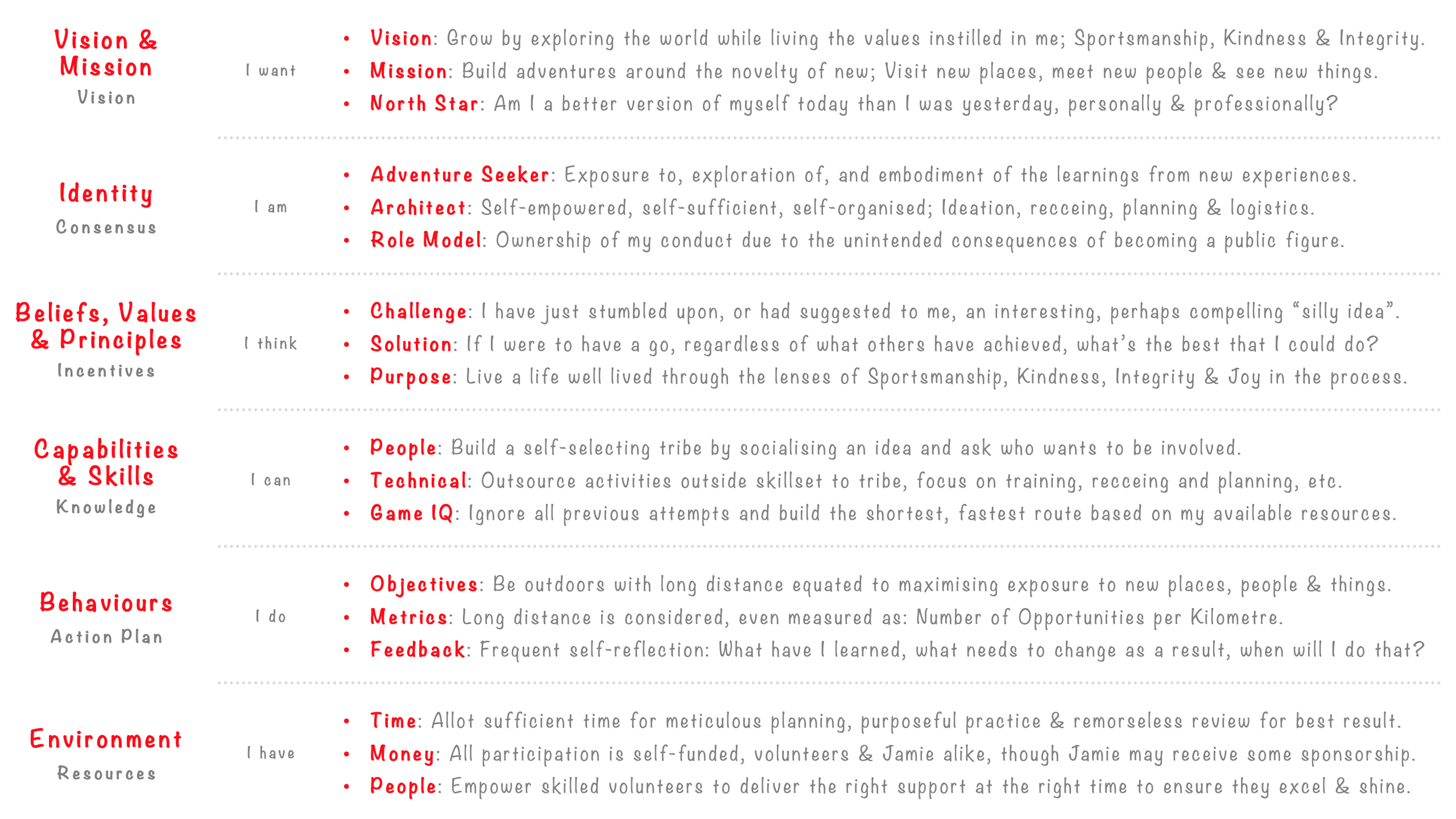
Source: Jamie Aarons | Performance Architecture | Peak Performance Unlocked Podcast | CS1
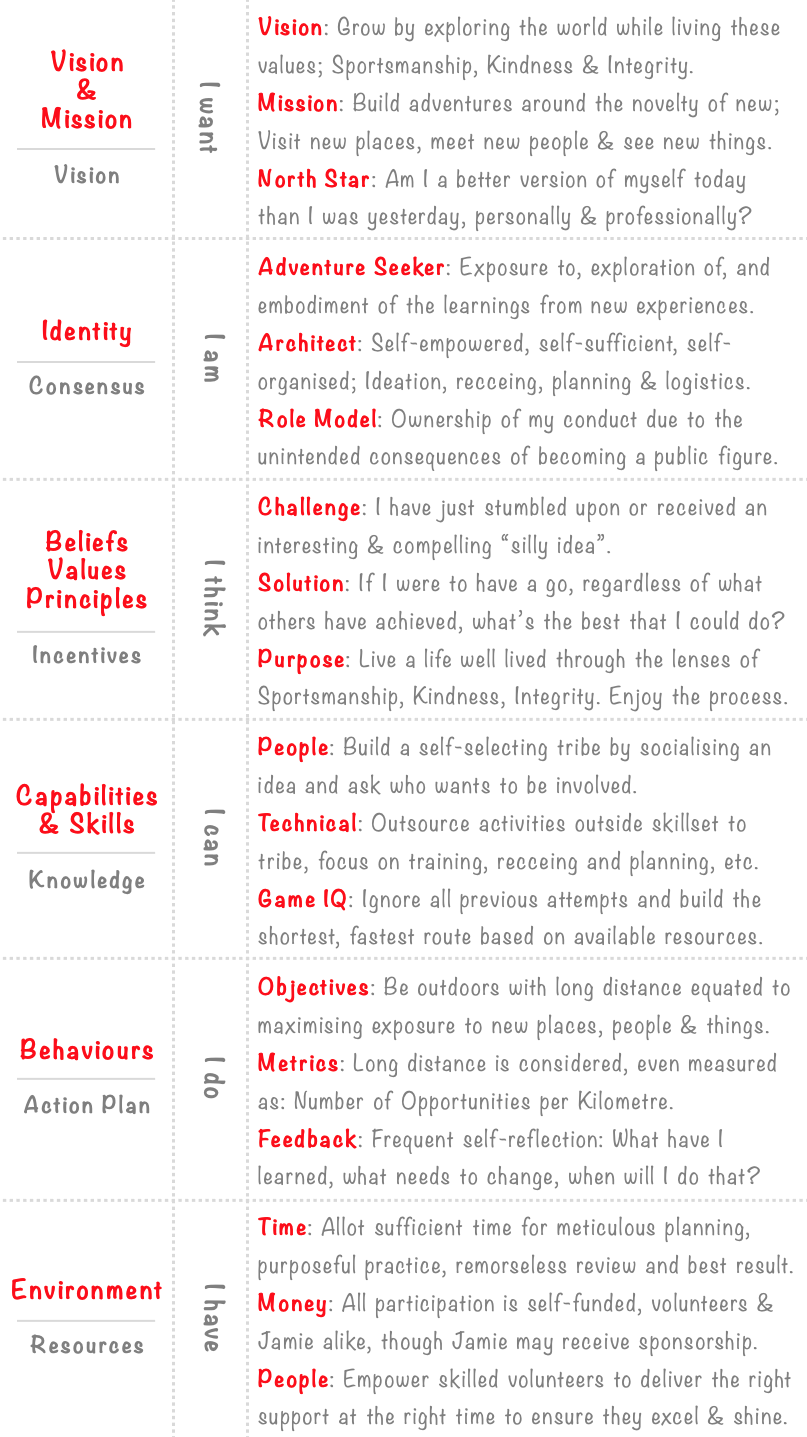
Source: Jamie Aarons Strategy for Success | Kenny Wallace, Peak Performance Unlocked Podcast | Ep1
Call to Action
This episode is intended to be used. Viewers are expected to examine their own operating system under pressure and ask:
Where am I compensating rather than designing?
Which identity is appropriate for the task in front of me?
What signals am I ignoring that should be treated as data?
What can be simplified to preserve energy for execution?
Decide on one change. Define when you will act. Then act. Everything else is a distraction.
Extended Learning
If you wish to capture your own case study observations you can do so here: Personal case study review.
Guest Reference
Jamie is an accomplished adventure racer and ultrarunner having competed in events around the world for over 20 years, with numerous podium finishes and race records:
West Highland Way Ultra: 160km/100miles. Women’s 1st, 2nd & 3rd, Top 10 Fastest Women of all time.
Tor Des Geant AKA Tour of The Giants: 340km/211miles, 30,000m, Women’s 2nd.
Ultra Trail Snowdonia: 160km/100miles, 6400m. 1st place x2.
Maxi Madiera Ultra: 100km/60miles and 5500m. 1st place in the inaugural event.
Cateran Trail Ultra: 90km/55miles. 1st place and women’s record holder.
Follow Jamie
Website: www.JamieAarons.com
Instagram: @JamieAaruns
Fundraising: World Bicycle Relief