
Performance Architecture
Performance is not an event, it’s a system.
Problem
Optimisation locally results in conflict globally.
All organisations are conceived, structured, staffed, incentivised and optimised in silos. The assumption is these silos, be they individuals, teams or departments, will automatically synchronise to produce the outcomes agreed at board level. In reality they form a collection of dislocated parts that collide instead of collaborate:

Individuals
Optimises effort & output to meet personal targets.
Decisions are made based on what is visible and urgent.
Feedback comes from workload, fatigue & missed deadlines.
Performance declines despite working harder.

Teams
Optimises team objectives roles and responsibilities.
Decisions made purely within team boundaries and handovers.
Dependencies show up as delays rework or miscommunication.
Delivery slows despite strong individual contributions.

Organisations
Optimises departments, KPIs, and functions in isolation.
Decisions made against reports and localised targets.
Issues surface as conflicting priorities and bottlenecks.
Strategy is clearly defined, but execution is inconsistent.
In business these range from working longer hours to the company missing delivery deadlines even though management reporting dashboards show green lights. In sport these range from athletes training harder and getting injured to losing tournament matches even though available training, coaching and management data suggests everything is on track. This has nothing to do with lack of intent, capability, or effort. The system isn’t failing, it’s producing exactly what it was built to produce. These results are signals it is working as designed, just not as intended.
“We don't rise to the level of our expectations, we fall to the level of our training.”
Archilochus
Greek Philosopher & Poet
680-645 B.C.
Solution
Performance architecture is the force multiplier.
The model below illustrates how Psychological Complexity, defined as the degree of intention, interpretation, judgement and decision-making required to operate effectively, and Ecological Complexity, defined as the degree of coordination required between people, roles, processes and resources, combine to translate aspiration into action, from an individual to an entire organisation.
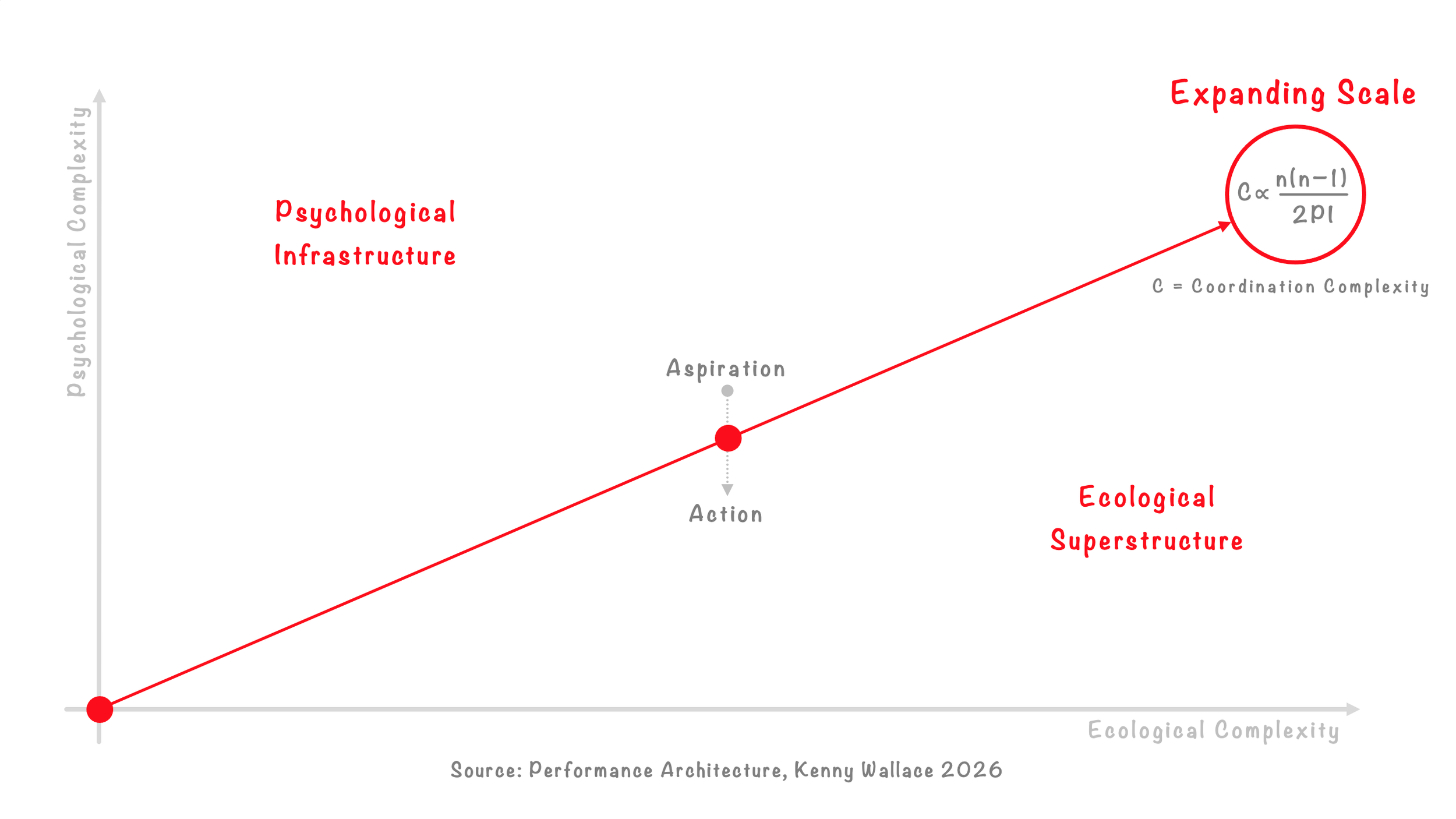
The vertical axis reflects the growing demand on how people interpret, decide and act as organisations scale. The horizontal axis reflects the increasing coordination required across roles, processes and resources. These complexities are not self-managing. They are governed and executed respectively by:
Psychological Infrastructure: The invisible system that shapes intention, interpretation, judgement, priority and meaning before anything is expressed.
Ecological Superstructure: The visible system of competence, action and resourcing through which the psychological infrastructure is expressed and made real.
These structures are always in operation at individual, team and organisational levels, and their relationship determines whether aspiration translates into action and performance improves or degrades.
For performance to improve, the cause and effect of board decisions must be explicitly traceable to the point of delivery, and back again. This creates coherence across the breadth and depth of the workers, their work and their working environments. A siloed organisation becomes a single unified system. This is performance architecture.
In business, this is seen in delivery moving from inconsistent to reliable, lead times reducing, and operations shifting from reactive to proactive, often ahead of schedule. In sport, this is seen in performance moving from variable to repeatable, training translating directly into competition outcomes, and teams delivering consistent results under pressure.
“We are what we repeatedly do. Excellence is not an act, but a habit”
Aristotle
Greek Philosopher & Polymath
384-322 B.C.
Application
Principles that keep cause and effect connected from end to end.

Performance
Build a strategy that empowers decision-making.
Vision and mission define the collective temperament, skills, actions, and resources required for mission readiness.
People
Build a culture that epitomises the pursuit of excellence.
Ways of working are the spoken and unspoken agreements that shape how people interact with each other & their environment.

Process
Build operational structures that enable swift execution.
Systems and processes are the guide rails that maintain focus, measure progress, and expose what works and what doesn’t.
When architecture aligns performance, people & process, outcomes become predictable and repeatable.
“Performance architecture is the force multiplier that turns practice into precision and pressure into flow.”
Kenny Wallace
Performance Architect
Behavioural Systems Design
Re-engineer your architecture
If these patterns are familiar, the question now is what are they costing you?
I work with senior leaders and boards when governance, decision-making, and execution are no longer producing the outcomes they should.

Performance
Architecture
Performance is not an event, it’s a system.
Problem
Optimisation locally results in conflict globally.
All organisations are conceived, structured, staffed, incentivised and optimised in silos.
The assumption is these silos, be they individuals, teams or departments, will automatically synchronise to produce the outcomes agreed at board level.
In reality these silos form a collection of dislocated parts that collide instead of collaborate:
Individuals
Optimise effort & output to meet personal targets.
Decisions are made based on what is visible and urgent.
Feedback comes from fatigue workload & missed deadlines.
Performance declines despite working harder.
Teams
Optimise team objectives roles and responsibilities.
Decisions made purely within team boundaries & handovers.
Dependencies show up as delays & miscommunication.
Delivery slows despite strong individual input.
Organisations
Optimise departments, KPIs, and functions in isolation.
Decisions made against reports & localised targets.
Issues arise as conflicting priorities and bottlenecks.
Strategy is clear, but execution is inconsistent.
In Business
These range from working longer hours to the company missing delivery deadlines even though management reporting dashboards show green lights.
In Sport
These range from athletes training harder and getting injured to losing tournament matches even though available training, coaching & management data suggests everything is on track.
Conclusion
None of these indicate lack of intent, capability, or effort. The system isn’t failing, it’s producing exactly what it was built to produce. The results are signals the system is working as designed, just not as intended.
“We don't rise to the level of our expectations, we fall to the level of our training.”
Archilochus
Greek Philosopher & Poet
680-645 B.C.
Solution
Performance architecture is the force multiplier.
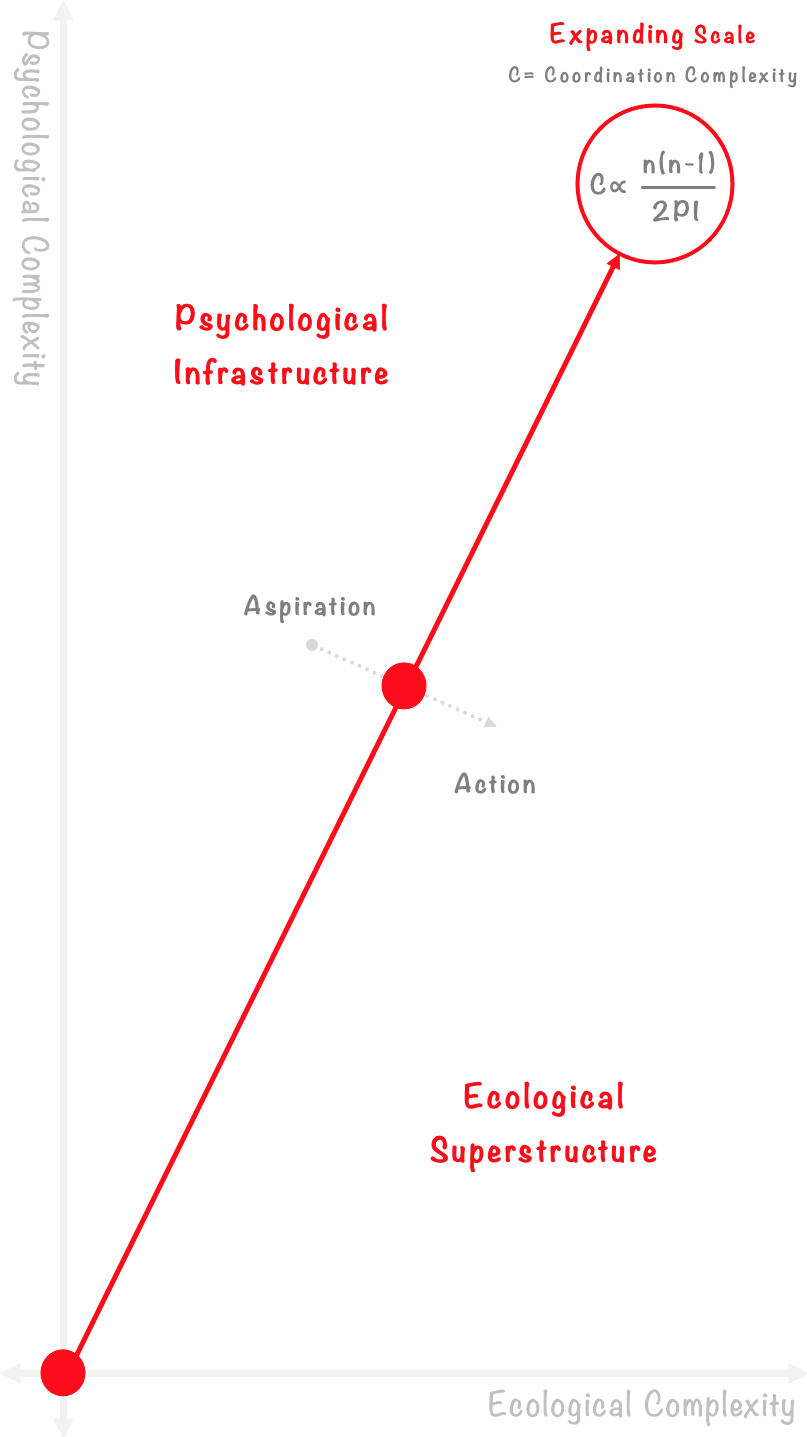
The model below illustrates how
Psychological Complexity:
Defined as the degree of intention, interpretation, judgement and decision-making required to operate effectively, and
Ecological Complexity:
Defined as the degree of coordination required between people, roles, processes and resources, combine to translate aspiration into action, from an individual to an entire organisation.
Vertical axis
Reflects the growing demand on how people interpret, decide and act as organisations scale.
Horizontal axis
Reflects the increasing coordination required across roles, processes and resources. These complexities are not self-managing. They are governed & executed by:
Psychological Infrastructure
The invisible system that shapes intention, interpretation, judgement, priority and meaning before anything is expressed.
Ecological Superstructure
The visible system of competence, action and resourcing through which the psychological infrastructure is expressed and made real.
These structures are always in operation at individual, team and organisational levels, and their relationship determines whether aspiration translates into action and performance improves or degrades.
Conclusion
For performance to improve, the cause & effect of board decisions must be explicitly traceable to the point of delivery, and back again.
This creates coherence across the breadth and depth of the workers, their work and their working environments.
A siloed organisation becomes a single unified system. This is performance architecture.
In Business
Delivery moves from inconsistent to reliable, lead times reduce & operations shift from reactive to proactive, often ahead of schedule.
In Sport
Performance moves from variable to repeatable, training translates directly into competition outcomes, and teams delivering consistent results under pressure.
“We are what we repeatedly do. Excellence is not an act, but a habit”
Aristotle
Greek Philosopher & Polymath
384-322 B.C.
Application
Principles that keep cause and effect connected from end to end.
Performance
Vision and mission define the roles, temperament, skills, actions, and resources required for mission readiness.
Build a strategy that empowers decision making.
People
Ways of working are the spoken and unspoken agreements that shape how people interact with each other & their environment.
Build a culture that epitomises the pursuit of excellence.
Process
Systems & processes are the guide rails that maintain focus, measure progress, and expose what works and what doesn’t.
Build operational structures that enable swift execution.
When system architecture aligns performance, people & process, outcomes become predictable, repeatable and profound.
“Performance architecture is the force multiplier that turns practice into precision and pressure in to flow.”
Kenny Wallace
Performance Architect
Behavioural Systems Design
Re-engineer Architecture
If these patterns are familiar, the question now is what are they costing you?
I work with senior leaders and Exec boards when governance, decision-making, and execution are no longer producing the outcomes they should.