Dr Matt Offord • High Stakes Leadership & Decision Making
Time: 3hrs 49mins applied listening.
Designed for multi-session study.
Episode Brief
Performance under uncertainty is not about having every answer in advance. It is about developing enough capability, experience and collective knowledge to exercise sound judgement when reality no longer matches the plan. This conversation examines how these capabilities are developed in high-consequence environments, and how the same underlying principles can be transferred into leadership, education and organisational performance.
How to Watch
Episodes are not designed for passive or background consumption. Treat the conversation as observation. Pay attention to how experience becomes knowledge, how feedback shapes judgement, how expertise moves through hierarchy, and how repeated exposure to uncertainty develops the capacity to adapt rather than simply comply with a predetermined plan.

Also available on
-
This transcript was generated automatically using Adobe Premier Pro. It has been lightly corrected, but may still contain errors.
00:00:00:00 - 00:00:42:04
Unknown
Today's conversation is with Doctor Matt Alford. Matt served 30 years as a Royal Navy officer, submariner and explosive ordnance disposal diver, specialising in underwater main warfare and clearance, building his leadership experience in environments where judgment, discipline, interdependence and operational come were not just abstract ideas, but daily requirements. He completed an MBA at the University of Strathclyde and a PhD at Durham University, both focused on operational leadership before becoming the Royal Navy's senior representative at Oxford University as a Senior Research Fellow.
00:00:42:07 - 00:01:13:25
Unknown
Today, Matt is a senior lecturer and associate director of learning and Teaching for the Adam Smith Business School at the University of Glasgow, where his work spans experiential leadership, education, digital learning, AI and eco pedagogy. But this conversation isn't just about a military career, academic achievement or leadership theory. It's a case study and how leadership forged under pressure can be translated and taught to the next generation through management, education.
00:01:13:27 - 00:01:56:12
Unknown
Together, we'll deconstruct how Matt thinks about leadership, education, and readiness, mapping out the underlying architecture for success that has carried him across professional domains and into the work of developing future leaders. Please welcome doctor, Matt offered. I'd just like to say thanks very much for coming on this episode, Matt. Just to recap what the episode, what we're looking to focus on is as you're someone that's worked in high stress environments as a an officer in the Royal Navy and now operating as an academic at the Adam Smith Business School in Glasgow University, where we have the privilege of actually filming this today.
00:01:56:17 - 00:02:45:19
Unknown
Thanks very much for that. I'm particularly interested in. What you've learned as a Royal Navy officer in high stress environments, the decision making around that, and what you've learned as leadership under the guise of leadership considered conceptually and practically. Yeah. How that then translates into the work that you do now as an academic. Yeah. Adam Smith Business School and how you use that knowledge to prepare our leaders of the future, regardless of what they go off into, whether it's an undergraduate that's coming here for the first time, whether it's a post-grad doing an MBA or a doctoral student that's under your supervision, how that all feeds into how your unique experience and who you
00:02:45:19 - 00:03:14:05
Unknown
are then informs all these other people that then go out and then have their impact on the world. Yeah, I find that quite a compelling. Yeah. Narrative or underlying story to. Yes, to to see what the cause and effect of all that is. Yeah. So to frame this for our audience, if we could, just go back to we're not going to do a deep dive on your whole life and just kind of pick up some round about when you read it.
00:03:14:05 - 00:03:45:12
Unknown
From what I understand, you signed up with Royal Navy and 1989. That's right. Yeah, we were both we lads. Yeah. And you. So you entered the Royal Navy and specifically the submarine service. Yeah. And which were you commissioned? Right out the gate and and how did how did that come about? Yes. So, so, yeah, I was 18 when I, when I joined, I was only I think, you know, I turned 19 a few weeks after I'd gone through the gates at Dartmouth.
00:03:45:29 - 00:04:06:23
Unknown
So leaving school, I wanted to be a pilot and, Yeah, I know that is quite funny, actually. Yeah. Yeah, that did that for some reason. That didn't work out for me because, you know, you have to be coordinated and things. But anyway, that was that was the goal. And, in the process of that, I tried out for the RAF and the Navy.
00:04:06:23 - 00:04:24:25
Unknown
I ended up having a choice, between the two. And I went for the Navy. Okay. So, yeah, I had I had my two A-levels. You didn't know you didn't need a degree at that point? No, that's really intense. So did you. Is that all you left school was. Was. I only left school. I left school with two A-levels.
00:04:24:25 - 00:04:50:13
Unknown
I don't mind, admitting I had a I had a D and an E in my. No, it's just A-levels. The reason that that that jumps out at me is because given your work now. Yeah. With two master's degrees. Yeah. And, you know, on your second PhD. Second, second doctor. Yeah. So when I think back to, high school, this idea of, of leaving school with.
00:04:50:13 - 00:05:10:28
Unknown
Yeah. To to two A-levels. Yeah. To to be where you are now and fully immersed in knowledge. That seems quite yeah. That's going to be an interesting arc to, to pick up on this. So anyway, sorry, I just thought that was, just to jump out. I mean, it is interesting because, you know, I'm very interested in learning and I was very excited when I started doing my A-levels.
00:05:11:00 - 00:05:33:05
Unknown
I, you know, I enjoyed doing my A-levels and, but it didn't work out because basically I had a lot of other financial pressures and I ended up having something like five different jobs. When, when, when I was a teenager, I'm like, I work behind the bar. I was still delivering papers at 18. I work behind the kiosk in the, in the, in the in the newsagents.
00:05:33:10 - 00:05:52:26
Unknown
I worked at Tesco's, you know, and I had a gardening job. So I had all these different jobs and consequently I didn't come out with, with particularly great grades. I had to drop one of my A-levels that I was doing. But the Navy at that time, and I think still to this day didn't necessarily recruit graduates. So you didn't have to get a degree.
00:05:53:16 - 00:06:15:03
Unknown
Is that is that different now? I don't think that it it's something it's still open. Yeah. I my understanding I'm not the expert on this, but my understanding was when I, towards the end of my career in the Navy, there was this, move to say, let's make all naval officers graduates, because I believe that's the case for instance, in the US military.
00:06:15:06 - 00:06:36:12
Unknown
And I believe the result of the discussion was no, we want to leave it open to non. So we had a graduate entry. Yeah. But we also had a non graduate entry. So the so the the upshot of that was I joined Dartmouth on the 13th of September 1989. Yeah. But I didn't pass out from Dartmouth. And so it's just just for the for the audience's benefit.
00:06:36:13 - 00:07:00:04
Unknown
The baby didn't have much understanding of, the military or the Royal Navy or what is Dartmouth. I is a bit of a Royal Navy base or whatever you want to call it. Dartmouth is where we have what's called the Britannia Royal Naval College or BRC, and that's where officers are trained. Yeah. So that's our that's our basically our new recruit entry, establishment training establishment.
00:07:00:18 - 00:07:22:00
Unknown
So officers go to Dartmouth Ratings who are non officers. They go to somewhere called Raleigh which is in Plymouth. Dartmouth is in Devon, but it's not very far from Plymouth 20 miles away. So it's all in the South course from the, on the, in the, on the Devon coast. So but because I was a non graduate I had to spend I think it was like 15 months at Dartmouth.
00:07:22:24 - 00:07:44:11
Unknown
Which was actually that bracketed. I had a period at sea of about three months in the middle. Okay. So you'd go and do your basic training, which is running around doing lots of runs at 5:00 in the morning, going on the rifle range, learning to sail and row and do as well as strategic studies and what have you, all of that kind of thing.
00:07:44:28 - 00:08:04:16
Unknown
And then you do that for about three months as your basic training. Then you go to sea and basically at sea you live the life of a non officer. So you live on a mess deck as a rating. You're scrubbing out, cleaning, doing various tasks around the ship so that you and you spend, you know, a week in each department.
00:08:04:16 - 00:08:22:24
Unknown
So you get used to how a ship runs. We went all the way out to Hong Kong from, from Plymouth. So we visited various places, around Europe and Asia, and then we all fly back from Hong Kong. And the next lot get on to the next trip. So it sounds like a very practical introduction to like.
00:08:22:26 - 00:08:44:29
Unknown
Yes. Before being awarded. Yeah, yeah. Officer rank. So yeah, you're an officer the equivalent of an officer cadet or is in the Navy. Those times that it's, we were midshipmen, so. But you're not you're not enlisted. You're not listed. You are commissioned. Right? But weirdly, so you go, midshipman. Then the next rank is sub lieutenant.
00:08:45:01 - 00:09:12:18
Unknown
When I got my commissioning certificate signed by the Queen to say that I was a commissioned officer, it was dated from the rank that I became a sub lieutenant. So a midshipman is a weird kind of. Not neither here nor there between us and as you rightly say, the emphasis of the Navy during that period of time is to give you this practical, experiential education which came to form my thinking about how how we educate and help people.
00:09:14:07 - 00:09:36:28
Unknown
And really, you know, kind of a lot of my philosophy about that comes from that sort of thing, because it's not just the the, you know, the baby officers, so to speak, but it's also all of the sailors as well, like when you're on the ship, all of the rating. So if they're an able seaman, for example, they will have a textbook, which is a list of literally tasks that they have to do.
00:09:37:00 - 00:10:01:13
Unknown
So let's say they have obsolete titles. Yeah, very aptly titled. For instance, if they have to do an Anchorage, it will say in the textbook, you, you are to operate the anchor five times, let's say, to, to the satisfaction of your supervisor. So, the Abby would then go and demonstrate to a petty officer or like a higher ranked person how that they how they operate the anchor.
00:10:01:13 - 00:10:21:09
Unknown
And then eventually when that person is satisfied, they would sign off on that. Right. And once you've got sufficient number of tasks done in your book, you can then do the exam to go for the course for your next rate, which would be like a leading hand in that case. So so so so so sorry to interrupt you, but that's something I'm quite interested in.
00:10:21:09 - 00:10:48:01
Unknown
So yes, there was the notion of feedback loops. So for you for the example that the when you got to play with the anchor for, for say for as a when you say to the satisfaction of whoever your supervisor is, is there like a feedback loop that you go through the ever you do it once and then you're given feedback where there's improvements to be made, and then you would essentially repeat that cycle five times.
00:10:48:05 - 00:11:05:22
Unknown
Yeah. So is that is this the kind of the beginning of the introduction to that way of thinking? Yeah, I think so. I mean, basically it goes even deeper than that because, you know, for us, when we were doing seamanship lectures, for example, you would learn how to, for example, replenish at sea where two vessels come alongside each other.
00:11:05:22 - 00:11:31:00
Unknown
And once you see all the one while you're still in motion. And this was a massive thing in in the Cold War, because this was something the Royal Navy and the US Navy could do, the other navies couldn't do, because we train to that level. Where we could do that is actually very dangerous to drive two ships together with just a few yards between them and start passing great big kind of hoses and things like that.
00:11:31:02 - 00:11:58:19
Unknown
So the way that we would learn, that is we'd learn it in the classroom. So there would be, you know, Chief Petty Officer some really, you know, experience guy talking through we didn't even have PowerPoint slides in those days, you know, view graphs, about how it was done. And then you would go and you'd have, like, a rig, somewhere in the grounds of the college where you would practice passing these lines and things like that, but in a static environment.
00:11:58:24 - 00:12:18:09
Unknown
Then you go to sea and watch it, then you then you take part in some part of it, and then eventually, and then you'd work around all the different positions until you got to that point all the time receiving feedback on that. You'd be taking exams and tests. So there would be a constant like feedback loop based. So is there a name for that in the military circles.
00:12:18:09 - 00:12:42:01
Unknown
So it's for example, in the business world we would just we would talk about continuous improvement. Yeah. We didn't as far as I know just so ingrained. It's just the thing that so ingrained there is something called the defence standard approach to training or D sat where a lot of these principles are laid out. But I would say that, the educators within the Navy, the education branch would know a lot of stuff about that.
00:12:42:07 - 00:13:11:01
Unknown
But what we as people who are recipients of this type of education, we weren't conscious of it. It just became eventually it becomes something that is kind of built in. So when you go and experience a different type of education, you know, straight away and this like kind of speaks to my experiences as a consultant, as a lecturer, working in different industries when they are doing professional development.
00:13:11:03 - 00:13:39:22
Unknown
And you, like a lot of it, is quite superficial, like you're getting the top layer of that very long feedback, kind of process. So it's very easy when you've had that experience to say, okay, I think I can see what's wrong, you know, that's a that's really interesting. So because when you think of it, the notion of incremental gains, that's, that tends to be at the heart of anybody in pursuit of peak performance, high performance, whatever you want to call it.
00:13:39:27 - 00:14:03:10
Unknown
Yeah. And capturing those marginal gains so that in sport you can best a close rival. In the military context, we're talking about very high stakes. Yes. Life and death type scenarios where you're your best rival is literally trying to kill you. Yeah, yeah. So it seems interesting that even from a very young age. Yeah, that that's no already ingrained.
00:14:03:10 - 00:14:31:11
Unknown
Yeah. As a, as in your late teens. Yeah. That's that's mindset. Yeah. And the practice was any, any activity or any skill that's undertaken is automatically. Yeah. Using no watches model of conscious and unconscious competence. You're automatically it's, it's you're already operating an unconscious competence with that with that one feedback loop. That's right. For developmental learning right out the gate.
00:14:31:11 - 00:14:55:04
Unknown
Yeah. And that's and that's quite something especially at such a young age. Yeah I think so. And I think that's encapsulated in that kind of military ethos of training hard and try easy. So you know, that's the whole idea. You I mean you're spending you know, yourself in the military, you're spending 90% of your time, maybe more training for something that you're going to do for a very, very short period of time.
00:14:55:04 - 00:15:14:05
Unknown
Ultimately, yeah. Or in most cases, I mean, I know obviously the country has been at war for years and years at various points in its history, but most of the recent conflicts have been much shorter than that. I know, and I was engaged in or involved in both of the Gulf Wars, which I know maybe we're not.
00:15:14:22 - 00:15:32:25
Unknown
No, no, that's I was going to say that's a that's a fabulous segue. So that's the Springs is into the 1990s to the 2000s. Yeah. So is this a risk because you were involved in main warfare and you were also an odd. Yes. Main clearance diver. So is that as within at that stage? Yeah, we can do that.
00:15:32:25 - 00:15:57:16
Unknown
I was a yeah, I was a submariner for seven years. But, I then became, a mine warfare clearance diving officer. And just to sort of explain that because it's quite a weird it's a weirdly long title, Mine Warfare and Clearance Diving Officer and it's sort of like, what does that mean? But I think essentially the way I would describe it, it was I was trained as an underwater bomb disposal officer.
00:15:57:16 - 00:16:23:04
Unknown
So I was I was an, I was a, a mixed gas diving supervisor, so I could dive and supervise dives on, on mixed gas down to, down to, well, whatever depth was in at the time because it depended on the equipment, but it was a maximum of 81m. And depending what kit that you you were diving and that was partly learning to dive and do the diving yourself.
00:16:23:12 - 00:16:43:00
Unknown
But then also supervising because I was an officer, you also became a supervisor. We also have we also have senior, ratings that do the supervision as well. In fact, they know like loads of stuff because they're much more experienced, than, than the officers are. So they're generally, they're generally doing the bulk of that supervision.
00:16:43:04 - 00:17:05:03
Unknown
But we're trained to do that as well. And then you're also running a team doing that. And eventually I ended up doing, sort of big counterterrorism operations where you're running quite a big, organization. So you're moving up in terms of responsibility. So that was the diving part. But you're also an advanced EOD operator. So can you explain a little bit about what that means?
00:17:05:03 - 00:17:44:08
Unknown
Yeah, I've got this notion in my head of it's like if the Hot Locker was filmed underwater. Yeah, I was probably collected over vast or I mean, a vast oversimplification. I think that film could be the subject of quite a lot of tape that we don't need to need to go into, and that's fine. But I in a sense, I mean, there is some overlap here because, that film is about EOD operators and, you know, it's worth pointing out that in the UK, and I think that the states have a different system, but, you know, essentially in the UK, everybody who is trained as an EOD operator goes to the same place
00:17:44:11 - 00:18:07:06
Unknown
to get the same training. So it doesn't matter whether you're Army, Navy or Air Force, you're getting the same training. And it's largely land based. So you have 14 weeks, you go to this, army base in, in Kent, and you basically spend a lot of time there and you start with, basically you start with all different types of ammunition working out.
00:18:07:12 - 00:18:30:00
Unknown
Well, how to identify them in the first place. Landmines, airdrop, weapons, you name it, you kind of end up learning about these things and doing lots and lots of tests. And then they teach you the different techniques for dealing with all of these different weapons. It's basically bomb disposal, but, well, it is bomb disposal, but it's the advanced sort of ticket.
00:18:30:00 - 00:19:02:21
Unknown
So you have EOD operators that might be involved in prepping. So let's say you come across some unexploded ordnance, you'll be in a team, and some people in your team would be prepping all of the equipment. But it's the advanced EOD operator that is going to go and walk towards that weapon and make a diagnosis, if you like, what's to be done about it, and then actually enact whatever it is to make that situation with all the diving skills as the foundation to gain access to make that diagnosis.
00:19:02:21 - 00:19:24:08
Unknown
Yeah. So when the underwater part comes in, so you've had your 16, 16 weeks of diving training. So you're already qualified as a diver and the diving supervisor at that stage. You then go and do all of this work, which is sort of classroom and field based with Army and Air Force has nothing to do with the underwater world.
00:19:24:08 - 00:19:47:24
Unknown
It's just about EOD more generally. And you end up doing things like chemical weapons. So you're getting dressed up in breathing apparatus and going out into the field to find, ordnance, which has been mocked up as, chemical weapons and putting plaster of Paris over them and making them safe and things like this, to dealing with a car bomb or something like that.
00:19:48:09 - 00:20:07:02
Unknown
All this kind of stuff, which is, which is shared by all three services. Once you've done that course, you then have like a three week, you stay in the same place, and the Army and the Air Force guys have finished, but you stay on for an extra three weeks to take that training and apply it to, underwater weapons.
00:20:07:07 - 00:20:35:07
Unknown
So they have a big pond there that you dive to the bottom, and you basically practice these techniques underwater. The other thing about, mines, as opposed to, you know, other types of land based or airdropped weapons is that mines are sensitive to their environment. They're triggered by magnetic, influence, by acoustic influence, by pressure, so that they're able to detect ships that go above them and explode.
00:20:35:07 - 00:20:58:10
Unknown
Or they might be a contact mine, you know, like the the kind of thing that you see in the films with the big horns, the big balls that are floating underwater with the horns sticking out there. The old fashioned contact mines. So those weapons, unlike an airdrop weapon, if an airdrop weapon has has fallen and hasn't exploded, it's not sort of waiting to detect something.
00:20:58:24 - 00:21:17:04
Unknown
It's actually a percussion. It's actually the, the, the impact of hitting something that sets it off. And if that hasn't worked, then it's, you know, is unlikely. Is that is that is it safe? No pun intended. Yeah. Is it safe to say it's in there at that point or probably it's probably not what I would say, but.
00:21:17:06 - 00:21:37:14
Unknown
Well, I'm just trying to, but I'm just trying to get my head around it. If something's fallen from the sky. Yeah. And it was supposed to explode at the point of impact because the impacts are triggered and that doesn't happen. Does that mean that it's, probably demonstrating the level of ignorance and no idea, but that that idea, if it didn't explode, is actually therefore safe?
00:21:37:18 - 00:22:05:27
Unknown
Yeah. Cause it's trigger. Your feeling you're thinking is exactly right. What I would say about it is that the level of risk has gone down significantly. So is is unlikely, but not impossible. Okay. That that it might go off. So, you know, you have to treat any ordnance with a level of respect. And, you know, when, when you're approaching something like, an unexploded bomb, you will have all of the, you know, the equipment that you need.
00:22:06:00 - 00:22:26:22
Unknown
They call it the long walk where you as the advanced the as the EOD operators dealing with it will walk on your own towards that piece of ordnance. And the others, that are on your team will be some distance away. Because you're working on the premise that, yes, this could go bang and you've got your armor and all of that.
00:22:26:22 - 00:22:49:15
Unknown
You know, you've seen the thing, like in The Hurt Locker with all the all of that, because the premise there is that it could go off. But the difference between that and, on a mine is that the mine is basically set to detect something that is going to set it off. So the fact that it hasn't exploded does not mean that that level of risk is necessarily decayed.
00:22:49:20 - 00:23:12:27
Unknown
So it's it's kind of more dangerous in that sense. Other than I would say, you know, in terms of like World War Two, for example, when a lot of these approaches were developed, a lot of mine clearance divers were killed in World War two because they were literally finding mines on the beach and taking them apart to find out how they worked, and in the process, getting killed quite often.
00:23:12:27 - 00:23:40:06
Unknown
Yeah, we now know largely how they work. So we're not we're not taking the risks that our forebears once did. So the prices paid up front. Yeah, in my knowledge, is now in the bank in a sense, which means, you know, you obviously you can't dismiss that risk. No, you know, the training, the training that we have, the equipment that we have, the knowledge that we have, it allows us to do that with a much lower risk than they were experiencing at that time.
00:23:40:12 - 00:24:06:00
Unknown
So basically, that course then trains you to deal with the mines, but then you have another 14 week course, which is a mine warfare course, where you're basically learning how these mine warfare ships, which are these small plastic ships, that we have in the Royal Navy that go into that, the glass reinforced plastic, the holes, because mines can be set off by metal and magnetic influence.
00:24:06:02 - 00:24:31:29
Unknown
So they go into the minefield and they're there between 400 and 700 tonnes. These ships, which are very small in the big scheme of things, you have a small ship's company of about 40 people. And you're going into the minefield looking for the mines with sonar. Or you might be what we were doing at the time, we don't do anymore is also sweeping for mines with the, you know, the World War Two type sweeps that you see on the films.
00:24:32:02 - 00:25:02:20
Unknown
So we were still doing that, in the 90s and up until up until the Iraq, invasion. So, and then after that, we stopped, we stopped doing the sweep so much, so you're going into those minefields and looking for mines. So the act of actually hunting for mines and even the statistics about, you know, if you've swept this corridor X number of times, how many mines do you think that you've found and how many might be left?
00:25:02:22 - 00:25:30:19
Unknown
So, you know, doing that sort of probabilistic. Right, sort of calculations as well. Okay. So then this is much more this is much less you as a diver and as an EOD operator and more you as an operations officer. This is where it's starting to get quite interesting because we've we've covered a lot of on I think this with set then set the tone with the type of work and a staggering level of skills.
00:25:31:16 - 00:25:58:18
Unknown
In terms of the practical side of diving. Yeah. The practical side of dealing with, mines and explosive devices, the almost infinite range of how these things might manifest from, from traditional through to improvised. Yeah. And then all the different of water environments and depths and, and all that. So that, that that's a tremendous amount of technical knowledge to come around.
00:25:58:18 - 00:26:33:27
Unknown
Yeah. So what I'm kind of interested in to lay it on top of all of that is. Like strategic thinking skills so that you you've indicated that just a moment ago, was the fact that you've got to build up these statistical probability models. Yeah. Because then you've got to assess for safety for everyone that you're responsible for and, and, and the, the, the not not just your immediate team, but the people that are going to potentially pass through those waters across that land.
00:26:33:28 - 00:27:06:22
Unknown
Yes. So which brings us kind of nicely into, so managing uncertainty and, and for how you, how you deal with that on off those military models to help you deal with that. So, for example, but uncertain as to how many mines that are out in this, this area of ground. Yeah, but we know that from x number of passes, the statistical likelihood is X versus Y, you know, organising and managing other people to do that because it's not just about yourself, it's the consequences to the people in your charge.
00:27:06:22 - 00:27:33:14
Unknown
Yeah. Doing the actual work. Yeah. And remaining kind of calm in the chaos. Yeah, I think I think noise are very underrated skills in a military context. Yeah, that tends to get overlooked, I think, when a lot of military personnel then go off into everyday life. Yeah. So this idea of like accurate decision making, negotiating, managing people under extreme duress.
00:27:33:17 - 00:27:59:19
Unknown
Yeah. So I wonder if that's something that we could know again, in terms of layered on top of because you've said that you've said the the or create the foundation. Yeah. For very high consequence work. Yes. So when it comes to that leadership and whatnot. Yeah. How does that now fit into all of that. Yeah I mean that was very interesting for me because I had this seven year, seven year period in submarines that I mentioned.
00:27:59:24 - 00:28:27:15
Unknown
So I did that and I ended up navigating submarines. And then I changed quite radically my career. And the result of that was that I was much older than my peers going in. So when I did my diving course, they were all significantly younger than me. And then when I went onto the ships themselves and we got involved in, the invasion of Iraq in 2003, and I was I was the second in command of one of the ships, the the executive officer, as they called it.
00:28:27:18 - 00:28:53:04
Unknown
So I had to prepare the ship for those, operations. And being much older, it kind of brought, when I say much older. I was 33. But, you know, you felt like, I mean, when you're on the ship, you've got, sort of 4 or 5 officers on board that ship. And, you know, I was the second oldest because the captain was slightly older than me, but not much.
00:28:53:06 - 00:29:16:20
Unknown
And the others are like in their early 20s. And then the sailors themselves are quite often late teens or early 20s. Our senior eights are usually older and wiser and more experienced and so on. But there's a lot of young people on that ship, and you're going into potentially a war situation. We didn't know because there was a referendum to decide, if you remember, whether we were going to get involved in Iraq or not.
00:29:16:25 - 00:29:35:09
Unknown
So we we'd actually been out there for months. We were actually out there for ten months in total. So we didn't know whether we were going to go and do this job or not. And as you rightly say, it was all about clearing areas actually for humanitarian aid to go through. So there were going to be ships with aid going through these waters.
00:29:35:12 - 00:29:59:13
Unknown
So you're quite right to say that on the one hand, we managing the emotions of those much younger people who are then coming to you and saying, well, what happens if this and what happens if that with the actual I mean, we were very fortunate because, it was a successful operation for us. We didn't take any casualties ourselves within that ship.
00:29:59:27 - 00:30:22:04
Unknown
So we all come back, having, not having not sustained any injuries or fatalities. So that was a that was a happy story for us. But obviously going in, you don't know what's going to happen. You can't tell people what's going to happen, but people are looking up to you to sort of manage their emotions. And then there's also, as you rightly say, the strategic side of it.
00:30:22:06 - 00:30:47:14
Unknown
Well, not that this was down to us because we were just one cog in a big machine, but you know, how how much to what extent is this now safe? And you can't ever you can't ever say that it's completely safe because you're constrained by the intelligence that you have that tells you what the best guess is, how many mines might be in there?
00:30:48:29 - 00:31:13:06
Unknown
I mean, this is not just talk. I'm not just talking about Iraq here. I'm just talking about, you know, generally speaking, you know, you don't really know there's a there's an incredible amount of, World War Two ordnance, just generally, I mean, around the UK, but around the world, there's just there's explosives lying around the seabed just all over the place, from previous conflicts and things like that.
00:31:13:06 - 00:31:32:20
Unknown
So you don't know what's going to be there even before somebody put extra stuff, or whether somebody has put some mines in there or whether they haven't. And what type of mines and how many. All you've really got is a best guess. But we do have these statistical packages, tools that we use to try and define what that risk might be.
00:31:32:20 - 00:31:35:24
Unknown
So, so, so.
00:31:35:27 - 00:31:58:12
Unknown
So that that model's there to help you manage the uncertainty and ambiguity to with to where within whatever is considered an acceptable level of risk. So one of the things that jumped out at me was you talking about the junior rates and manning them, managing the emotions of younger people, in a lot of cases on this are probably still in the late teens or early 20s.
00:31:58:12 - 00:32:25:05
Unknown
Yeah. Have you got any examples that spring to mind of or things that pop that kind of a bit that could bring back a bit nostalgia in a good way? That you could give us to help us understand how you actually manage an individual or a team of sailors through it, through something like that. So what are the type of things that that come to you and ask, and how would you manage that?
00:32:25:05 - 00:32:47:15
Unknown
Because this I guess this is me looking at your kind of stakeholder management skills. Yeah. As much as I'm aware that the military is, from my experience, as much as it's perceived as command and control. Yeah, those that is actually a lot more relational than. Yeah. And I think the outside world actually realises, well, I could give a, I could give a few examples of that.
00:32:47:15 - 00:33:11:22
Unknown
It's a really good question. But, I could talk about my own research if that's okay. I yes, I did so later in, in later in my career in the Navy, I got to do a PhD that the Navy funded. And I was looking at leadership in the Navy, and what we were doing, I was actually part of an organisation called Flag Officer Sea Training, which was like the training, of the Navy, if you like.
00:33:11:22 - 00:33:42:25
Unknown
So our job was to go on board ships and make sure that those ships were fully operational, or I should say, we would assess them to some extent, but we would also provide training. So, one of the jobs I had to do was to go out to the Falklands with about 17 there, about 17 people in my team of all different, because it's worth pointing out that, you know, although I had this specific background in EOD and what have you on the ship, even though the ship is a mine warfare ship.
00:33:43:20 - 00:34:05:25
Unknown
The people that you've got onboard are engineers, electrical engineers, chefs, you know, every kind of, almost every kind of vocation you can think of and the team of people doing the, the, the EOD bit is quite a small team of about half a dozen people. And all of those people exist to facilitate the EOD people.
00:34:05:27 - 00:34:32:20
Unknown
That's similar to the business. When you think you've got a manufacturing company, you get the people that actually are the makers. Yeah. And then you've got all the supporting departments, whether it's sales, marketing, finance, it's all procurement. And in theory, they're all there to enable the people to actually make the best product possible. That's exactly right. And actually the EOD part of it, the diving team are actually only a small part of the main purpose of that ship, which is about mine warfare.
00:34:32:20 - 00:34:51:07
Unknown
So you've also got mine warfare specialists as well that are operating remotely operated vehicles and things like this. All right. Never I never talk to me when you talk about main warfare. Yeah. I only ever thought that I had the notion of it's not just somebody someday going out in a diving suit from a ship or a submarine to say, right, we need to.
00:34:51:12 - 00:35:16:26
Unknown
Yeah. No. It's like, well, that is that is a part of it. But you have just one. That's just one part of it. The bigger part is the mind warfare department, which is a warfare department. Yeah. Yeah. Okay. Which, which, you know, you have some really experienced, people within that department that are experts in, you know, picking out mines and identifying them on the seabed with a, with a sonar picture, operating.
00:35:16:26 - 00:35:39:03
Unknown
So you're operating the ship in what we call in ops room control, which means that the mine warfare ratings that are in the ops room, that are looking for the for the, looking for the mines on the seabed using sonar are being directed by a very experienced mine warfare, specialist who works with the operations officer, who would be me.
00:35:40:11 - 00:36:02:18
Unknown
We work together as a team to actually, we're actually controlling the ship at that point. So we're actually driving the ship through the minefield. And the officer, the watch, who is the person on the bridge, is actually making sure the ship is safe, but he's going wherever he or she has been told by the ops room to go, okay, so you've got this whole industry, isn't it?
00:36:02:19 - 00:36:33:03
Unknown
Yeah, it's a big machine. And they're operating things like remotely operated vehicles, but they also are in charge of the diving teams. The diving team effectively works for them. So if we find the mine, then we in the room would decide how we going to prosecute that mine. And bearing in mind we might also, up until recently be using sweeps as well to find mines, and that would also be the mine warfare, people that would put those sweeps up, which is a very dangerous, very, very, complex, manoeuvre done at sea.
00:36:33:09 - 00:36:51:17
Unknown
Continue. When you say sweeps, does this mean like use section loffler and any of the water. Yeah. And cigarets and then you patrol. Yeah. That is essentially that's about right. Yeah. Okay. So basically that was just I was just asking but yeah. No, that's exactly right. Well, I mean we would normally have a route that we would clear so that other ships can get in.
00:36:51:17 - 00:37:14:21
Unknown
So we will sweep ahead and we have these huge, wires that are trawled behind the ships for, you know, hundreds of yards with, they're serrated and they have explosive cutters along the, along the length of, of, of the sweep. And they would go along and face as we snag, you know, if you're looking for contact, mines are moored to the seabed.
00:37:14:28 - 00:37:41:03
Unknown
They would snag and cut the lines that those basically samples. Yeah. I thought it was you were going to describe some huge big complex high tech. I mean a very big no. We just drag some stuff behind the ship and it just cuts the mains free. Yeah. Okay. More or less. I mean, we can also I mean, it can be more complicated because we can put in things like, acoustic generators, which is a great big three tonne, piece of kit that we have to lower.
00:37:41:08 - 00:38:05:20
Unknown
You can imagine, you know, you're on a moving platform, trying to stream this very, very, these very heavy pieces of equipment behind the ship is very, very dangerous. Requires a huge amount of expertise. And the all of that comes from the mine warfare department, essentially. You know, the the diving team is a is a cog in that bigger machine.
00:38:05:20 - 00:38:34:14
Unknown
Yeah. But as I say, you've also got, you know, chefs and mechanics and all of these, you know, so, so essentially, what, what we're doing in this training team is to go and, visit the ship with, with all these different specialisations. So I might, so in this instance, we were actually, working with, an offshore patrol vessel which is used in the Falklands just to maintain security around the Falklands.
00:38:35:02 - 00:38:56:27
Unknown
So you've you don't have any of the mind warfare side of it, but in my team, you've got, you've got racket, you know, you've got service police, for example, to make sure that all the regulations and the discipline on board is correct, you're taking chefs with you, you're taking experience engineers, to make sure that all of the engineering routines and things are correct.
00:38:57:19 - 00:39:27:08
Unknown
There's myself I was basically, looking at the executive function of the ship, which is the sort of leadership on the command. And you know, how the ship is run, let's say, more widely like a ways of working. Yeah, we play the writing with everything from the culture on board to actually making sure the ship is clean, and hygienic so that people aren't catching illnesses and things like that, that the, the chefs have all got their food hygiene certificate and, you know, all of this kind of thing.
00:39:27:08 - 00:39:53:17
Unknown
Is that something it's actually is it quite easy for that to slip for the extended periods at sea? I imagine that it would be because, I mean, obviously the Navy is run pretty is a pretty you know, they run tight ships. So so you don't generally see you don't generally walk on board. I don't think in a modern professional navy, you're not going to walk on board a ship that is just like, why is the ship even at sea?
00:39:53:20 - 00:40:15:09
Unknown
You're usually the, the, the area of performance you're working in is, is that marginal? Is that sort of marginal area where they're already at a high level, but you want to try and support them to be even better? And what we do is we, we, we fly out there, and then we basically put them through a series of exercises.
00:40:15:09 - 00:40:35:21
Unknown
So we might start off by just checking the things, routines and things are working properly, but then we'll go out to sea and we will simulate things like a fire in the engine room or a flood in a certain compartment, or somebody has fallen down a ladder and broken their leg. And we will use kind of quite realistic scenarios.
00:40:35:21 - 00:41:07:15
Unknown
So we use smoke generators. We'll use, you know, prosthetic things for, for blood and what have you to try and make it as realistic as possible. And then we'll try and put that together. So we'll say, well, actually you've got a flood, you've got a flood in the engine room, but on the way down this guy falls down and breaks his or her leg or so there's all these companies, you know, you build it up and then we'll try and get maybe the RAF to pretend to be the enemy and fly an attack profile, and they have to defend the ship against this wall.
00:41:07:15 - 00:41:24:12
Unknown
This is all these other things are going on, and we'll just build it up and build it up, and they'll eventually they'll end up, for instance, will say, you can you're going to take some soldiers to go and, to do an operation on this beach. So you're soldiers, you mean Marines? Well, actually, it can be either.
00:41:24:12 - 00:41:49:08
Unknown
So it can be Army. I mean, ideally, ideally would be Marines in that, in that instance, but yeah, now we do we do use, British Army soldiers as well. And generally in the Falklands we're usually working with the army, down there. So and that's good for them because they're not necessarily trained, to, to be even to be onboard the vessel, you need to know various things what to do in the case of a fire and what have you.
00:41:49:15 - 00:42:07:14
Unknown
So essentially, we train the army at that point, the army, the army will send us a company or the Navy send us a detachment, actually, and we will work with them about, you know, how to stay safe at sea. But then we'll go and take them to a beach somewhere. And of course, they'll have a navigation exercise to get to that beach.
00:42:07:20 - 00:42:26:06
Unknown
And then things might happen along the way. There might be fires, floods, or people might just go missing, you know. And these will all these will all be sort of simulated by us. And we will decide, you know, we'll look at how the ship responds to that. But what I did in terms of my research, to answer your original question was to look at.
00:42:26:06 - 00:42:52:27
Unknown
So I started looking at my PhD. I was interested in how prestigious people channel information. And by prestigious I mean well-respected and, you know, respected for their professional knowledge and so on, but not necessarily a higher rank. It sounds more like an an interlocutor. Yeah, yeah. Like that enables and knowledge and information to move around successfully as opposed to somebody that has the authority for delegation.
00:42:52:28 - 00:43:21:11
Unknown
Right. That's right. And sometimes these are the same people. But sometimes I always so what I did was I used social, social network analysis to map who were the prestigious people on board the ship. And then during these exercises, I was noting, how information. So I was literally if, for instance, we had a casualty at the bottom of a stairwell on the fourth deck down of the ship, I would sit there and wait for that person to be discovered.
00:43:21:13 - 00:43:44:04
Unknown
And then I would, if somebody passed information person A to person B, I would follow person A, then person B, then person C to see where that information when through what routes it went to the bridge where the captain would be making decisions, and who the captain listened to. So and I was able to map that.
00:43:44:06 - 00:44:09:19
Unknown
And what I discovered was that there is a hierarchical system with the captain at the top and the information that spreads from the captain to the lower deck, is very efficiently moved from top to bottom. So, you know, the captain might say, right, this is my command priority. I want everybody to focus on this. That information goes down and goes through very, very efficiently.
00:44:09:21 - 00:44:34:26
Unknown
But the actual information moving back to the captain to create the feedback loop for him. Yeah, it's him or her. Yeah. To create that feedback loop, is actually really kind of torturous because it goes through these influential, prestigious people. And it's really interesting because the ship in question had a phone system so they could pick up the phone and call the bridge, but nobody ever did that.
00:44:35:01 - 00:44:57:18
Unknown
They would actually physically go whether it was three or 4 or 5 decks or whatever it might be. They would actually physically go up the stairs, and the steps to go and speak to the captain or the command team around him or her. I had one, one female captain, one male captain, and went there twice. But whoever the captain was, they have a command team around them.
00:44:57:24 - 00:45:22:04
Unknown
And then somebody would emerge on the bridge and say, I've got this piece of information. And it would go through these various, interlocutors, as you say. But what was really interesting was the more prestigious that person was, regardless of their rank, generally speaking, the more they were listened to. Because you can imagine there's a lot of fuss going on.
00:45:22:04 - 00:45:52:06
Unknown
There's a lot of noise, white noise. Yeah. And there's a lot of information that the match and the captain and his leadership team has to actually filter out. That's right. To focus on the 5% that's actually meaningful in terms of yeah, making a decision around what's your immediate next step. Yeah. Exactly. So I then created a simulation. So so what I did was I realised that these prestigious people, are able to transmit information more efficiently than, than the less prestigious people.
00:45:52:08 - 00:46:32:13
Unknown
I wouldn't say regardless of rank, because prestige is somewhat connected to rank, but not exclusively. So many questions. Yeah. So yeah, let me throw some stuff out here. Because one of the things that's jumping out at me is I'm seeing a lot of parallels. And, I can't remember the person's full name, but it came up with the Allen curve and communication, and he talked about this idea of this kind of invisible communication network within organisations where, like you've just described, it seems to appear independently of rank.
00:46:32:14 - 00:47:05:12
Unknown
Yeah. And how just that certain people have this ability to get just the right information to just the right person. Yeah. And it appears to happen by accident. Yeah. So I'm interested in do we have an under the. Did your research reveal why this happens? And as the, the this prestigious person as a, like, a model of characteristics and traits as to why.
00:47:05:12 - 00:47:28:22
Unknown
So if you took two people of identical rank as edges of something that stands out, that you could see all this is why this person was chosen over this one. Yeah. Even because it's, If we're stepping outside the official channels for how information should be passed, this person has been chosen for a reason over this or several reasons.
00:47:28:22 - 00:47:59:02
Unknown
Yeah. I be able to distinguish between the two. I would say it depends. So what I was looking at was us creating networks or looking at networks based on, whether basically on personal or professional advice. So what I would do to map out this network is say, who would you go to for professional advice? And whoever whoever's name came up the most, let's say, would be the most prestigious person in the professional advice network.
00:47:59:11 - 00:48:24:18
Unknown
Generally speaking, they were also the people that people went to for personal advice as well. And that's that's not a that's not a coincidence. These people tended to have a lot of experience. So something strikes me that there's something fairly trustworthy about them, whether that's a combination of their knowledge. Yeah, or their willingness to support another individual or, or the combination of the two.
00:48:24:25 - 00:48:51:27
Unknown
Yeah. Yeah, it's just it's got that. Yeah. I could almost derail this whole podcast and go down now go down a rabbit hole just on that one thing. Yeah. Because what, what we're, what we're getting to is this, this notion of or what I think of as somebody that presents with natural leadership as opposed to having to hold a position of authority.
00:48:51:27 - 00:49:17:26
Unknown
Yeah. And that's. Yeah, I think there's a there's even more to this than that because, and that's why I guess you flag that up as a potential digression. But yeah, I mean, essentially it was I think it's experience that counts more than, let's say, traits of leadership, you know, like this person has. I mean, let's take a really kind of, a really easy example.
00:49:17:26 - 00:49:44:09
Unknown
For example, some leadership scholars might say that intelligence is important in leadership. So they might say, absolutely. Yeah, more, more intelligent people are more likely to be leaders. So intelligence becomes like a trait. But actually, while that might be true, is very it's a very reductive model of leadership in the sense that you can have you could have the brainiest guy or woman ever.
00:49:44:10 - 00:50:04:12
Unknown
But if they can't communicate, I'm totally useless. If you're in a fire and they don't know anything about firefighting, they're not really going to be any use to you. So, you know, it's actually it's kind of experience that really matters. So I found that the most prestigious people in the network, generally speaking, were people like the captain, for obvious reasons.
00:50:05:09 - 00:50:30:12
Unknown
But then beyond that would be something like the chief. The marine engineering officer, who's the chief engineer on board or the weapon engineering officer. And they're usually in this patrol vessel, situation. These are non officers. They are senior rates. Often they're chief petty officers, which is like a sergeant in the army or they're worn officers, which is sort of like the like the nearest.
00:50:30:15 - 00:50:55:27
Unknown
No, the highest you can get for noncommissioned officers. And these people carry a huge amount of respect because they have rank, they have authority, but they also tend to have more experience than the officers. So some of the officers to, to give a very extreme example, might be 21, 22 officers that are just out of training.
00:50:55:29 - 00:51:22:24
Unknown
So who are technically a higher rank than the engineering officer. This that's also something that's an so we've got the potential for the age. And then I'm also we've got something that's jumping out at me is the fact that we've got two hierarchical structures. Yeah. So if from my experience, officers tend to be somebody that's expected to think about the strategy in the long term.
00:51:22:24 - 00:51:53:15
Unknown
Yes. On the enlisted and CEOs and whatnot. They had all about short term and tactics. Yeah. So when we talk about expedience and to me there's like an inflection point for the divergence of these two things and how they might be valued. Yeah. And it sounds to me with the tests that you're putting them under all appear to be very tactical because it's like I'm watching this person then speak to this person who can do this information.
00:51:53:18 - 00:52:16:28
Unknown
And that's stuff that's happened at a tactical level. Yeah. So why would you speak to an officer in that context? Or if it's an engineering problem, then if it's a tactical problem, you're going to speak to the person that's most likely to have encountered that problem. Engineer. Yeah. But why. So I'm just yeah, that's certainly true. But what I found was that those positions of influence tended to cross domain.
00:52:16:28 - 00:52:47:03
Unknown
So the engineering officer would be involved, like the marine engineering officer. The Mod, as they're called, would tend to be involved in lots of things way beyond engineering. They're generally, I would say, seen as a go to for that kind of experience, even wisdom. If you like. I mean, you're right. I mean, the ship is doing a tactical job, so it's very hard to comment on the strategic side of it because even the captain is essentially a tactical tool.
00:52:47:03 - 00:53:13:18
Unknown
Well, okay, I think, I think, I think to differentiate between strategy and tactics in this particular instance, because start a strategy can be a tactic depending at what level. Yeah. And the and the overall picture that it's happening. It's almost rather so. Yeah. So so my, my idea of strategy and this idea, this, in this context is the captain's job is to achieve this overarching mission.
00:53:14:07 - 00:53:37:15
Unknown
And, yes, that and to ensure that all the other people at it are informed of that so that the people in engineering or the dive team can do the tactical work. Yeah. With underneath that mission. Yeah. So that makes sense. Yeah. So a really good example of that is the captain would set the priorities. So it might be that you've got a fire in the engine room.
00:53:38:03 - 00:54:08:09
Unknown
But actually your priority, the captain's priority is not for the ship to move anywhere. It might be to use its guns to defend itself. Yeah. For example. So the priority is actually keeping the guns going and keeping the ammunition quiet while someone else is taking care of doing the literal firefighting. Yeah. So that that would be handled because he still might be, I imagine the captain's main position, and that is I need to protect the ship and to protect the ship we need to defend.
00:54:08:09 - 00:54:48:10
Unknown
You might contain the fire. Yeah. For example, by keeping the boundaries cool, but not actually putting in a firefighting team until you've. Until you're safe to do that. Yeah, yeah, maybe that's a bad example. But, you know, that's the sort of thing. So it was really interesting when I did that research and the conversations that that created around the Navy itself, including, you know, some pretty high level conversations that we had because it sort of informed, some of the my idea was that essentially because the Navy and this sort of informs my thinking about how I talk about leadership today is that, you know, describing that whole thing about being a diver and
00:54:48:10 - 00:55:06:28
Unknown
so on. It's a very technical. It's a very technical vocation, you know. Yeah. But it's not it's not the only one, you know, I was talking about being a pilot at one point, you know, very, very technical. The guys that operate the engines, the engineers that, you know, the whole Navy is really working in this incredibly technical background.
00:55:07:06 - 00:55:25:27
Unknown
There I was talking about the statistics of mine clearance. But, you know, when I was in submarines, we had to use statistics as well to work out how to find our way through the ocean underwater, but also to detect enemy submarines. We used statistics for that as well. So it's all about data and it's all about technology.
00:55:26:00 - 00:56:03:16
Unknown
And my view is that this kind of changes the traditional view that we have of leadership, in the sense that we tend to think of leaders traditionally as an individual, or perhaps a small group of individuals who make quick decisions in sort of crisis points and who are able to see through a situation and go right, plan A and motivate everybody to do plan A, but in those really, really technical situations where you're conjuring with lots of data that's telling you multiple things, you're dealing with uncertainty, which you mentioned at the beginning.
00:56:04:06 - 00:56:28:07
Unknown
And, you know, you have to find a way through that. And that typically can't be done by one or a few people. That's usually a collective effort. So when I came back and obviously the Navy, I mean, we've spoken about, wars and things, you know, like operational war-fighting, but actually the Navy is involved in a lot of constabulary roles where we're sort of policing the sea lanes.
00:56:28:07 - 00:56:52:25
Unknown
The Navy is also involved in a lot of, you know, disaster relief working with NGOs, you know, groups of civilians who are not in this hierarchy that wouldn't really understand that hierarchy. So you need a flexible leadership system where basically, yes, you have this hierarchy, you have command control, and there is a time and a place for that.
00:56:53:02 - 00:57:11:27
Unknown
You know, if you're in a if you're in a fire and that fire is going to spread. And I mean, basically the lifeboat that you have on board your ship is the ship, right? That's the lifeboat you want to preserve. You don't want to be in a little orange version. Yeah. In the bigger one that's got showers and the galley that provides hot meals.
00:57:12:03 - 00:57:37:16
Unknown
So, you know, you want to protect that and you need you need command and control to, to protect that. And sometimes people just have to do what they're told and they have to do it right now. So there's a place for that. But if you're, you know, you're involved in a complex disaster relief operation, working with NGOs and governments and different, you know, Coast Guard and different other organisations, political could be political.
00:57:37:16 - 00:58:02:17
Unknown
And therefore, this, this much more informal prestige based network is going to become important. So when I when I answer problem solving, you probably need, you know, as many brains as you can get around the problem. So it's a lot of nuance, isn't there? There's a lot of nuance. So what I came back with, because a lot of people said, well, you seem to be undermining this command and control system that's so important to the Navy.
00:58:02:20 - 00:58:41:09
Unknown
And I said, well, no, that's not the case. I'm not I'm not undermining that. What I'm saying is that there are two systems, and the Navy seems to be particularly adept, and I'm sure other organisations in this high consequence environment have become particularly adept at switching between these different modes of decision making. Yeah, and it isn't even it doesn't undermine the hierarchy that, for instance, you know, a relative junior person comes onto the bridge and says, I found out something that you didn't know, and I think you need to change your priorities because that then triggers a discussion and something comes out.
00:58:41:09 - 00:59:02:03
Unknown
But ultimately, that's the captain's decision, whether that happens or not. And the fact that this, you know, lower ranking person has suggested that he or she changes their strategy isn't a problem for the hierarchy. We don't we don't suddenly have discipline problems, you know, because this this lower ranking person has been listened to. It just seems to switch seamlessly.
00:59:02:03 - 00:59:26:18
Unknown
And there seems to be subconsciously, people within that organisation need seem to be able to understand when it's appropriate to challenge. Yeah, and when it isn't appropriate. But what are the things that jumps out? Me there is it's interesting that they perceived that you were undermining, the system. And it's like, I'm not meaning I'm just revealing to you something that already exists.
00:59:26:18 - 00:59:56:01
Unknown
Right? And what already exist is actually incredibly effective. Yeah. And when I, when I think of my own time, in the Parachute Regiment that there's this notion of everything's top down, how can I, can I put this? You've got on one hand, you've had this group of people, when they're receiving this feedback or sort of senior leadership are saying this is undermining our efforts.
00:59:56:01 - 01:00:26:24
Unknown
Yeah. When actually the reality is that enabling this informal feedback loop. Yeah. Is that actually what reinforces discipline? Because it means it's a demonstration that knowledge is valued. Yeah. No mistakes is valued. Yeah. And regardless of what rank you hold as well within the formal hierarchy. Yeah. I, I, I good ideas are valued regardless of where it comes from.
01:00:26:24 - 01:00:49:18
Unknown
Yeah. And I, I've actually written about this in a case study. I can remember the very first time I ever went on a clothes target recce and, a eight man section going out. Section commander had been given his orders to go and do this recce. I was quite I was not long out of PE company at this point.
01:00:49:18 - 01:01:07:04
Unknown
So this is the first time I'm really experiencing this at this level. And then he sits. He sits all of us around in a circle. Yeah. And he sits down and explains, this is right, lads. This is what we've got to do. Yeah. This is where we're going to go. This is what we need to find out. And it plays out.
01:01:07:06 - 01:01:27:03
Unknown
This. This is what I've come up with. Yeah. On the basis of this is how I think we might be best to do that. Yeah. Can anybody see any holes in that. Yeah. Yeah. That's right. And then what happens is we all sit and debate for a few minutes. We plug any gaps for those thinking, any ideas that have been suggested that that are actually genuinely worthwhile.
01:01:27:03 - 01:01:46:25
Unknown
He's right. Okay. Well, I do that. And that goes into the plan. Yeah. And what actually, I, I didn't realize at the time, but there was a sense of I really feel part of something. He doesn't really feel for it. I wouldn't have been able to articulate it back then. But yeah, there was a real sense of war kind of coming together.
01:01:46:27 - 01:02:09:24
Unknown
And when I when I think of all the performance psychology stuff that I've learned now, years later, there's that what, what, what actually discovering is giving everyone that voice, except in the everyone has a high level of competence because by default, you in a unit. That's. Yeah. In the constant pursuit of excellence, at least theoretically that would be that.
01:02:09:24 - 01:02:33:05
Unknown
And there's that element of. Yeah, the other things that came out of that experience that are invisible as by the section commander handling that, all of that, he we all know, know what the mission is. And so if any one of if anything happens to him, any one of us in theory, albeit going down to the two, I see anyone can now take over the role and still see the mission through.
01:02:33:05 - 01:02:53:00
Unknown
Yeah, there's the element, because we've all had to see, but all individually highly invested in its success. Yes. No, nobody's getting dragged along. Is that. Oh, God, I just can't be. And you go, I want to do a good job. Yeah, yeah. And it reinforces and that and that moment, the brotherhood. Yeah. That's something that was invisible to me back then.
01:02:53:00 - 01:03:24:04
Unknown
But no. Yes. Is is completely apparent. Yeah. Yeah. So it sounds like that's it's so it's interesting to me that they're highlighting this as a negative thing. But it's actually this is absolutely crucial in building a well-oiled machine. Well, I think that there's just so. Well, hold on. Just bear with me one more second. Sorry. So but the but the one thing that is of interest to me, as interest to me is so the speed of the Cascades versus the speed of the feedback loop.
01:03:24:07 - 01:03:46:28
Unknown
And why? Because the captain picks up the intercom and says what he needs to say, and it goes out and it's instant. Yeah, but yet the feedback loop is somebody, for whatever reason. Yeah, experiences and needs to work their way physically all the way up to the bridge and speak in person. Yeah. And was at any end say that you sound on why that happens.
01:03:47:02 - 01:04:11:20
Unknown
Is that the visit a feet of not being listened to or they just, they I mean, I just, I'm just where the I think. Right. So is that that's really very interesting is very interesting and was what I would say is, you know, initially before I get on to that, I would say that the questions that were asked and the challenges that were made to that research, when I brought it back into the main core of the Navy, was just really about that sense making.
01:04:11:20 - 01:04:28:12
Unknown
So, you know, that was that was that was there was first thing the likes of trying to understand. Let me just trying to understand it. So I wouldn't say that. All right. Okay. Yeah. So actually was you know we used it, you know, that the research was used within the Royal Navy to. Yeah. To basically say that we need to practice both of these kinds of types of communication.
01:04:28:12 - 01:04:54:05
Unknown
So and indeed, when, when we did my warfare, you know, in the early 2000, we did everything in kind of networks of ships, in chat rooms, basically. So, so that that was that. But in terms of my understanding of why that was, I just want to say the first thing is that although the information went through this sort of circuit, this route to get to the bridge, it did so, so quickly.
01:04:54:09 - 01:05:19:00
Unknown
So I'm talking about people like leaping up the stairs and transmitting that information, within, within seconds, signing out. So that there's a lag. But it's not significant. There's a lag, but it's not significant. And I would say that generally speaking, there is a sense that. So the research that I'd done prior to that was really about how leadership is understood by the ship's company.
01:05:19:03 - 01:05:45:24
Unknown
And it's really interesting how leaders behaviour is being monitored all of the time and how even though leaders have a high rank, if they behave in a way that the breaks those norms, there's usually consequences. For that leader, you know, like basically people won't put in their 100% or they might even try to sabotage them or things like that.
01:05:45:27 - 01:06:26:05
Unknown
So there is a sense that, you know, there is a sort of sense that this is a mutual endeavour, and that we're working together. And when we're passing information up to the bridge, that's valuable information that we have to convey to the bridge, undistorted. And I think the reason that they don't pick up the phone is because the phones are just ringing all over the place, so you don't know, you can get your information through, and it's genuinely quicker just to go up there and tell them, but you might pass that information on to a trusted other person if you trust them and say, can you pass this information to the
01:06:26:05 - 01:06:51:29
Unknown
bridge if you feel that that information isn't going to, but the risk is that the can the Chinese West posting. Whereas as we pass an asteroid twist, by the time it gets to the end, it's a different story time, because I thought in my research I was going to discover I'm very interested in information and information theory, and I thought that perhaps the information may be degraded by the number of times it's passed on to different people.
01:06:52:05 - 01:07:18:07
Unknown
But what I found out was that all of the information that got to the bridge was 100% intact. It was always so it was really, really well guarded. And I didn't expect that. But for instance, the, the, the one, the, the example that I like to talk about was the executive officer of the ship. And one of the crews that I looked at, he had only got on board the vessel, I think within a couple of days of us doing this.
01:07:18:07 - 01:07:41:24
Unknown
So he was within his first week in that particular, time deployment. And so nobody really knew him. So he hadn't had time to build up any kind of level of prestige. It wasn't really a, it wasn't really a kind of reflection on him, but it was more a reflection on the fact that he hadn't been on board.
01:07:41:27 - 01:08:03:23
Unknown
But he discovered some really vital piece of information because he was walking around the ship while they were having this big exercise, and he discovered that there was a fire that wasn't being dealt with that was potentially quite dangerous to the ship. So he went to the bridge to pass on this information to the captain, but he just wasn't listened to.
01:08:03:26 - 01:08:24:04
Unknown
So he was trying, even though he was the second highest ranking officer on board, he could not get this message across. There was all this noise on the bridge and they were busy sorting out other problems. Was he correct in this? Correct that there certainly was. Yes, he was correct on the information that he was conveying was very important, but it wasn't.
01:08:24:04 - 01:08:46:28
Unknown
It never made it into the command kind of view because he just didn't have the prestige to carry that across. And eventually they found out a different way and then they dealt with it. But it was just so interesting that because he hadn't kind of got that, he hadn't quite been, you know, he's not been assimilated to have been assimilated into that whole network.
01:08:46:28 - 01:09:17:01
Unknown
So, so his information is just dealt with at a lower valence, you know, a different level of value. So that was really interesting because it wasn't really that this person had any defects of any kind. It was just, and this is where this, you know, this argument about traits and things where it hits reality. You know, in theory, there is some, you know, a charismatic individual that walks onto the bridge and says, I have something important to say, and everybody listens to them.
01:09:17:01 - 01:09:51:12
Unknown
But I think the reality is something that's just brings to mind as if we take the human element out of it and think of the ship as a system. Yeah. As it got something to do, possibly with him being so new, that he's not perceived as part of the system. Yes. Yet. So. And what I mean by that is humans are tremendous creatures of habit, and the military functions a lot on, repetition through training.
01:09:51:15 - 01:10:14:21
Unknown
So as if he's not been involved in that repetition, that's why the person that he needs to speak to isn't used to receiving input because you're outside of the system. That's right. This is the channel that would normally come through. And it's actually what we're bumping up ahead against is, how well a system is able to adapt.
01:10:14:21 - 01:10:35:22
Unknown
Yeah. To these changes. Yeah. To the system. Yeah. Being with this particular officer being a component with, within that system that's not fully adopted. Yeah. And does that make sense. That means that's 100% correct. I mean, I think that, you know, this individual has done the same training as everybody else. He just hasn't done it with everybody else.
01:10:35:29 - 01:10:57:13
Unknown
So, you know, and that that that's the link. And we're talking about a really we're talking about a high performance system here. We're talking about, you know, a warship which is got a fully trained crew, which, you know, there was there was some research done by somebody called Carl, like, and colleagues on an American aircraft carrier about how does this warship even operate?
01:10:57:13 - 01:11:20:04
Unknown
It's got so many, moving parts. It's just it's impossible, mind boggling. It's mind boggling how this system performs at the level that it does. And the same is true for this particular warship that I was. You know, they've done all kinds of training to get to that point, to be put together as a crew. This is a highly effective, military unit.
01:11:20:06 - 01:11:42:27
Unknown
But even then, you can still see that, you know, they're not robots. They're humans. So they still have that issue where, you know, there's some slight missed connections here and there. And actually, because of the redundancy in that system, it ended up not being a problem. They they identified the problem in the end because they've got all these redundancy.
01:11:42:29 - 01:12:04:20
Unknown
So what I did. So to take that to sort of final conclusion, I created a simulation where I basically created a network that was based on what I'd observed in numerous warships, mine warfare ships and patrol vessels that had a network that was sort of an average of all the vessels that I'd been on. Okay, do my research.
01:12:04:26 - 01:12:25:19
Unknown
I then, because the great thing about simulation is you can create situations that can't happen in real life. So I then created a completely flat structure where there was no rank, but prestige was just evenly distributed through the network randomly. So like a sort of communist conclave that was running a warship, if you like, like a like not even that.
01:12:25:19 - 01:12:46:28
Unknown
More like, what's that word? Anarchic. Like an anarchic one. And then I had a top heavy one where all of the high ranking individuals were also high prestige and a bottom heavy one where all of the low ranking people were high prestige. Am I seeing some modelling here? That's somewhat similar to the Battle of Trafalgar?
01:12:47:05 - 01:13:26:22
Unknown
Yeah, that's right, I was using the same system as my Battle of Trafalgar simulation. And then what I did was I created a situation where one person within that network would be randomly, let's say, say the word infected with information, and that person would have to spread that information by passing it on to their neighbour. And the chance of passing on that information was dependent on how prestigious that person that was passing the information was, because I wanted to find out whether the flat, the normal hierarchical system, the top heavy or the bottom heavy condition would pass on that information more quickly.
01:13:26:24 - 01:14:02:03
Unknown
And the kind of shocking news was the anarchic one was the one that passed on the information more quickly, like it was about twice as fast as the hierarchical model. As Nelson. Yeah, everybody's working with shared intent. Yeah, everyone has shared it. But you've you're individually responsible for playing your part within that system. Yeah. So if you want to just if you, if your only goal is to pass information, you would have a flat, equally prestigious structure because people would pass that information much more quickly than if they're a hierarchical kind of bottlenecks.
01:14:02:05 - 01:14:22:20
Unknown
But the hierarchical system still outperforms the other two conditions. So actually if you have, if you have like, a command and control system where just the people at the top make all the decisions in a trusted that's less effective than if you have some kind of real world mix of prestige that you see on, on the ship.
01:14:22:20 - 01:14:44:25
Unknown
So, so basically what the Navy had was a pretty efficient system that is able to adapt to multiple situations. But if you only had the one situation where you just needed to share information but not necessarily make decisions about it, then the flat structure would be the quickest way of doing that. The problem is that no one would make a decision about the information, so it wouldn't.
01:14:44:25 - 01:15:08:23
Unknown
It wouldn't really work. But if you were, if you were involved in something like a disaster relief type thing where it was more about sharing information and collaborating, you probably want a flatter system. But the Navy system is fantastic because it basically has this adaptability so it can move within some constraints within. And it seems to happen intuitively.
01:15:08:23 - 01:15:38:04
Unknown
Yes. Yeah. There really I think it's really my experience in the Navy just, you know, speaking anecdotally is that, basically it seems that the ship's company, the ship's company are actually quite capable of understanding when this situation exists and when that situation exists. Yeah. And I've never uncovered any particular reason as to like, what's the trigger.
01:15:38:04 - 01:15:56:05
Unknown
That means that an individual or a collective know when to move from one to the other, because that. Yeah, I think if you could capture that and bottle it and sell it, you could make a lot of money. I would say it's basically down to habits, you know, it's just that time. I don't think there's any shortcuts for it.
01:15:56:07 - 01:16:17:12
Unknown
But this is the thing that I. Yeah, I'm not so sure that any of that is innate. I think that for whatever reason it's learned. But it but it happens in the shadows. Yes. So nobody knows what it is or why it happens or how it works. Exactly. Yeah. He's got these two sticks that somehow were able to move between.
01:16:17:12 - 01:16:46:00
Unknown
But yeah, there's this black box that was in the middle. And that's exactly what kind of like and is kind of like and Colleen Roberts, who did this research on an aircraft carrier, Colleen Roberts was a lieutenant commander in the US Navy. And Carl von Keyser is a social researcher. And basically they said that it was it was impossible, like, for instance, if they were launching an aircraft in, you know, such and such a seat, you know, in high winds or something like that dangerous or operational environment.
01:16:46:03 - 01:17:13:10
Unknown
And basically you're trying to land an aircraft on an airfield which is moving and changing direction constantly. Yeah. They said rather, Viking Roberts. So there's no way that the captain, for example, knows everything that's going on. There's this thousands of interactions all happening. And he called it. He'd fall into relating. He would fall into relating. Yeah. Where, where individuals are relating to each other, understanding the overall mission.
01:17:13:13 - 01:17:39:03
Unknown
But interpreting the information, you know, in terms of their own context and making that happen so that all these little transactions and interactions happening out with what the leadership know about. Because if you gave four people the job of running an aircraft carrier, it would be cognitive overload and they wouldn't be able to do it. So they have all of these brains like hundreds of brains, working on this problem.
01:17:39:06 - 01:18:04:21
Unknown
But somehow that's coordinated in the most effective way. And that is a I mean, that's a high, really high level of performance that can only happen. I mean, I mean, aircraft carriers are particularly interesting because, you know, when the UK, when the US broke on these huge aircraft carriers that they now have, they've had to go through a period where the Navy itself doesn't have that capacity.
01:18:04:21 - 01:18:22:27
Unknown
Cognitively. They don't have the teams to do that. So it takes years to build them up. And I think in the early years of the Fleet Air Arm in the US, there were lots and lots of deaths and accidents at the very beginning until they learned this craft. And this is where, you know, when you hear about other navies.
01:18:22:27 - 01:18:48:12
Unknown
So now building huge aircraft carriers, you go, okay, they have an aircraft carrier, it's going to be 20 years, but for the years and years before they actually have that. And that's because of all the like you said, it's the learned behaviours and spending time with people. And that's why I say there isn't really a shortcut so that we can just train people to be able to do that, because it's such an incredibly complex task.
01:18:49:14 - 01:19:08:17
Unknown
Yeah. So, so I mean, it's a thing of wonder. I think really to. Yeah. See that level of collaboration. But on an aircraft carrier, how many people are we talking about? I think some of the US ones have got like, what, 5000 they have to put on them. Yeah. I mean, I just literally it's literally a floating city that operates 24 hours a day.
01:19:08:21 - 01:19:29:22
Unknown
Yeah. I mean, I think our aircraft carriers have about 7 or 800 on them. But when I was I actually served in an aircraft carrier in 19, 91, I think it was and they were in those days, they were much smaller than the aircraft carriers we've got now, like about three times smaller. But we had a crew of about 1200, I think, something like that.
01:19:30:02 - 01:19:54:13
Unknown
But actually the ships are got bigger, but the crews have got smaller because of a technology. But B it's that performance and that training that we're able to do more such a high level of competence. Yeah. Yeah. Absolutely. So so the fact that you've carried out all this research is this because by this time, because you've, you served, what, 30 or 30, 33 years in the Navy?
01:19:54:13 - 01:20:16:27
Unknown
Yes, just under 30, 29. And it was, what, 17 of those were actually at sea. Yes. That's right. Yeah. So I was a I was a seaman officer. And we basically in that particular specialisation, pretty much our job is at sea. Okay. So, so we've got 30, 30 plus years in the Navy, 17 of those at sea.
01:20:17:00 - 01:20:43:05
Unknown
And I'm assuming the research came towards in, in the kind of the sunset years of that. Yeah. Period. Yeah. Yeah. You could say that. I, I'm laughing because basically, I, when I came back from Iraq, and I don't know whether these two things are related. I'm not suggesting that they are. But I suffered from, sight loss, initially in my left eye.
01:20:43:07 - 01:21:04:19
Unknown
And then, in both eyes. And I had to have surgery on my left eye. I had a, a corneal graft in this eye. And this I just basically eventually stabilised. So essentially, my eyesight was so poor that, I could no longer be a diver, or do any of that sort of thing.
01:21:04:19 - 01:21:21:26
Unknown
And also, the other thing that we haven't really spoke about is that I was also qualified as an officer of the watch as well. So I was qualified to, if you like, drive the ship, from the, from the bridge. And I was and as a, as a submariner, I was a navigator as well. So I was involved in all of this navigation and things like that.
01:21:22:06 - 01:21:46:00
Unknown
But my sight loss was so, was so great that I could no longer do that either. So essentially, all of my career doorways were shut very, very easily. So this is where, again, things are getting interesting. So that sounds like where maybe not quite there yet, but you've had your taste of doing vessels and operating in an academic context, albeit while still at sea.
01:21:47:29 - 01:21:54:23
Unknown
The, the issue with your eyesight which is now taking you out. Yeah. Of.
01:21:54:26 - 01:22:25:07
Unknown
Being able to be at sea and is this know the starting point where you're transitioning towards. Yeah academic life. Yeah. So because this that I think this is quite interesting in the academic world operates from my from my understanding so much on theory and plotting theory. Yes. And then the idea is that once you've got your degree or your postgraduate whatever, you're then taking that theoretical understanding.
01:22:25:07 - 01:22:52:03
Unknown
Yeah. And putting that out into the real world to generate knowledge, which is, yeah, to me, applied understanding. Yes. Because you've now got a feedback loop. Yes. Of interacting with the physical world. Yeah. So. So what was the reason that you then or, or how did you end up in the world of academia as a as a professionally.
01:22:52:04 - 01:23:16:18
Unknown
Yeah. Because that's, that's quite a change, a direction I can see for you maybe got the taste for that. Yeah. But to then say I'm actually going to. Yeah. Apply for that type of work. Yeah. Yeah. So how did how does that come about. So yeah I mean it is interesting. So basically I was left with you know I couldn't really pursue any, let's say operational career goals.
01:23:17:03 - 01:23:44:04
Unknown
And I'd seen there was an information notice that the Navy basically funds and the Army and the Air Force do this as well. One PhD a year. And I done my MBA by that stage. And actually, I've reached a bit of a crossroads in 2007 where I was contemplating leaving the Navy anyway, for other reasons. And I'd done an MBA as a partly so to prepare for that moment and then decided to stay in the Navy anyway.
01:23:44:05 - 01:24:02:06
Unknown
Yeah. So I done my MBA and I thought, you know, I'd be really interested in my MBA. I did leadership studies, and I was really interested in, developing my knowledge of leadership through a PhD. And that was on the back-burner. And then I saw this information notice. So I applied and I was I was rejected the first time.
01:24:02:06 - 01:24:34:06
Unknown
So I applied the next year and the and I got a place. So they funded my research. And that took place over six years because it was a part time PhD and I was doing my full time job. So all of that stuff where I was doing training, I run the counter-terrorism operation at some point in that in those six years, and I was doing this on the side, going down to Durham Business School for, you know, periods of a week at a time to do some training, if you like, and then going away and doing my research, collecting data and what have you on the back end of that, having published all that research
01:24:34:06 - 01:24:55:28
Unknown
and shared that research with the Navy and, kind of shared it with the Navy Board, and we'd made some there were some changes that were made. I did I did a little side study about the effect of sport on performance of, of, of, ships companies. So I found that ships, companies that were engaging in playing a lot of sport together were also performing better in training, for example.
01:24:56:03 - 01:25:17:21
Unknown
And all of this was shared with the Navy at the time. So at the end of that was an opportunity to go to Oxford University because we also, fund one officer a year to go to Oxford University. So I went to, so I joined Saint Anthony's College and did some post-doc research into officer training in the Navy while I was based at the University of Oxford.
01:25:17:23 - 01:25:42:22
Unknown
And then I guess I sort of ran out of options in this academic line of work because obviously the Navy is an operational thing. And there's unlike the US Navy, which have quite a big academic side to it. So you have, for example, I mentioned Colin Roberts, who did that research on an aircraft carrier. She was a serving lieutenant commander at that time, an academic in uniform, if you like.
01:25:42:25 - 01:26:05:08
Unknown
We didn't have that option in the Navy. The Royal Navy. So I was kind of like, I'd kind of got to the end of my time in the Navy, so I thought, right, okay, I'm going to now step into academia because I've done this PhD, I've done my postdoc. It's like the obvious place to go. But the reality was very different because I applied to I put in my notice it takes 12 months to leave.
01:26:05:11 - 01:26:32:01
Unknown
So I had this 12 months to try and reach out to a university and find a job as a lecturer, and I just had no luck with that at all. No success at all. So I applied. I tried applying for some other jobs, you know, management jobs in business. I had no luck with that either. I think I wrote 100, I think I wrote around 100 applications in that transit transition period.
01:26:32:17 - 01:26:53:03
Unknown
And I got 1 or 2 interviews out of that, you know, so it was really, really difficult after 30 years of being in the Navy to try and just sort of switch seamlessly into some civilian role, academic or otherwise, proved to be really difficult. In the end, I decided to run my own business. I thought, well, I'll just work for myself.
01:26:53:03 - 01:27:14:23
Unknown
That's going to be the easiest way. So I did that for a couple of years, and then I saw a job advertised here at Adam Smith Business School, which is a part time job, different sort of tutoring kind of role. I applied for that job, and on the back end of the interview, the business school said, oh, we think that you will be better off as a lecturer.
01:27:14:23 - 01:27:36:16
Unknown
And we have actually a profile that we're thinking of that we'd like to recruit you to. So I applied for that job. So that was somewhat serendipitous. Yeah. So that was serendipitous. It was just fortunate that, the head of school at that time saw something in my interview that he thought, that is somebody who I can use for this project.
01:27:36:18 - 01:28:05:11
Unknown
Do you have any idea of what that was? At the time, I didn't know that to me. But basically the job was to, set up the first online masters program at the school, because actually, as part of my business, I'd been I'd spent quite a lot of time, working abroad, working with, with the health sector in other countries around medical education, weirdly, and doing a lot of, a lot of digital education around that.
01:28:05:11 - 01:28:38:02
Unknown
And this was about digital education. So, again, because I had that experience, I was a natural fit for that role. And so I created the first, online MSC in this, business school. And that was, that was really successful. And what was the masters was in marketing actually. So it's not it's not my, it's not my subject, but but obviously I worked with marketing academics so you could build that, you could build the infrastructure that would allow them to weigh their, subject matter on top of all of that, for delivery.
01:28:38:04 - 01:29:02:03
Unknown
That's exactly. Okay. So and I provided a lot of the pedagogical underpinnings for that, you know, the educational knowledge, that I garnered from partly in an informal way, from my time in the Navy, but mostly from this time, running my own business that I'd basically self-taught, if you like. Okay. Yeah. And that's how that's how I came to be in, in, in the business school.
01:29:02:03 - 01:29:33:22
Unknown
And I'm not involved in that project anymore. As soon as that project was kind of mature and up and running, I handed it over to to somebody else. Yeah, yeah. So, so from the experience of the Navy, are you aware of any friction or when that started to percolate through coming from such an operational environment? And to a business school where everything's much more CG based.
01:29:33:28 - 01:29:54:19
Unknown
So that's I'm really interested in, because one of the questions that I noted down here was what, what carried over successfully and what didn't. Yeah. Yeah. And and what what adaptions did you then have to make. Yeah, that's a really interesting one because I mean, I think that the characterisation that you have of the business school as being very theoretical is very fair.
01:29:54:21 - 01:30:31:19
Unknown
And in fact, there's quite a lot of, let's say, challenges to that model, even in academia. So academics are writing papers saying the management studies is more theoretical than it needs to be. Because management, you know, Henry says, I write in series on the series now. Yeah, it's become well, what's what's happened is that there's this system where in order, in order for for a normal research focused academic career, to progress, you need to be publishing in journals that are highly theoretical.
01:30:31:22 - 01:30:50:04
Unknown
So these are the journals that you get highly incentivised to do that. So you're incentivised to do it. So if you if you do some study into a practical solution to a practical problem, those sorts of journals, the elite journals are probably not interested in that. But if you write a philosophy of that particular problem, they might be more interested.
01:30:50:12 - 01:31:13:14
Unknown
So you're incentivised, as you rightly said, to write that highly theory or to do highly theoretical research. And so which to me strikes me as the opposite of where you've come from. Right. Because your first PhD. Yeah, was proper hands on and following people around. Yeah. The ship with a clipboard go to the best person. Yeah. Which is to me very, very different.
01:31:13:14 - 01:31:40:15
Unknown
Yes. That's correct. So and I didn't publish that work in those elite management journals either. I published one piece of work in a much more practice based leadership journal, and the other one was published in a much more scientific journal, actually, about the social networks and things like that. So in a sense, what I was bringing to the party and probably explain why nobody was really interested in following me in the first place was not really the engagement with that theoretical world.
01:31:40:17 - 01:32:19:08
Unknown
So that for me was a big problem. And it was a clash. You know, when I first when I first arrived at the school, I was a bit of, you know, I didn't quite fit the jigsaw, ended up forming, like a little small, sort of cohort of, what are sometimes called academics because there's this interesting, phenomenon in business schools and higher education generally that business schools are hiring more people like me because we can teach students and we can, convey these sort of practical examples and stories from our previous life.
01:32:19:19 - 01:32:45:19
Unknown
And the students enjoy that, and they find that meaningful, which is not trying to say that basically all academics should be like this. It means that really what we need is diversity. So obviously that theoretical work is valuable is very valuable. But it's not the only thing that's valuable. We also need practical understanding, and we need all kinds of different talents and diverse talents and experience within the school.
01:32:45:21 - 01:33:13:08
Unknown
And that is starting to happen. You know, the academic workforce is diversifying. So we're seeing education focused academics, practice based academics, and we're seeing research focused academics, whereas we only used to have research focused academics. So higher education is in transition. In response to the demands being made by society. A lot of people will feel that that change is not fast enough, but it is happening.
01:33:13:08 - 01:33:31:07
Unknown
Well, and then you've got an institution here. Overall, that's what, a half a millennia. Yeah. Yeah, yeah. So it's, it's a you've basically got you're trying to change the direction of an oil tanker. And that's not going to happen within a few minutes. Yeah. And when I came into that organisation, you know, I did find that frustrating.
01:33:31:07 - 01:33:53:13
Unknown
At first everything was about theory, but I found my niche, you know, because I became an education focused academic, I found out that all of my experience in the Navy was worthwhile in that particular niche. Yeah, particularly because I had a bit of a head start on experiential education, which is becoming more and more important in business schools.
01:33:53:15 - 01:34:19:17
Unknown
And since then, you know, what I learned in the Navy was good, but it was sort of learned by experience, and it was kind of anecdotal. I didn't really understand the reasons why I approached education in a certain way. It's just what I'd always done. So as an academic, I had much more access to resources. I did an MSC in Digital Education at Edinburgh, so I learned more about, you know, what is it?
01:34:19:17 - 01:34:46:03
Unknown
What is it that I'm doing? I learned a lot more about John Dewey, who's an early educational, philosopher and one of the American pragmatists in the, in the 20th century who laid down a lot of the sort of our understanding of experiential education. I learned a lot about, experiential learning loops. Those feedback loops that you I learned about those things more formally than I had done before.
01:34:46:03 - 01:35:07:06
Unknown
So it's like Kolbe. And so it's that simple because what sense what's jumping out at me at the moment is this idea of learning in the Royal Navy, was a means to a bigger end. Yeah. Big end. Whereas learning here as the end. Yeah, yeah. And it sounds to me that you maybe struggled a little bit.
01:35:07:06 - 01:35:28:27
Unknown
I did between the two. Yeah. And then what's actually happened as a result of you doing your master's in education. Yeah. Of where we are at the beginning of this conversation, we talked about your introduction to feedback loops and what not. And it became, yeah, unconscious a level of unconscious competence because it's just the way that it's unspoken, but it happens.
01:35:28:27 - 01:35:59:25
Unknown
That's exactly. And you've now done the Masters. Yeah. Which is raised up, which is pulls the unconscious competence of this from years ago and raised it into conscious awareness that all these are that this is a psychological infrastructure that's underneath all of this, that that underpins how this all actually takes place. Exactly right. And what I, what I learned, which is really interesting, was because of this experiential basis, when I started teaching students, I started thinking, well, how can I give them experiences?
01:36:00:01 - 01:36:22:10
Unknown
So I've created all kinds of experiences. I take them outdoors. For example, I did my lowland leader with Mountain Training Scotland so that I could take out groups of students into that, into not into the wilderness, but outdoors. Let's say, I learned about simulation. I become a simulation instructor. I did courses in that. See, that's something that's quite interesting.
01:36:22:10 - 01:36:42:19
Unknown
I don't believe that you learned about simulation. No, no. When you look at your entire life. Oh, yes. Your entire career arc. Yes. ABS is immersed in simulation. Is it really is. I mean, you're absolutely right about that. But I mean, I did a formal simulation course, shall we say. I think simulation is absolutely key to the military.
01:36:42:21 - 01:36:59:23
Unknown
We do we do simulation all the time, even if we do like what they call tabletop tactics, where, you know, they discuss a problem and everybody says what they'll bring from their own domains. But then you say, oh, but what if this happens? Oh, well, in that case, I can do this, that and the other. That's a simulation.
01:37:00:00 - 01:37:28:15
Unknown
And I think that's just I think that's in our DNA as military, veterans and so it's it's interesting that you bring this up because it's, it's one of the things that keeps me employed, if you like, because the one thing that I find really interesting in business as. The lack of rehearsal. And any aspect of the work that they do.
01:37:28:16 - 01:37:53:09
Unknown
Yeah. Which, which blows my. Yeah. Absolutely blows my mind because like you have come through whether it's sport based or military based. Yeah. Everything, everything is practice to death. Yeah. So that you've got like 100% muscle memory when the time comes. And as business seems to operate there the other way around, when it's like, we'll just crash your way through this.
01:37:53:09 - 01:38:17:23
Unknown
Yeah. And maybe if we've got the time and we're not on to another emergency, we might do some deconstruction of what actually happened. Yeah. To see what we can learn. Yeah. And it's, it's it's something that absolutely fascinates me, especially when it comes down to the context of leadership. And I had a really fascinating conversation with, a CFO maybe about a year or so ago.
01:38:17:25 - 01:38:39:24
Unknown
And this was somebody that I first met when they were in the first team leader role. Yeah. I've, a large enterprise I was doing some work with and we're just having a conversation, revisiting some of her life, and she was talking about how the amount of certification that she had to go through. Yeah, just to manipulate numbers on the page as an accountant.
01:38:39:24 - 01:39:01:19
Unknown
Yes. And I was given there's absolutely no training. Yeah. Or any insight provided I know I've got a group of people that I'm supposed to coordinate and organise. And she says, looking back on it, due to my own incompetence, I genuinely think that I've done some lasting damage to people's lives and their confidence and fought not because of my own.
01:39:01:22 - 01:39:16:23
Unknown
I was just like, when I look back on it, I was so inept. Yeah, yeah, yeah, but you do not know that. You do not know all of that stuff. Yeah, yeah, yeah. And for leaders in the military. Yeah that, that just but that the likelihood of that happening is so low so far less. Yeah I agree with that.
01:39:16:23 - 01:39:53:24
Unknown
I mean I used to find that was part of that kind of. So yeah that transition I mean anybody will tell you that I mean you, you've experienced yourself. The military to civilian transition is particularly painful. And I would say that it was you know, it probably took me about five years to complete that transition. Part of it is about is about that, but also that, you know, the theoretical nature of things, but also even in a meeting where we're deciding on something quite inane, you know, I would say, well, what about if this goes wrong and this would be sort of met with, well, why are you being so negative?
01:39:53:26 - 01:40:16:09
Unknown
And I'm like, I'm not being negative. I'm just trying to, as you said, rehearse all the different possibilities so that we have a plan to control all the variables. Yeah, exactly as much as you can, but it's totally alien. And it brings me back to I did a job as a consultant working with a big engineering company. And one of the things that they were trying to install was what they called LFI or learning from experience.
01:40:16:28 - 01:40:39:03
Unknown
And they wanted an LCC system. You have LFI, specialists and things that basically mean a fancy terminology for a feedback loop. Yes, it is, but it is a domain within its own right. I mean, there are a LFI specialists, but the problem that this company had was, I mean, for me, this idea of learning from experience obviously was just, you know, natural.
01:40:39:06 - 01:41:01:00
Unknown
So that was part of the reason that I was brought into the team to install this LC mindset. But the reality is that that was never going to happen because the company culture wasn't ready to accept this. So we created lots of documents about LC, but it never took root because the culture of the company wasn't ready for that step.
01:41:01:14 - 01:41:26:04
Unknown
And I would say the that I would say is also fairly alien. I'd say it's fairly alien in academic environments. It's fairly alien in business environments. Some companies do it really well, but you usually find that in high consequence. Organisations aviation, maritime, oil and gas, you know, there is a much more developed sense of learning from experience.
01:41:26:04 - 01:41:47:08
Unknown
It's much more documented. You know, even things like in the back in the diving world, we had the box, which had a little post box in the front where you could make suggestions or where people would post. There was a near miss, for example, when something happened and somebody could have got hurt, but they didn't, and they put that in the box and they have a suggestion box, let's say.
01:41:47:11 - 01:42:11:08
Unknown
And it's all anonymous. And also like the no blame culture about when things go wrong, you know, I was I was really up against it with all of these cultures because I found that academia was more hierarchical than the military. There's much more that's interesting. Yeah, there's much more. If somebody is a certain academic rank, then you do not challenge what they say.
01:42:11:11 - 01:42:32:12
Unknown
And I found that really difficult because coming from military, where challenge is expected and encouraged, if you if you do something and it turns out that you know, something goes wrong and you knew that it was going to go, you're going to get hammered, you never spoke up, then you are responsible. Yeah. So I found that quite difficult that that kind of culture didn't exist.
01:42:32:13 - 01:42:43:19
Unknown
Of course, there's no reason for it to exist, but this that's really interesting. And the in something that promotes itself.
01:42:43:22 - 01:43:08:11
Unknown
As a there's a lot at the top. You know would top universities do business schools that otherwise is this idea of an establishment of learning excellence. Yeah. Yeah. You've just described a way of working. Yeah. That actually prevent that from happening within their own. Yeah. There's an interesting thing going on here that I, you know, and I don't want to be like too negative about academia.
01:43:08:12 - 01:43:31:28
Unknown
No, no not it's not trying to put anything down. It's just I'm just looking at the disparity and the claims. So I think of my own experience of, of late of trying to get through the admissions process at the University of Edinburgh. Oh yeah. Yeah. Yeah. But that's, that's a conversation for this is more a journey of sense making that starts off as frustration that is, why can't they do it this way?
01:43:31:28 - 01:43:53:00
Unknown
This is how I did it in the Navy. And it worked really well. Okay. That's a that's a good that's an interesting thing to look at. The reason the reason that they don't do it is because it's not the Navy and it's a different it's a different set of circumstances and different outcomes and different outcomes. And this is the this is yeah, this is the culture that has grown up that allows that to happen.
01:43:53:06 - 01:44:16:01
Unknown
So it's actually just it is literally just a transition of essentially growing up and realising that actually it's not about stamping your feet and saying, oh, what we need here is a more Navy based system, because everybody would leave, you know, because the people that work here didn't that's not what they say. No, they're interested in, you know, and they would just go and work somewhere else.
01:44:16:01 - 01:44:46:27
Unknown
So you have to, you know, to understand why this is the case. And it is interesting in the sense that this is an organisation, this is a school. And the university that, enshrines curiosity at the core. You know, everybody who works here is curious to some extent, all of our students, we hope curious to some extent, but it's actually understanding that that curiosity is limited to specific things.
01:44:46:27 - 01:45:10:23
Unknown
Usually research topic. And there's less curiosity about other things. So managerial things, we're not interested in how to manage this better, because that's not what I'm curious about. Whereas I think in the military you are tend to be curious about everything. When you're when you're working in an environment that is literally going to kill you unless you are curious, then you are curious about everything.
01:45:10:23 - 01:45:30:02
Unknown
Like if you're in a submarine, you want to know where that drip comes from. Or why the ventilation sounds a bit different today or whatever, you know, because all of these things could be a precedent to something far worse. Yeah. So it sounds like you're almost on the verge of perpetual and existential crisis. I think you are.
01:45:30:02 - 01:45:50:03
Unknown
I mean, submarine. So you're in a heightened state? Yeah. Submarines. They say, 95% boredom, and it really can get very boring, and 5% sheer terror. And there's, like, literally nothing in between. I think. I think the military is like that as a whole budget. So you've got to hurry up and wait. Hurry up and wait things.
01:45:50:05 - 01:46:22:16
Unknown
Yeah. So so there's all really good reasons, but this, this kind of thing about theory is a genuine tension within business education because we've got a system that's grown up around academic careers, which is based on theory and which helps academics in their careers, and helps students to some extent, because we'll share our research with them, which will be highly theoretical, but is missing this practical, this practice, part of it.
01:46:22:18 - 01:46:45:10
Unknown
And it's interesting in the history of business schools that business schools the world over. It originally sprung up, and we were saying in the car before, they sprung up, you know, over 100 years ago, 120 years ago, to deal with practical problems. And they were schools of practice, a bit like a school of law would be in the universities, fundamentally based on practice.
01:46:45:17 - 01:47:17:01
Unknown
You know, medical schools are based on practice. And so business schools are also based on practice, but they have gravitated towards a more theoretical arena. And this has become important for the reputation of the school. It's become important for careers within the school. But as things are evolving and developing within the sector, there's a recognition and a realisation that maybe we need to balance this up with a little bit more practice.
01:47:17:07 - 01:47:52:15
Unknown
And Henry Ginsberg has famously said very recently, management is not about theory. Management is not about, ritual or science. It's about practice. It is a practice. And it should be practiced by science and above all, has its place. Right. But that the the I've you know, it's a committee. That is the thing that it comes back to where maybe you're going to get the academic equivalent of the Royal Navy at the end anyway, because we talked about how, learning is a means to an end in the Royal Navy.
01:47:52:15 - 01:48:19:07
Unknown
Yeah. And maybe what's going to happen is because business schools originally started off with practical problems. Yeah, they've become very steady, theoretically orientated or theory orientated. Coming back to the thing that you said that because study, and being published rewards your ethical paper. So the whole system ends up leading towards that because that's how to get reputation.
01:48:19:13 - 01:48:40:11
Unknown
Reputation leads to funding. Yeah. Funding and so on and so on. Yeah. Yeah. But what you're describing now is coming back to the living is now the means to the end. Yeah. A and the end as solving business problems. It sounds like it's on the path to going full circle. Yeah. Maybe. And I think I think it's just an I think it's evolution.
01:48:40:11 - 01:49:09:18
Unknown
I just think that, you know, there's never been the perfect business school or the perfect, university. They're always like any other establishment. They're just always changing. You know, research has been the flavour of the day since World War Two is really. So it's worth it. You know, it's really interesting to think, you know, if you think about the 500 odd year, history of this university, it's only in the last less than 100 years, that research has been like a thing that they're really interested in.
01:49:09:18 - 01:49:53:12
Unknown
So it was much more about scholarship and about teaching. And really, you know, universities first arose to try and create a moral, ethical education for people going into society. Basically, religious education research came in after World War two. It's a it's a Johnny come lately. You know, so universities have not always been about research. And a lot of the, a lot of our kind of, intellectual giants that were involved in this university, for example, Kelvin, whose monument is in the Kelvingrove Park, you know, probably wouldn't have spoken about research like the word the word research wasn't really used until the late 19th century.
01:49:53:14 - 01:50:17:18
Unknown
I mean, I don't know, but probably he thought of himself as a scholar and very likely thought about his teaching with the same kind of level of importance as his research that he was doing. So. And I think for, you know, we've had this research turn, but now what we're seeing is an educational term, not the education will Trump research or that research will become less important.
01:50:17:18 - 01:50:36:21
Unknown
But I think it's becoming more balanced. It's becoming more balanced. And I think people are realising there's a there's a marketplace of students. I know that's a bit vulgar to say it like that. But we are competing with each other to get the kind of larger share. And those students are interested in what, that teaching experience.
01:50:36:21 - 01:50:55:08
Unknown
Yes, they're interested in research. So the research won't go away, but they also want to have that good experience. And God knows they're paying enough money for it. So why not? So I think it's more that it was about research, or maybe it was about teaching than it was about research. I think now it's about both. Or it will become more about both.
01:50:55:08 - 01:51:23:23
Unknown
So we're seeing this, this, this change. And I see within that we've seen the growth of education focused academics were becoming more kind of accepted, and seeing that parity with our research colleagues. But, you know, it's interesting in the medical school, you also have practice clinical academics, people who are, you know, conducting surgery and, seeing patients, but are also academics and they're called clinical academics.
01:51:23:25 - 01:51:41:10
Unknown
And I think, I wonder whether we could do something similar to that in the business school, where we have somebody who is a CEO of a company but also works within the business school, you know, that'd be quite interesting. Yeah, yeah. So.
01:51:41:12 - 01:52:13:12
Unknown
I'm just wondering, is this because we've covered a lot about the your experience in the Royal Navy? And it experience that the Adam Smith Business School and we've talked about the kind of purpose of these things quite a lot and how the systems working that different types of learning and how it's valued and applied. I'm wondering if it's.
01:52:13:15 - 01:52:42:11
Unknown
Yeah. So when you think about whatever study that we've been talking about, how do you bring all of that into the classroom now? So because now we've, we've talked a bit. You had experience as a leader. The stuff that you've discovered through research and we're now in the position where you're able to inform a whole year on year, hundreds and hundreds of students are going out into the world that will at some point take up leadership roles.
01:52:42:12 - 01:53:11:01
Unknown
Yeah. In fact some of them are coming here as postgraduates in order to improve that ability. Yeah. Or the marketability or whatever it is to be better leaders. Yeah. So so with everything that you've experienced in everything that you've taught so far, like what's, what's your experience of taking that to students. So what. Look. So one of the things that you highlighted is this idea of taking them out into the outdoors and getting away from those bricks and mortar.
01:53:11:01 - 01:53:29:02
Unknown
So so what's the rationale behind all of that and what do you think that they're gaining. So on those types of experience and what is it that you're trying to impart to them. Yeah. So I mean that's really evolved. And I would say that it's in a constant state of evolution. I'm doing a doctorate in education at the moment.
01:53:29:02 - 01:53:54:04
Unknown
And as you mentioned before. So that's that's my second doctor that I'm doing at UCL. And that's really helped me to understand my previous experiences from the Navy and let's say operationalise that in a properly professional educational way. So I started off as a lot of my colleagues have done and probably will continue to do. Okay. And this is the stuff that I learned in the Navy.
01:53:54:10 - 01:54:19:25
Unknown
I'm now going to bring this to my students so that they can experience something similar or oriented that way. So they have experiences as well. And then what I realised from my studying, from learning about Dewey and the pragmatists, especially the American pragmatists, is a sort of philosophy, is that knowledge is for action. So, yes, you do need theory.
01:54:19:25 - 01:54:42:09
Unknown
Theory is important. You can't do anything unless you have a theory. You can't drive a car unless you have a theory. You need is just a tool hold, isn't it? Yeah, exactly. Yeah. Sorry. I realise I've just scraped, but that's okay. But. Yeah, basically, you do need theory, so I don't want to in any way, diminish the importance of theory, but ultimately we want we want action.
01:54:42:09 - 01:55:03:29
Unknown
We want knowledge is going to be for action. And what I was doing was giving students experiences, which wasn't enough. So I realised that what I did in the early part of my transition of just coming into the school and perhaps somewhat arrogantly saying, oh, this is a terrible way to teach. Let's give them some experiences, was that that was actually kind of wrong.
01:55:03:29 - 01:55:28:19
Unknown
And what you need is a kind of mixture of all of these things. So, you know, like Kolb and Kolb talk about, abstract conceptualisation. So that's your theory part, concrete experience. You know, reflective observation. And then, you know, action so or experimentation. So you have these kind of four parts of it. And what I realised was I just switched one.
01:55:28:19 - 01:55:50:22
Unknown
Yes, it was wrong because all they were getting was the abstract conceptualisation. But my concrete experience wasn't an improvement. It was just different. So what I've learned to do from studying and from, you know, an academic understanding of how this works is to put all those four things together in an experience which some of it is in the classroom, some of it is PowerPoint.
01:55:50:24 - 01:56:25:19
Unknown
And then I'm taking them outside, and I'm hoping to create a reflective feedback loop for them. So it's not just going outside and saying, oh, isn't this fantastic? I mean, we're here in the MBA suite right now. And earlier this year I took the MBA students out to, well, I was part of a three day field trip that we did, but my my little bit that I delivered was to take the students into, into a natural setting in Aviemore and do some, discussion about what their futures were and what kind of leaders they were going to be.
01:56:25:22 - 01:56:52:22
Unknown
But yeah, we created this really nice backdrop, I know, in the Highlands. And it was a beautiful day. And so we saw ospreys and all this kind of thing. But it wasn't about the backdrop. It's actually about how are you using that outdoor classroom to help them reflect. So we actually use like a time we use a timeline where we said we're going to go to the future and look at what 2030 looks like for you and what kind of leaders you'll be.
01:56:52:24 - 01:57:15:06
Unknown
And then we use the backdrop, the physical environment, a to create a sense of travel. So they move through the landscape not very far. It wasn't like very physical. Okay. But also to say like as a responsible leader, how would you, conserve these sorts of landscapes, you know, what kind of businesses can people have in this background?
01:57:15:06 - 01:57:48:13
Unknown
Because it's not just a wilderness. There are businesses here as well. So it's trying to create that reflective. So it's trying to create that reflective observation part as well as a concrete, concrete experience and the theory so that they can then go out and experiment with these ideas that, that they have. Yeah. So can you, can you walk us through something a bit more specifically like I have a particular exercise that springs to mind.
01:57:48:18 - 01:58:14:14
Unknown
Yeah. That you could actually walk us through to. Yeah. Together because it sounds you've got a mixture of helping the students set an aspiration for themselves for the future. Yeah. So there's a whether that's specifically goal setting. I do not know whether it's just an idea or a vision of some kind. And then challenging them to think about if they're in business, how does that actually affect the physical environment.
01:58:14:16 - 01:58:34:19
Unknown
Yeah. But is there something, a particular learning moment that you could walk us through to explain to us what how that how it works in real time? Yeah, because one of the things that you described to me there was creating timelines, and so do you mean that you were doing like a spatial marketing exercise and that you would stand in one spot and you would contemplate?
01:58:34:24 - 01:58:55:09
Unknown
Yeah, a puzzle of some kind. Yeah. And then you'd move to the next spot and contemplate or I mean, is that what you mean? I mean all of those things. Really. Okay. I would say like, so the problem solving thing is something that I've definitely used a lot where we can take them outdoors, or we can put them into a digital environment and give them puzzles, and we can give them an escape room.
01:58:55:15 - 01:59:15:07
Unknown
That's really good for problem based learning. But we can also use it as a reflective space. So one of the things I would do, for instance, I've done this numerous times to take students out to Kelvingrove Park, and we look at the monuments of the leaders that we see there. So you've got Lister, for example, there's Kelvin, there's Thomas Carlyle.
01:59:15:13 - 01:59:36:05
Unknown
I mean, they're all they're all male, white, male leaders. Yeah. But but that was typical of that. Typical of the time. Yeah. And we take them out and we'd say, look at the monument. We asked them to take up, make observations and reflect on the monument and say, what is this monument telling us about this individual as a leader?
01:59:36:08 - 01:59:55:16
Unknown
What are we getting from this? And we ask them to vocalise, you know, what they're what their reflections are. And it's always really interesting because I've taken students out. I don't know how many times say to the monument of Kelvin and they always say different things, you know, they say they say some of the things they say are largely the same.
01:59:55:18 - 02:00:17:02
Unknown
But then there'll always be something that a student, will observe that will go, oh, I never really thought about it that way. So, you know, it's really it's really interesting. The monument. To Kelvin, you have Kelvin who's sat on his on his chair, and he's writing something so you can get quite a lot of scholarly kind of vibes from this individual.
02:00:17:04 - 02:00:40:20
Unknown
If you go around the back of his monument, there's all kinds of things that are behind his chair, and these are things that he's worked on in his life. One of them is actually a naval binnacle, which nobody knows what a binnacle is, but essentially a binnacle is a device that allows a magnetic compass to be unaffected by the metal ship that surround it.
02:00:40:24 - 02:01:03:20
Unknown
So they encase it, in, in this, in this construct which has these big LED, I think they're led, but these great big metal balls on either side which, neutralise the magnetic field in inside the binnacle so that the compass is reliable. And Kelvin did a huge amount of research into nautical instruments. That's one of the. I mean, he was a polymath.
02:01:03:20 - 02:01:26:06
Unknown
It wasn't just it wasn't just about thermodynamics and what have you. So actually, what these little artefacts show you is the breadth of this man's knowledge and of his research. So all of these monuments are telling you something about what kind of leader that person is. So we asked the students to reflect. Now, obviously they don't know what a binnacle is.
02:01:26:06 - 02:01:41:18
Unknown
So it's quite it's quite helpful to be able to go. Do you know what that is? And, you know, nine times out of ten, oh, some of them go, oh, it's a binnacle. But then, you know, a lot of them won't. So then there's a discussion about what is that thing. And maybe they'll do some research to try and find out.
02:01:41:18 - 02:02:02:27
Unknown
So it's, it's that sort of curiosity led it's a movement through time and space, but it's also it's about noticing things because leadership is very much about noticing things. If I want to be a responsible leader, then I have to notice my impact on the world, how I'm changing and being changed by the world at the same time.
02:02:03:09 - 02:02:29:11
Unknown
And if I, if I don't, then I'm just going to miss all this fantastic stuff. So how so? How does taking them outside to the statues in the park? Change? The learning experience. I realise that I might be throwing a hypothetical here, but if you were to do the same topic setting in a lecture hall and talk about the same person, so are you.
02:02:29:12 - 02:02:51:08
Unknown
Are you aware of what what the differences that make that a superior? So what I'm doing is I'm displacing them. So, you know, we're taking them out of their comfort zone and we're putting them into a selective and receptive state of mind. So, you know, when we do the Time War, can we say, imagine that it's now 20, 28.
02:02:51:10 - 02:03:11:25
Unknown
We are deliberately placing them in a reflective state of mind, because when you but you can't do that in here, you can't really. You mean you can't? I'm just I'm just I'm just playing devil's advocate. I would I would argue that it's not as effective. So if I mean, for one thing, once you once you get up and start moving around, you know, your lymph system starts to be engaged.
02:03:12:02 - 02:03:36:13
Unknown
You know, you're you're flushing out the toxins out of your brain. So your brain is working better. And I think just by virtue of the fact that you are in a different environment, you know, you're going to be attentive to it. There's so much about the classroom, which works on a technical level, but it's taken for granted because students are in there all that's I'm sure if we taught you we're talking about novelty here.
02:03:36:16 - 02:03:57:00
Unknown
But I do think novelty obviously start as part of a versus, psychological automation of being in a class. Yes, yes. You're trying to, you know, so it's sort of like talk about, you know, Kahneman for example, thinking fast and slow is to move them from mode one to mode to thinking. So it's just a mechanism for doing that.
02:03:57:00 - 02:04:24:27
Unknown
You can do it all sorts of different ways. You know, you can do it inside the classroom for sure. But it's actually it's actually the outdoor environment does work really well in that respect. Obviously it's logistically difficult and all the rest of it. So, and some things, you know, sometimes when you're talking about information, you know, acquisition of information, PowerPoint is a way that's kind of developed over the years to be a pretty efficient way of doing that.
02:04:24:29 - 02:04:46:14
Unknown
But you have to bear in mind that people have a like a on average, 18 minutes, I was going to say 20 minutes. Yeah. So and c d it's I think PowerPoint is a really good way of consolidating the information you want to share. Yeah. But it doesn't mean it's the levy. An impact is in any way effective because there's a lot of variables involved in that.
02:04:46:15 - 02:05:28:21
Unknown
Yeah. I mean, Dewey, John Dewey has this thing called logic of experience. And basically he argues that organisms, wherever they may be, they go through their environment, learning about their environment because they're interacting with it or having transactions with the environment. And those transactions are changing the environment and changing the organism at the same time. So what I like to do is, you know, in line with that logic of experience, is to give people a kind of transaction with the environment, whatever that environment might be, and to notice how they're changing and being changed by that environment.
02:05:28:24 - 02:05:54:20
Unknown
And it doesn't really matter that in that environment, I'm not referring to a natural environment in a, in a sort of eco, you know, ecological way. But I am thinking about it in terms of whatever it is, it's a dynamic thing. And therefore whatever truths are revealed by that transaction, you know, that's that's getting you closer to the idea of knowledge, you know, that's knowledge that you can use and take for action.
02:05:54:27 - 02:06:17:20
Unknown
It's not I personally don't believe in absolute truths, but I think there are truths in that moment that you can then use to fix a problem or whatever. So, so so the idea is that because truth to be absolute wisdom to me, if that I thought was truly obsolete, would imply that we are doing that well on the basis of we know, we know of all things.
02:06:17:20 - 02:06:36:27
Unknown
Yeah. But so but truth only goes so far as to this is what we've learned so far. And the ocean of all the stuff that we've yet to discover in this context. Yeah, dealing with this and this is what I, you know, really enjoy about the pragmatist. The American pragmatist is they they they were realists and they used logic.
02:06:36:27 - 02:07:09:03
Unknown
So they were kind of very scientific in their approach, but they accepted that they weren't going to solve any of these huge problems, but they could solve practical problems that are important now. And if that's doing something to help humans and human society, then that can only be a good thing. So let's let's just focus on these problems and what, what the truths are, you know, and I think, yeah, that's I think some management as a practice, I think that's very relevant.
02:07:09:03 - 02:07:46:09
Unknown
So I'm not suggesting that, you know, it's a philosophy for everyone. But I think that in management terms we can think about it in terms of practice. And we can think about what are the problems that are faced by businesses today. Because a lot of the the rules of engagement that were set out in the 20th century about profit making for businesses and things are being challenged because, not because of any, change of, of culture or philosophy, but actually because the resources that were being used to make, you know, to create value.
02:07:46:12 - 02:08:11:06
Unknown
We now have a deeper understanding of those resources. And it's just bad business to deplete those resources because those resources are also sustaining our businesses. So if we if we remove all the resources from the world, then our business falls. So actually sustaining, you know, sustainability isn't just a modern buzzword. It's good business because we want to sustain our business as well.
02:08:11:09 - 02:08:44:04
Unknown
Yeah, I think that's an interesting topic. When you get into corporate buzzword bingo. Yeah. Yeah. And I think I think that stems from, I think of my own experience of when it was an internal business partner thing and, you know, these terms been turned around. But having done some research on behalf of companies into what business partnering actually is, that the frequency with what the term frequency with which the terminology is used is completely disproportionate to the understanding of what it actually is.
02:08:44:04 - 02:09:06:13
Unknown
Right? Which is interesting in itself. So I wonder if when we talk about sustainability, because I even remember, did you ever watch W1E or it may have been, 2014? It was one of the parodies. It was either the one for the the Commonwealth or the Olympic Games in London. And the other one was about the BBC.
02:09:06:20 - 02:09:28:18
Unknown
And there was one of the characters was appointed to the head of sustainability. But the continually go into meetings, I'm never able to explain what it actually is, and no one around the table has any clue what this person's job is. Yeah, so there's this person that's continually turning up that's parroting all this buzzwords. Yeah, there's no action is ever taking place.
02:09:28:18 - 02:09:55:25
Unknown
And it's quite clear that everyone around the table, including the person that has the job, has absolutely no idea what any of it actually means. And I can't help think that that's. Yeah, where some of this but some of it has come in sort of it could become a hostage to that. So the problem is when a buzzword is developed or emerges or whatever, everybody spends a lot of time and effort and money on that thing, which is great because you see it, you know, progress.
02:09:55:25 - 02:10:19:27
Unknown
But then of course it will get discarded. This next, next buzzword that comes along, and I think for me personally is might be just a personal view, but I don't see that sustainability and management are really that different. You know, I think management is about sustaining. You know, it's about it's about husbandry. It's about it's about maintaining a resource which is nourishing you or whatever it might be.
02:10:20:04 - 02:10:51:16
Unknown
So of course, it's also about sustaining it. Yeah. But yeah. So anyway, I mean, I don't, I don't in my lectures, I don't preach about these sort of things because I would prefer students to make up their own mind. So what I try to do by giving them, an experience is allow them to develop their own thoughts and their own reflections, because and I think this is quite a big deal in education because we're moving from hopefully, this idea that you come along as a teacher and you pass on information.
02:10:51:16 - 02:11:14:02
Unknown
So I have information in my head that I'm going to somehow transmit, you know, degraded into another head. And that's never going to happen because that other brain, which is just as complex as my brain is going to interpret it in terms of its own experience and its own position and everything else. So it's never going to be what's in here.
02:11:14:15 - 02:11:32:13
Unknown
So all you can actually do is enable people to learn about their environment. And that's where, you know, the outdoors becomes sort of incense, a metaphor for that. But as I say, you know, you can do this digitally. You can do it inside the classroom as well. I do a lot of education through simulations as, as we've met.
02:11:32:13 - 02:11:55:29
Unknown
And we have these big simulations where, where students, groups of students run a company and they have lots and lots of complex decisions to make every week. And it's an absolutely fantastic experience. They really enjoy it. And even when they're in the classroom, and they form their groups and they're working together and they're discussing this, you know, you've managed to get that displacement away from the classroom.
02:11:56:04 - 02:12:15:04
Unknown
It's suddenly it becomes novel. And it's really interesting. One of the big complaints I get from students is that they don't understand the simulation, because it's too complicated. And why don't I spend more time teaching them how it works? And I say, you know, actually, confusion is good. I want you to be confused. You will be confused.
02:12:15:11 - 02:12:49:10
Unknown
You cannot learn without being confused. Yeah. It's like good, good people are scared of incompetence. But actually it's step one and the ladder to learning. That's right. And they're and they're going through that whole process. And it's very similar to what, you know is what I experienced in the Navy. Again, you know, it's how is how teams of individuals I always thought it was great when I was, when I was on, on the mine warfare ships, because they're so small and the officer the wardroom, as they call it, which is a group of officers, is 4 or 5, maybe six people.
02:12:49:13 - 02:13:09:16
Unknown
I remember thinking at one point and I was 33, and I was kind of like the old man of the group. And the rest of them are in their early 20s. And I thought to myself, you know, if we get a signal today that says, go to this place in the world, let's say it's in the Southern Ocean and go and clear a minefield.
02:13:10:00 - 02:13:38:12
Unknown
And you need to sail on Monday. Suddenly, that group of people, along with all of the other members of the ship's company, will put their hands together and think about, how are we going to do that? You know, and it's not just about whether this person is technically brilliant. You know, fixing engines and can make a new clutch on a lathe or has amazing skills, or this person is a mine clearance diver that can dive to these unimaginable depths or whatever it is.
02:13:38:16 - 02:13:57:27
Unknown
It's actually about ordering enough toilet roll. It's about making sure you've got bread, makes you know, it's all it's about all it's about all of these things. Yeah. And I thought if that signal comes in today, we can do that. And you know, we've got a combined age of like nearly 100 if you put this all together, maybe that's an exaggeration.
02:13:57:27 - 02:14:19:15
Unknown
But, you know, we're really young and we can do all of those things. And that is incredible because whatever problem we're given, we'll get our heads around it and we'll figure out a solution to it. And yes, at the beginning that problem will be overwhelming and confusing. So this is kind of like this, the essence of what I've brought into my education.
02:14:19:17 - 02:14:49:03
Unknown
But what I want to do, what I have been doing, is thinking about that more philosophically and more from a proper professional development. It sounds it sounds a lot more like, you're teaching critical thinking. Yes. Alongside game IQ. Yeah. That's right. Is that. Yeah. So yeah, that's a, that's a as I said, because you can be the most intelligent person in the world.
02:14:49:06 - 02:15:09:22
Unknown
Yeah. But if you don't ask those so what questions then it's not going to be if you take everything on face value. It's that intelligence that you've got to train that intelligence. It's like it's like being very naturally strong. But if you if you don't ever train that strength, it will it will always be limited. So, so, curiosity then.
02:15:10:15 - 02:15:38:02
Unknown
Yeah. So we've covered a lot, a lot of the Royal Navy experiences in academia and looked at the approach with students and why you do what you do. And it's essentially that last but summed up with critical thinking and game IQ. Is there anything that kind of springs to mind to like you when you're going through all of this?
02:15:38:04 - 02:16:02:29
Unknown
Is that is there anything in any thread that's jumped out with for what it is that you're seeking in life, or what gives you fulfilment and each of the roles that you fulfil? Yeah, that there's that gives brings around fulfilment of sex, self-actualisation, what's what what is it you think you may be seeking as your as you've worked your way through, or is it your or is it changed?
02:16:03:05 - 02:16:26:24
Unknown
I don't think it has changed. I've realised this because I think teaching for me is the purpose. And I didn't I didn't discover this until I actually started teaching. And when I taught my first class of level one undergraduates had come straight from school, through the Scottish system, many of them being about 17 or 18, three hundreds of them in a lecture theatre.
02:16:26:24 - 02:16:48:12
Unknown
Right. Teach them management principles of management. And that very first lecture I just got such a buzz off of that. I thought, this is incredible. This is what I love doing. This has been my purpose. And so for a while I thought, well, I've had this fantastic, really enjoyable career in the Navy. And then there's this second career where I've really discovered my true purpose.
02:16:48:14 - 02:17:17:25
Unknown
And I think that maybe as a naval officer, I was kind of average. But as a lecturer, I feel like I'm much more engaged and kind of passionate about what I'm doing. But then I realised that actually these two things are very much linked. And I think back to when I was a, like a 19 year old, officer, a midshipman or a sub lieutenant in 2021 teaching ratings about how to balance their books, for example.
02:17:17:25 - 02:17:38:11
Unknown
So they would bring in their chequebooks and their bank statements, and I would show them how to reconcile statements, because they didn't necessarily know how to do that. And I just thought, well, this is something I can help them with. Is this funny thing in submarines that when you join a submarine, you have to learn all of the systems, every single system, hydraulics, high pressure.
02:17:39:00 - 02:17:57:21
Unknown
How the nuclear reactor works, every single system through that submarine. You have to be able to trace that, sub that system so that if there was a hydraulic burst in the engine room, even though you work on the bridge or the control room, you need to know how to double valve isolate that hydraulic burst because you're the person there.
02:17:58:15 - 02:18:22:05
Unknown
So in order to find out that information, you're usually asking the sailors who know about these things and you're just wandering around as a baby officer in your bright white overalls, trying to, you know, trace systems. And you're asking them, where is this isolation, where's that isolation? And they're helping you. And I realised that a good way of leveraging that cooperation was to be useful in some way.
02:18:22:09 - 02:18:44:18
Unknown
So it's like, what? What can I do so. Well, actually, you can teach me or let you know, like sailors quite often, if they haven't got maths or English from school, they do a naval, language or maths training and they take an exam. So we as officers we would run classes maths because I was the navigator. This is so not what I was expecting to come out.
02:18:44:18 - 02:19:13:04
Unknown
So this came the question. Yeah. Sorry. I'll get there in the end. No, no, it's fantastic. But it's just just the idea of lit one of it's such a beautiful example because it, it it just remains is that there's, there's an incredibly human element even in environments that there's so purposes geared towards warfare. Yeah. And you've described a very human moment of I'm going to sit down and help this person figured out how to manage their money.
02:19:13:05 - 02:19:30:24
Unknown
Yeah. That's it's just like, whoa, you know, they haven't got that from Scotland. So we would do. So I would usually do maths. That's what I would teach. I would be a disaster to teach English because my own, my language skills are fairly atrophied anyway. But I would teach, I would teach maths. So that's how I kind of got.
02:19:30:24 - 02:19:54:03
Unknown
So when I thought back, I thought, well, I love teaching and I've almost discovered it. And then I thought, no, I've actually been doing this since I was, since I was, you know, 20, 21. And then what would happen is that I actually ended up, teaching, one of, one of our senior, ratings maths so that he could teach his kid maths at home.
02:19:54:24 - 02:20:17:09
Unknown
And then I ended up coaching a Royal Marine through a philosophy degree. After I did my, my MBA. And I realised that all along, all along, I've been involved in teaching because I think it's just a natural thing for me to do. So I would say this has been my purpose. And then within, if you're going to teach, you cannot help but learn.
02:20:17:12 - 02:20:41:15
Unknown
So I've become very interested in how we get knowledge in the first place. Like what's the difference between data and knowledge? What's the difference between doing a Google search and actually finding out something? What is the difference? Well, so basically I think that's a great question. So let's dive in. I think it relates to performance in the sense that, you know, you need to know what action to take.
02:20:41:15 - 02:21:06:28
Unknown
So it's not just about having capacity. It's also about direction isn't it. And direction comes from knowledge and action. So data. So you have so you have a spectrum between data and knowledge. Knowledge is something you can act on and data is basically literally from the Greek. It means distinctions or something that's different. So we go in the environment and we notice things that are distinct or different.
02:21:06:28 - 02:21:34:21
Unknown
Those are datum that a single one is a datum. Plural is data. And I think it comes from the Greek data moana or something like that. So literally data are just differences. So how do we turn that into information? It has to be organised in some way. And then when we organise the data, we get, organised data is essentially so I'm, I'm referring here to a general definition of information that was developed by somebody called Florida.
02:21:35:06 - 02:21:58:12
Unknown
Florida as an information scholar. And he wrote about this. And basically what he says is that mathematical information is data that has been arranged or ordered. So ordered data, well ordered data is mathematical information. And when you say ordered, you mean something that's meaningful. Orders that are pattern in is not meaningful yet okay. It's just organised.
02:21:58:15 - 02:22:23:17
Unknown
And then to make it meaningful we have to cross a semantic barrier. So it therefore has to be it has to relate. It has to be true. So in fact the word they use is vertical. But it basically means true. So information which is incorrect is not useful and not meaningful. It has to be true. So it has to be true and it has to relate to a specific context.
02:22:23:24 - 02:22:42:27
Unknown
And then we can say that semantic information that's useful information. And then to put it to make it knowledge, we have to fit it into the wider context of the problem we're trying to solve. Because now we can act on it and it becomes knowledge. How does it relate to all those other bits of information and the best metaphor that I can think of?
02:22:43:06 - 02:23:02:05
Unknown
So this is a jigsaw. And I put this on LinkedIn, actually, and some people said, well, I don't think that's quite right, and that's fair enough. But I think it makes sense to me because if you have a jigsaw and you want to figure out the whole picture and let's say that whole picture is knowledge, what you start off with is all these jigsaw pieces which are different.
02:23:02:07 - 02:23:18:02
Unknown
So they're like data. They almost seem like they're desperate. Yeah, they look at the outset, I mean, there's no two jigsaw pieces that are going to be the same in terms of shape and quantities. Even they don't even appear that they may even be connected. That's right. There's no obvious thing. So what you're going to do to start with is to arrange them.
02:23:18:02 - 02:23:35:00
Unknown
So you look for the corners, you look for the edges, and then you're creating a data set because you're saying, these are all my corners, these are all my edges, these are all the blue ones. So these must be sky and these are all the green ones. So this must be the grass or whatever. So you're actually creating a data set.
02:23:35:03 - 02:24:00:22
Unknown
But then you know you're thinking, well the sky must be above the grass. So you're working out the relation of these different pieces to each other and you're setting them up relatively speaking. So therefore you're creating information. And when you contextualise them as to where does this actual piece go, then you're creating knowledge. But that knowledge is totally based on the jigsaw pieces around it, not just that jigsaw piece.
02:24:00:22 - 02:24:19:23
Unknown
That's a really nice analysis. I quite like that metaphor is good. I like doing it. Yeah. So that's what I've kind of so from me that comes from teaching because, you know, I say to students, right. You know, this is a great essay, but there's not enough critical thinking or what do you mean by that? I don't know what you mean by critical thinking.
02:24:19:27 - 02:24:41:21
Unknown
So I've had to articulate, well, how do we get from data to knowledge? And I think this is quite interesting in the age of AI as well, because I can say, you know, without fear of contradiction, I can do all of that data rearrangement like it's brilliant, it's like a JCB. So moving parts of recognition is superb. Yeah.
02:24:41:23 - 02:25:19:13
Unknown
So, you know, it's far quicker and stronger than the human brain for arranging data. But it can't create meaning. It cannot do that. Only you can do that. So I can say to students, you know, yes, you can use AI to arrange data only you, only the human brain can create meaning from it. Anybody who says I can create meaning for me, I would I would have to challenge that, you know, because it's actually it might feel like the AI has created meaning for you, but you've just you've just developed meaning from what the AI is given you.
02:25:19:13 - 02:25:46:00
Unknown
But it's you that did that, not the AI. So, you know, we don't give ourselves enough credit. Yeah, I think it's one of the things that I've come to use just to stay on this topic of AI at the moment is I've used ChatGPT quite extensively in the last six months. And I can genuinely say that some of the stuff that it produces is truly outstanding.
02:25:46:00 - 02:26:12:08
Unknown
And there's other stuff that's absolute nonsense. But what I've realised, the correlation is, is the stuff that it's produced. That's really all its game is when I'm on my game. Therefore, my prompts are really well for AI. Therefore it organises the information in a way. So all I'm actually getting back is some form or the quality of its output is a reflection of my input.
02:26:12:08 - 02:26:32:19
Unknown
That's right. Which I which I don't think that that's actually something that's stated particularly. Well, I think the there or at least what I, what I see out in the world in media for not talking about media is you give it this information and it does this amazing thing to organise. And it's like, actually, no, it doesn't do that.
02:26:32:19 - 02:26:51:27
Unknown
It doesn't. It's its output is purely a reflection of your capability to leverage it as a tool and give it the input that it needs to get. Yeah. Because I find myself quite it's quite funny sometimes that I find myself getting really quite irate with it. And all of us look into teaching sometimes you just seem to be absolutely useless.
02:26:52:00 - 02:27:12:23
Unknown
And I suddenly like, oh, it's because I'm going through an energy dip. My critical thinking is impaired at the moment and I'm feeling quite tired. So my prompts are. But the quality of my prompts are deteriorating. Therefore, so does it say so where is it? Actually I'm good. That's things just useless. I just don't understand. Yeah, and actually, it's all my fault.
02:27:12:26 - 02:27:35:03
Unknown
Yeah. I mean I do like digressing, so I thought that was an interesting observation. I think it's interesting because the eye can never be at fault because it's a tool, you know. So yeah. So if it's anyone's fault, it's your fault. Always use of it. Yeah. But you know, you, you're supplying meaning in the input part in, in the development of your prompt.
02:27:35:05 - 02:27:55:16
Unknown
And if that prompt doesn't produce the results you want, then you're going to work on that process. And so you're injecting meaning all those points. But then you're also taking the output and developing further meaning from that. Yeah. So in a way it's a scaffolding for you. I mean you would have done that anyway. It's probably just going to take you longer.
02:27:55:16 - 02:28:17:23
Unknown
So it's like a scaffolding for your, you know, you're making meaning out of it. And I think I think, you know, maybe, maybe I don't as a big favour in the sense of nothing else is caused us to, to reflect on, well, what is it that the human brain is creating? You know, the human brain is the most complex thing in the universe that we know about.
02:28:17:23 - 02:28:56:17
Unknown
Yeah. The complexity of the AI model versus the human brain is completely, you know, you can't compare the two. I actually have a slide which shows the complexity of an AI model versus the connector of the human brain, which is the human, all of the neuron's and all of the connections within the brain. And you have to use a logarithmic scale to get them both on the same chart, because the human brain is so much more complex than, than an AI model, it would be very, very odd if the AI could could replace that saying there's no way to billions or millions of years.
02:28:56:18 - 02:29:18:20
Unknown
Yeah. So it's you know, and I think that what we're failing to do is give the human brain credit for its AI is a collaborator, but it's a very much dimmer collaborator. Yeah, but it is there as a tool. But we don't give ourselves credit for the meaning that we make. The AI is stimulating this thing, and it's achieving amazing things.
02:29:18:20 - 02:29:45:14
Unknown
And instead of saying, oh, look what I did with my brain, we say, oh, well, look what I did with AI. Yeah, yeah, yeah, I think the credits go wrong. Yes. Yeah, but I just but but digressing a little bit as much as that's interesting because coming back to this idea of for now, I was asking about for thought you were seeking and you've highlighted this idea of the discovery of teaching and and that's kind of your purpose.
02:29:46:14 - 02:30:07:01
Unknown
Do you have a notion of if we step into the world of young in archetypes, what sort of hats you find yourself wearing? And I don't just mean, well, I'm teaching, therefore I am a teacher. And then the archetype of a teacher, I'm thinking of, like, the idea of an investigator or a researcher or another set.
02:30:07:06 - 02:30:28:16
Unknown
Or do you have to have, like, maybe 2 or 3 archetypes that can spring to mind? Yeah, that you can put on that enables you as a teacher? Yes, probably. I think that's the best way I can think to phrase that. Yeah. I mean, I'm certainly I certainly see myself as a leadership practitioner. So, you know, I think, you know, I am a leader.
02:30:28:20 - 02:30:54:24
Unknown
I think of myself as a leader. Maybe we shouldn't say leadership practitioner because that's the bit is a bit like overstating it. I'm basically a leader. You know, I've, I was involved in all kinds of leadership roles, through 30, 30 odd years, some of them very complex because, I mean, for instance, I was a deputy harbourmaster in a nuclear dockyard, and that was a really complex managerial task.
02:30:55:26 - 02:31:30:00
Unknown
I also led people in diving teams and dealing with, you know, challenging conditions, potentially dangerous conditions. I also lead teaching teams here. I have to be a leader. I have to be able to manage and lead upwards as well, because, my one of my roles here at the school is to champion, scholarship, which is basically or scholarship of teaching and learning specific that an archetype in itself, I think being a champion.
02:31:30:07 - 02:31:56:15
Unknown
Yeah, I think so. Yeah. And advocate and that kind of thing. I've done a lot of that. I do a lot of peer mentoring here at the school because Education Focus Careers are a developing career track within the university and in higher education. So I feel like I have to advocate to explain to people what is it that we do and what is the value that we bring, as well as research, what is it that we do?
02:31:56:15 - 02:32:13:05
Unknown
So I do a lot of that. So yeah, I'm an advocate. I'm a leader. Yes. I happen to teach leadership as well, but that's more in my teaching kind of role. And I would say the inquiry part of it, the scholar, the scholar part is a really important part of my. So why would you put that in as an architect?
02:32:13:06 - 02:32:45:20
Unknown
I would certainly put that school. So I normally explain or introduce myself as a leadership scholar, which means that I'm interested in leaders leadership, in practicing that in my own life, but also helping other people. But I also do research and inquiries into that. So, so, so so what's interesting there is the leadership scholar encompasses this notion of the champion, the advocate, the practitioner.
02:32:46:20 - 02:33:09:26
Unknown
So, so teaching is actually more of a competency rather than an identity. I think teaching is really kind of important to me though. So yeah, I'm not saying there it, but just because I'm just interested in I mean it is I mean so like for example, I don't have we, we might be recording a podcast episode.
02:33:09:26 - 02:33:36:08
Unknown
Yeah, but I don't consider myself a podcast. Yeah. But my, my overarching interest. Yeah. Is performance architecture and behavioural systems design. Yeah. And that's what I do out in the real world. I podcasting is a skill that's developed as a result of trying to create the opportunity to meet people like yourself, whether, whether it's academics. Yeah. Talk to your military personnel, business leaders.
02:33:36:13 - 02:34:06:11
Unknown
Yeah. Sports professionals. I can see that. You get it. So that that's a skill, but it's not an identity. Yeah. No, I totally understand what you're saying, but I would, I think for you that that, you know, that makes a lot of sense. I think for me personally, I do see myself as a teacher because the reason I say that is because although I teach leadership, leadership is something that I've coincidentally ended up teaching, but I'm actually interested in a lot of things, and I would be quite, quite happy to teach math.
02:34:06:13 - 02:34:25:07
Unknown
It's quite circuitous, ey, but what I mean is like leadership. Yeah, yeah, leadership meant to teaching back in Toledo. I think there's a I think there's a sort of there's a virtuous circle. There's an overlap between teaching and leading. I mean, teaching is a form of leadership, isn't it? Really? So, but I would be just as happy teaching.
02:34:25:07 - 02:34:49:00
Unknown
Teaching a form of leadership. I mean, is it if you look at the, the, the Anglo-Saxon word for leadership. And I knew this from professor Roger Gill, who was my mentor in my MBA and in my PhD. Okay. And he wrote in his book that he looked at the etymology of leadership, and he said that it comes from the word lay down, which is an Anglo-Saxon word meaning to show the way.
02:34:49:02 - 02:34:58:14
Unknown
So leaders show the way. And that's very analogous to teaching isn't. Oh, right. Okay. All right. That was that was well played.
02:34:58:16 - 02:35:17:22
Unknown
Okay. But my argument here is that I would I would probably be equally happy teaching maths. Provided it was I mean, I'm not saying I have enough maths knowledge to teach maths, a high level, but you know, I would, I would be happy to teach what I know and I would be happy to learn more.
02:35:18:04 - 02:35:44:24
Unknown
I'm actually going to be teaching next year research methods about quantitative statistics. Because I've used a lot of statistics in my life, and I'm quite happy to teach that, and I'll be just as happy teaching statistics as leadership. So for me, I think it's leadership that define that teaching that defines me personally. It's been a real and it's been a real revelation to me, to be honest, that that's that that's the case.
02:35:44:26 - 02:36:05:26
Unknown
I would be happy to teach. I would be happy, you know, when I go places and find out about things like geology or what birds live in that particular area. I think it's for the purposes of teaching it to serve people, which, which makes me a bit of a bore, but but I think that's, I think that's kind of what, what, what drives me.
02:36:05:26 - 02:36:31:23
Unknown
Yeah. Well that's an interesting segue because the next question is based around, your sources of motivation. Yes. So where you with which is your, your internal incentive structure? Yeah. That shape how you lead teach, yeah. Behave as an advocate, all of that sort of stuff. So yeah. Any insight or anything that springs to mind on that?
02:36:31:23 - 02:36:59:23
Unknown
Yeah, I think, I think my, my motivation is really about exploring and finding things out and then sharing that with people. I sort of think that when I did, I did a balanced thing ages and ages ago, and it came out this was when they had slightly different labels around belly bins. And the thing that I came out with, I mean, I, I'm not suggesting that, you know, I know there's controversy about these sort of things, but I just saw a window into the world of psychometrics.
02:36:59:23 - 02:37:22:08
Unknown
Yeah, the world of psychometrics. Yeah. Okay. Yeah. Which is, which I won't go into. So we just qualify this. Yeah. Yeah. A little bit. Yeah. In case there's other folk going oh here we go. They're going to go down. There's voodoo. So yeah. Pseudoscience. Yeah. Yeah. Because my perspective on psychometric testing, whether it's insights or Myers-Briggs is I absolutely understand the fundamental flaws of any self-reported assessment.
02:37:22:08 - 02:37:51:13
Unknown
Yeah. In my work, I'm not using it as a way of pigeonholing people with a label. Yeah, it is purely a tool. Yeah. That's used with an individual or a collective to open the door. Yeah. On the to look at the notion of people's strengths and weaknesses in a way that they can do it without feeling vulnerable or, or feeling that they're being exposed or whatever that is.
02:37:51:13 - 02:38:13:13
Unknown
Yeah. And it gives them some kind of data. Yeah. That we can then use as a discussion for team dynamics and how the function is. Yeah, that kind of thing. So it's a conversation starter too. Yeah. It is not it's not a definitive this is your label. This is your for life. These are your traits. Yeah I don't I don't buy into any of that at all.
02:38:13:15 - 02:38:32:24
Unknown
So it's it's yeah, it's it's like that I think. So we can part that. I think that's very, very nicely summarized. Okay. I think so. The one that I came up with when I did it was, I think it was called Resource Indicator. And I always thought that makes that actually makes sense to me because I think that's what I do.
02:38:32:24 - 02:39:00:08
Unknown
I tend to I get very indicate resources. Yeah. So basically you're going out in an exploratory kind of mode to say, oh look, that's interesting. That thing over there. Let me tell you about that. And while you're digesting that, I'll go and find something else. It sounds like, because I'm slightly bored of that. Now, that almost sounds okay, but that sounds more like, curation of information that might be relevant to the audience.
02:39:00:09 - 02:39:20:12
Unknown
It could be that I've got a really vague memory here, and there is no such thing as a resource indicator. I've just literally dreamt that up. Okay, but but for some reason that sticks in my mind that I always felt that that is my motivation to, you know, I'm not really.
02:39:20:14 - 02:39:23:12
Unknown
I'm not really that.
02:39:23:14 - 02:39:44:25
Unknown
Interested in, I'm just going to go and shut. The door is closing now. Oh, right. Okay. Yeah. I don't know if that was just a complete lack of situational awareness there, I think so, anyway, so, yeah, so I, I did that, I do, I leave and I don't know, it's a very human moment, so it's a very human moment.
02:39:44:25 - 02:40:08:27
Unknown
That's true. I think that's I tend to yeah, I enjoy discovery. So for me, discovering new things, whatever they might be, is part of the joy. But it's also bringing that back and sharing it with people. So I enjoy that process. But what happens is I very quickly get bored of those things and I kind of move on.
02:40:09:00 - 02:40:33:24
Unknown
So there's some strengths and weaknesses in that whole profile. But I would say that that's basically what my motivation is. I get very I get I really don't like the sort of classical kind of main team roles. So within every, any team or even, you know, when I was when I was in the Navy, I always wanted to do something that was a bit different to everybody else.
02:40:33:25 - 02:40:55:13
Unknown
I was always attracted to those sort of things, and the end ends up being quite a hard path in the end, because a lot of the mainstream things, let's say a tried and tested, we go, okay, I was going to open again, yeah, a lot of those things are sort of tried and tested. Should we just wait for that to close again?
02:40:55:15 - 02:41:07:25
Unknown
Yeah.
02:41:07:27 - 02:41:25:09
Unknown
Yeah. So a lot of those are I don't know. It is what it is. It is what it is. A lot of those things are sort of tried and tested, and therefore there is a known path. And in a sense that is, you know, allows people to feel secure in those roles and allows them to develop competence.
02:41:25:11 - 02:41:48:02
Unknown
But for me, I'm not I'm I seem to always want to do things the hard way and find these kind of niche areas where I can forge my own knowledge. And that's always that's always been a big motivation for me. So what did you. I maybe need to explain this with the phrase, I'm not sure if it will make sense out the gate, but do you enjoy suffering?
02:41:48:02 - 02:42:08:03
Unknown
And what I mean by that, in the sense that if I if I take on my own experience, like when I go out, when I go out running or training of others, an element of enjoying the suffering because, yeah, the, the adaptations that then take place. Yeah. Mean that you physically and through. Yeah. And I have the same thing for.
02:42:08:03 - 02:42:39:27
Unknown
Yeah. As hard as it might seem, I actually quite enjoy the short periods of cognitive dissonance and the frustration and discomfort that comes with that. Because because the reward is on the other side far outweighs. Yeah, any of that, that discomfort or I think that's something of an age experience thing as well, because I think when you've experienced failure enough times, you understand that you're not defined by those failures and therefore and you actually start to enjoy it in a way because you know, the knowledge that's to come.
02:42:39:29 - 02:43:01:22
Unknown
And you know, the this rule, this because of a pattern of previous experiences you expect and anticipate, those breakthrough moments as well, and the joy that comes and the joy that comes with the clarity and the. Yes, it's quite profound. Exactly. So you think, yes, I'm in the ninth circle of hell right now, but I know, I know that I will yeah, I will emerge.
02:43:01:23 - 02:43:24:04
Unknown
I'm on the outside and I will be actually, you know, I'll be, I will have, I will have grown through this experience. So yeah, I think for me, I'm just one of these people who goes and tries stuff, fails a lot, makes mistakes, and learns from those. And I'm not sure that I know a different way to learn.
02:43:24:20 - 02:43:47:28
Unknown
So I think for me, it's slightly necessary. I actually don't think that there's any other way to learn because of any, any biography I've read from, whether it's American or British elite special forces. Yeah. Business. Yeah. Every single one of them, even Churchill's talked about there's great world leaders. Yeah. As you don't know, relentless cycle of failure.
02:43:47:28 - 02:44:12:24
Unknown
Yeah. With that's, that's, interrupted by moments of success. Yeah. That's right. Yeah. So I, I don't think there is any other way to learn and I, I think adversity is the greatest teacher. I think it really is. And I, I, I'm, I'm really pleased to hear that because I thought perhaps it was. No, I think, you know, it was just me, but I just, I, I don't think there is any other way to.
02:44:12:24 - 02:44:39:05
Unknown
And it's difficult because it is painful as well. So it means that you do have to endure this, you know, the pain of failure and, and all the rest of it. But what I do now is, I'm very open about my failures. So. And this has been really interesting. I wrote a blog, for, for a, a magazine within higher education talking about how I failed my promotion attempt, back in 2021.
02:44:39:08 - 02:44:57:03
Unknown
And, I was saying that what I learned from this process and actually I then went on and I was promoted, two years after that, based on what I learned from failure. And, and this blog piece was about that. And I quite a lot of people coming, you know, messaging me and saying, you know, thank you for your honesty and all the rest of it.
02:44:57:03 - 02:45:28:08
Unknown
And, a couple of weeks ago, I mean, a few weeks ago, I actually failed an interview that I was, that I basically was going through a process of professional development that leads to a certain, recognition level, shall we say. And I've worked my way through this thing is taken about a year. I got through all the preliminary stages, got to the interview, and then failed the interview, which is okay, because basically next year, at some point I will probably do that interview again and then hopefully it'll complete.
02:45:28:10 - 02:45:47:09
Unknown
But in I was giving a talk to some other education focused academics here in the school and I spoke about, you know, failing this, this, interview, I basically went off on the wrong foot right from the outset. And, it just went from bad to worse, right? Yeah. That was a cascade of errors all the way was a cascade of errors.
02:45:47:09 - 02:46:10:02
Unknown
And actually, I dug myself in a deep hole, and instead of, like, stopping, I just kept digging deeper, I think. So it was just one of those. But basically. Yeah, you know, I learned a lot from that. But people again came to me and they were they seemed to be surprised that I was sharing this with them. And my conclusion is that people generally don't share their failures, I think.
02:46:10:05 - 02:46:35:20
Unknown
But I made a sort of a point of, of being open about failure, because I know that everybody does fail. Even if they don't talk about their failures. They must. Something's going to identify with what you're talking about. Yeah, it's not everybody. And I think it's a human way. I think it's more accessible because what I think is that failure reveals a reality, whereas success only strengthens the fantasies that you have about yourself.
02:46:35:22 - 02:46:56:00
Unknown
So when you succeed at something, you tell yourself a story. Oh, I'm good at this. Then you succeed and you think, oh, that's because I'm good at this. So you haven't actually learned anything? Yeah, well, but you have validated your belief system. You validated your belief system. It could be that you succeeded through sheer luck or some, you know, you know, I mean, this is a good one for entrepreneurs.
02:46:56:00 - 02:47:13:14
Unknown
I think, you know, entrepreneurs, they succeed, they make a lot of money. They go and start another business and they do exactly the same thing because that worked before. But the chances of that working again is pretty slim in the complex world that we live in. So failure kind of reveals to us what you know, when you fail, you do it.
02:47:13:15 - 02:47:31:21
Unknown
You do a postmortem on it. Yeah. It's funny. One of the one of the things that I've been working on, more so in the beginning of this year and we'll hopefully finish it before this year. So because that's a personal goal, as is starting to develop with these courses that I've talked about. And. Oh yeah. Yeah.
02:47:31:21 - 02:47:55:24
Unknown
And that has been I probably stepped into that with the because I've delivered a lot of, information in my work through coaching and training for it. I've been asked to. And it's relevant. Yeah. I thought, how hard can it be? Because historically, I've been able to see a problem with a business, put together a short framework.
02:47:55:24 - 02:48:16:23
Unknown
Yeah. Some themes that we're going to cover and then immediately deliver that the next day. Yeah. To, to deal with some emergency that's taking place within an organisation. Yeah. So I thought, well, how hard can it be to actually write a training course? And then suddenly it's I think I should smash that, say, the park in a couple of weeks.
02:48:16:27 - 02:48:38:18
Unknown
Yeah, I like several months later, it's like, why is this so difficult to finish? I just don't understand why this is taking so long. Yeah, but the thing that I hadn't anticipated is because I'm trying to create something sort of automated. Yeah. So that it can be delivered in a way that it's cost effective to the user. Yeah.
02:48:38:18 - 02:49:03:04
Unknown
That means it's going to be access to all essentially. That's what I'm trying to create. Yeah, I see, but what I've then had to do is discover that it's the discovery of I'm not I'm not writing a framework here. I'm actually writing a script. Yes. For a viewer or a reader to follow. Yeah. That takes them through a story.
02:49:03:04 - 02:49:29:04
Unknown
Yeah. That flows. Yeah. That's logical. That leads them to a conclusion and engages the critical thinking part of having read your scripts. You've achieved mastery and. Right. Okay. Well, I'm getting there. Okay. Yeah, yeah. But that that that was I cannot express the sheer level of frustration that was involved in. Yeah. Trying to deliver this painful and then purely by chance.
02:49:29:04 - 02:50:08:29
Unknown
Yeah. I just happened to see a YouTube video of Simon Sinek. Oh, yeah. Who's. Yeah. And, unarguably been a very successful author. Oh, yeah. And it just happened to be a clip that was talking about the authors curse. And talking about that you, you think you've got, you've got a handle on a subject and this, this was almost verbatim my own thoughts from my own experience, because the amount of learning and how much going back to the books that I needed to do to get the research and then find contextual examples and take examples from my own work to actually sell the story to make it meaningful for the reader.
02:50:09:01 - 02:50:33:17
Unknown
It's just like, this is painful. Yeah. So he then goes on to talk about, you think you know, a subject. Yeah. So you decide that you're going to write a book about it. Yeah. And I think this, this will hopefully be useful to people. And then you discovered all this stuff that you don't know what you thought you didn't know, because you've got this part of the story and you've got that part of the story, but you don't have the knowledge and the information to to bridge these two parts.
02:50:33:17 - 02:50:50:03
Unknown
So you now need to go away and learn about that to the end to be able to create. That's fun. And he said the, the, the cognitive dissonance was utterly, yeah, agonising. Yeah, yeah, yeah. To the point where you're just like, I cannot wait for this is over, but for the product you end up with at the end is fantastic.
02:50:50:03 - 02:51:12:04
Unknown
And I had that sudden moment just like, you'll have done this, write your blog where I'm like, oh, I'm actually experiencing my rite of passage into something I've never done before. And that's an amazing. And yeah, the the instantaneous sense of calm that washed over me as a result of that realisation of this is actually normal. Yeah. You're not struggling.
02:51:12:04 - 02:51:30:24
Unknown
Yeah. Because you're incompetent or you're lacking intelligence or you're stupid or you don't know what you're doing. Yeah. You're, you're creating the to use your analogy of the jigsaw. Yeah. You're figuring out where the edges are. Yeah. You're discovering what. But yeah, it's this guy. What's this salon. And then piece by piece. Yeah. You put it all together.
02:51:30:24 - 02:51:55:24
Unknown
Yeah. Like it's like. And I just became. Right. Okay. And I'm not actually writing a training course or an online learning thing. I'm actually writing essentially a chapter of a book that happens to focus on this topic. You're creating your creating knowledge. Yeah. And that's lazy. Wow. So, so anyway, so I know that's a little digression. No, but just to just I end with, you know, an example is excruciating.
02:51:55:24 - 02:52:22:26
Unknown
It's excruciating. I think it's incredibly powerful. That example is a really good example because I've seen I've seen your scripts and they are amazing. And that is, you know, that's borne out of that level of pain. That's the only reason I can write something coherent and short and relevant. No. Yeah. Is because over the course of the the last 11 months of this year, it's actually something I've had to work factually grown as a as, yeah, I know, I know, I'm going to take a comfort break.
02:52:22:26 - 02:52:41:18
Unknown
Is that because of course I can see you getting uncomfortable. Just getting really? Yeah. Okay. It's just gonna make me sick and then I'll start the comments, okay? Yeah. 30 minutes later, we were at the point where we were. We were kind of and gone over a bit of mission, an invasion. The idea of what is it you're actually seeking from your navel?
02:52:41:18 - 02:53:04:29
Unknown
Academic life. Yeah. We've looked at the hats that you wear. We've covered some of the, motives, sort of so because I was curious to understand beliefs, values and principles. So I use them in the sense of beliefs to me of what you hold to be true. The values, the order of importance.
02:53:04:29 - 02:53:38:12
Unknown
Yeah. Of what you hold to be true. And then the principles are the rules that govern how you actually execute. Yeah, that makes sense. Yeah. So so what I'd like to move on to now, if it's okay. It's kind of highlighting the. So is it a pattern in the key skills that you, or as a key skills that transcends from when you were a teenager and you joined the Royal Navy right up to to where you are now.
02:53:38:12 - 02:54:08:25
Unknown
Yeah. And. So and so so. Yeah. So what do you think your key skills, in terms of developing others and being successful in your own endeavours. Now, whether that's and doing your studies on your second doctor. Yeah. Research, working with your students and developing them. Undergrads or post-grad. Yeah. Is there anything that kind of springs to mind?
02:54:08:28 - 02:54:36:14
Unknown
Yeah. I mean, I think curiosity is not a skill. I suppose it's more of a trait, but, it's I think in this continuum, curiosity would be easier to put. Yeah. Because I have met a staggering number of curious people over the years. Yeah, yeah, yeah. So I, I don't and I, I think there is an argument for nature versus nurture for both sides of that.
02:54:36:14 - 02:54:55:10
Unknown
So, but in this context, I think, I think it's valid to put curiosity down is a key skill. Yeah. I have a kind of restlessness which I think I need to keep learning. And I guess that feeds into the teaching. And what I've done is I've created. So I guess that's a trait. But what I've done is created skills around that.
02:54:55:10 - 02:55:29:20
Unknown
About initially skills were, you know, learning how to learn certain things like how to dive, how to do sort of, fuze immunisations or whatever it might be for a body like actual skills. And then I guess the set of skills that I've learned latterly is around education. And how do we educate people? Because I work quite a lot with, industry and I work with a lot of facilitators, coaches, consultants who come from a very practice based, background.
02:55:30:02 - 02:55:56:06
Unknown
And what they tend to do is they tend to share their own experiences and facilitate discussions around other people's, and they have a they have a certain skill set. But I'd say my skill set is a different one. And this is why I quite often work with them. And we can complement each other because my skill sets are around instructional design, around pedagogy, and the, the educational underpinnings.
02:55:56:09 - 02:56:19:07
Unknown
So it becomes more than just about a discussion. It's more like, well, what order does this discussion come in? And what what's the framework that we need before we can have the discussion and that kind of thing? Whereas, a lot of a lot of those people that I work with are absolutely mustards, you know, really brilliant, sort of what we call plug in and play facilitators.
02:56:19:07 - 02:56:35:11
Unknown
You know, you give them a slide deck and they can they can make it happen. And I think my skills are more around instructional design and, and how to, how do we assess that learning and all the rest of it. So it's the sort of like the more strategic view of it. So there's a set of skills.
02:56:35:11 - 02:56:57:17
Unknown
But all of that comes from curiosity, which has led me down this journey of, well, how do we get to this point of knowledge, which is reliable knowledge that we can we can act on? So I think I think that's okay. I think resilience is in there some a fight for if I broke the skills down into, say, the three key categories.
02:56:58:04 - 02:57:19:08
Unknown
The reason I'm doing this is this is just something it's anecdotal. It's based on my own work. I've not done any scientific or any research. It does. But to me, skills seem to fall into three key categories. So you've got people skills. Yeah. So the ability to communicate, organise and influence. Yeah. I body of people the collective.
02:57:19:09 - 02:57:52:15
Unknown
Yeah. Whether that's from a position of authority. Yeah. Or whether it's just because you're somebody that's a natural leader and it's really good. Yeah. Leading people to a cause. The technical skills which you would learn, I suppose, either academically or in the workforce. Yeah. Think the skills that you would enable you to complete specific, tasks under the banner of your profession and then an interesting one that ask that I like to use is game IQ, which comes from the sporting world.
02:57:53:25 - 02:58:16:29
Unknown
Is that a term that's familiar to you? It's not familiar. Okay. It makes sense to me, but so. So the I sort of say so the purposes of brevity, game IQ as it's actually it's almost like a set of skills to do with strategic thinking, foresight, planning, that kind of thing. So it stems from the sporting world.
02:58:16:29 - 02:58:38:05
Unknown
So a sporting analogy would be, what's my interest in rugby? Maybe the next would be clear game IQ is the ability to understand the rules of the game. I see and apply them in real time, you know, dynamic situations. So so you've got the framework of the sport. Yeah. And then those all the skills that are required.
02:58:38:10 - 02:59:06:09
Unknown
Yeah. To to to plan for a match with a worthy, and a worthy adversary. Yeah. And figure out how you're going to train best. Yeah. And then those putting that and action right on the field during the time. Yeah. And adapting to the changing conditions on the field in real time. Yeah. Yeah I guess so you've got the strategic thinking been able to plan ahead for say anticipate in years how this particular role possession might play the game.
02:59:06:09 - 02:59:29:26
Unknown
So what you may implement in order to. Yeah. What do we round that. So to me that's what game IQ that's interesting. So and then you've got the same in the business. But also yeah in business world we might call it commercial acumen. The ability to understand what's happening in the market, your place within the market, the problem that you're trying to solve and also maintain the business as market conditions change.
02:59:29:26 - 02:59:51:13
Unknown
Yeah, yeah. So you could so it's so the reason I like using game IQ, this is a terminology that I can apply across any domain. Yes. As opposed to if I just said commercial acumen. Yeah. To me that would be just business focus. Yeah. So so that's, that's the business of that particular game. Yeah. Yeah. So and the rules of your particular game were the Royal Navy.
02:59:51:14 - 03:00:24:13
Unknown
Yeah. And warfare. And in this context the game is the academic world in this school that's business and Leto's of the future. Yeah. So, so if we were to think if we were to use those as three categories, do you have skills that kind of jump out that you think that, that the evidence suggests that you have a high of above average slash enter a high performer in those particular fields.
03:00:24:16 - 03:00:45:04
Unknown
Yeah. I mean I think I've always been I've always I think my leadership skills have come from essentially from the Navy. But I do think, you know, when you say leadership skills, do you not in the context of people. Oh, yeah, people say that's in the people skills area. So I think the you know, I was always interested in leadership.
03:00:45:04 - 03:01:02:21
Unknown
I was in the cadets when I was at school. You know, I worked my way through the ranks within the cadets. I got to I was in the in the Air Force cadets, actually air cadets. Yeah. So and I became I think I got up to a flight sergeant in the air cadets working my way up doing exams and things.
03:01:02:21 - 03:01:25:17
Unknown
But I really enjoyed that lead those leadership roles that come with that. So that's been, you know, since I was a teenager and I'm talking early teens, working my way through. So leadership's always been interesting. What I learned from the Navy about that, though, I think, and it's something that I like to talk about quite a lot because but secondly, in the beginning, when I was in submarines, I was in all male environments.
03:01:25:19 - 03:01:51:15
Unknown
And what strikes me, particularly with some of the discussions we have today about being a man and all that sort of stuff, is that I was in I was in a sort of tin box with 170 other men, and I didn't particularly notice that these men were like particularly masculine or anything like that. There was a lot of looking after each other, and there was a lot of compassion and kindness and things like that.
03:01:51:18 - 03:02:16:01
Unknown
And I think I, I learned, I learned my I learned a lot more about leadership from that point of view. And yes, there is a degree of telling people what to do. I suppose there's always going to be some person telling somebody else that they need to do X, Y, or Z, but mostly it was highly collaborative and, you know, I really kind of love that environment.
03:02:16:04 - 03:02:47:13
Unknown
And for me, leadership is in a sense a kind of transaction. It's like, how can how can I help you to help me kind of thing? And I sort of work on on that level more than anything else. So seeking out. Yeah. Unity for mutual benefit. Yeah, exactly. And and this has paid huge dividends for me here because, I think, you know, getting older as well, you know, if you, if you have this kind of mindset of driving through change, that's useful sometimes.
03:02:47:13 - 03:03:10:24
Unknown
But if you try and use it all the time, what happens is you get friction and resistance and you get politics and all of that sort of thing. And it's just annoying and it just takes longer to do things that way. So actually being political enough to understand when to drive through change and when to collaborate with most of it being about collaboration, you know, that's something I learned from the Navy.
03:03:10:24 - 03:03:31:05
Unknown
And even having a rank doesn't necessarily mean if you can, you can tell people what to do. They won't smash you in the face just because you told them what to do. But the degree to which they'll do the thing, it has a lot to do with what they think of you as a leader. So you know, the amount of men, the minimum amount of input.
03:03:31:05 - 03:03:56:11
Unknown
Yeah. Would qualify as compliance. Yeah. Yeah. Exactly. Yeah. Compliant evade type behaviour you know. Yes. No problem. And then just do nothing and then and then the onus is back on you to chase that up. So you end up doing more work in the end. Whereas, you know, looking for that mutual kind of, collaboration. Most people accept that they have a job of work to do and that they'll be told, right, do this.
03:03:56:28 - 03:04:18:00
Unknown
But there's a way of there's a way of having that conversation. So, you know, I've learned a lot about that communication. I think a lot of it has to do with fairness. I'd say that I learned that as when I was the, executive officer of the ships, you're in charge of discipline. So you would basically be seeing people that had committed some kind of discipline breach.
03:04:18:00 - 03:04:39:27
Unknown
I mean, they're not breaking the law. They're just you know, they got drunk. They were late getting back on the ship, or they got drunk and they started a fight or whatever. And then you see them at your table, and evidence is produced in this legalistic style, and then we decide the guilty ness of that person, or whether to convey it to a higher authority and all that sort of stuff.
03:04:40:04 - 03:05:03:00
Unknown
But if you decide that if somebody is found guilty of a crime and not a crime of of a breach of naval regulations, not crimes, but it might just be that they were late for work or something like that. You have to decide on a punishment that's fitting. And that's quite interesting, because if you throw the book at them, you that will get around the ship in no time.
03:05:03:00 - 03:05:20:21
Unknown
That that was an unfair penalty that you just and that would reflect on you and then that reflects on you and then you find nobody'll work for you. So you have to really you have to be so, so careful about people if, if they do something wrong in, in the Navy, they sort of almost expect to be punished.
03:05:20:26 - 03:05:40:28
Unknown
And if you didn't punish them, then that would be bad for the whole system of discipline. But they do not expect you to go beyond a certain limit. I've got an image of a bell curve covering my head for something. Yeah, yeah, make do with the you've got the extremes of if you don't punish, yeah. You're going to end up with an unruly crowd.
03:05:40:29 - 03:06:04:08
Unknown
Yeah. If you overly punish you're going to end up with a really excited. Yeah. So either end of the spectrum. Yeah. You get the same result. Yeah. That's right. Which is non-compliant. Yeah. Whereas so the balance is cleared to get the greatest amount of participation. That's going to be somewhere in the middle of those two things. Yeah I just I feel like there should be a name for that.
03:06:04:08 - 03:06:23:12
Unknown
But I don't I don't know what that would be. There's some sort of sense of I think as a, as a leader, if you have that level of power over another person, then you have to discharge that in a responsible and equitable way. And that's, and that's actually quite hard to do. And so you learn you learn that.
03:06:23:12 - 03:06:48:11
Unknown
And then coming into this environment, which is completely different, where you don't have that sort of power. But I still think, you know, it's making is making those kind of, pleas for fairness and things like that. And quite a lot of discussions, political discussions you're having within the leadership team and things like that is presenting a reasonable argument and saying, you know, putting forward ideas that people can live with.
03:06:48:11 - 03:07:12:06
Unknown
Yeah, okay. We can live with that. Yeah. Well, I'm not sure about that, but let's give it a trial. You know, it's that sort of, you know, equitable, equity that you're that you're kind of. So I think this is an important part of leadership because I think, you know, from evolutionary leadership, we know that leaders are being watched all the time by the people that they lead, who are deciding, is this person still fit to lead us?
03:07:12:09 - 03:07:44:20
Unknown
Because if not, we're going to do something about it. So I think it pays as a leader to understand that you are being watched and to be very, very careful about how you use words and what you say. And that's not about political correctness. It's about understanding the views of different people. Yeah. I think it's that the fit to lead is actually looking at if we use those logical levels, it's like, does this person want the same outcome as me?
03:07:45:08 - 03:08:06:18
Unknown
Do we have any kind of little overlap in their sense of identities? Do we share the same beliefs? Yeah. Values and principles. Yeah. And those are the things that people use to assess whether when somebody says, yeah, that's my kind of guy. Yeah. But then actually what they actually mean in summary is all of these things line up.
03:08:06:18 - 03:08:25:21
Unknown
Yeah. Yeah yeah. That's right. And not only that. So they appear to. So these are all the things that they say. And then they seem to be competent up to and capabilities and skills. And then the behaviours indicate that what they're seeing is true because their behaviour reflects what they've stated. Yeah. And and yeah. Yeah.
03:08:25:21 - 03:08:57:15
Unknown
And so when I, when somebody says that that's my kind of guy or my team women, whatever lies what they're actually saying is I've done an analysis of all of these things. Yeah. And it appears to line up in a way that it's agreeable. Yes. My way of life or way of thinking or ideology, whatever, insert whatever that is, I think is a really good, concrete example of that, that I used to like a lot and used to say quite a lot was when I was working as a when I was working in that training organisation I told you about, the term for us, people who work for this organisation.
03:08:57:15 - 03:09:21:21
Unknown
First flag of the sea training was with sea riders because we go and we ride on the ship for a bit and evaluate them. And when the ships used to come to us, they used to come to us for a four week period of time. And at the end of that period of time, they would be evaluated. They could either be good or they could be very satisfactory or satisfactory or just satisfactory or unsatisfactory.
03:09:21:24 - 03:09:42:27
Unknown
If they were unsatisfactory, they'd have to do some elements of the training again. But if they were a good or a very satisfactory, then that reflected very well on the captain in particular. And that person, he or she could expect that to be reflected in their record and therefore their promotion opportunities and all the rest of it.
03:09:42:29 - 03:10:05:03
Unknown
So it was very much, you know, an incentive for them to get a good or at least a visa. And the officer's also to a lesser extent. But for the sailors themselves, it didn't matter whether they got a good or a very satisfactory, but if they got an unsatisfactory, they'd have to do the whole thing again or some elements of it again.
03:10:05:10 - 03:10:29:06
Unknown
And it was, it was always it was very hard work to get through the training. So they just wanted to get through it and get the other side. So you have this you have this scenario where you have these completely different objectives. The sailors just wanted to get through it with the least, hassle. And the officers and particularly the captain, would benefit enormously if they got a really high grade coming out.
03:10:29:12 - 03:10:52:24
Unknown
So ever so slight misalignment. This is a misalignment. So, so as a as a leadership challenge, that's quite big because how does the captain and the officers incentivize the sailors, or should they be incentivizing the sailors to meet what is a personal probably a personal objective, or is it a personal objective seeking excellence? Yeah. But because that reflects on yeah.
03:10:52:24 - 03:11:11:12
Unknown
Whereas I imagine the lower ranks on the enlisted. Yeah. They're like, well, if, if, if I, if we achieve excellence. Yeah. My day to day it makes no difference. That's right. Exactly. So that's exactly right. Except I mean, there is an argument that actually wouldn't everybody want to be on an excellent ship that's better than everybody else and so on.
03:11:11:14 - 03:11:40:11
Unknown
I mean, and that's getting to what's the definition of excellence for that context. And everybody's going to have varying degrees of what that. Yeah will be. But anyway, it's a, it's a leadership challenge is what I'm saying. So it's a and some people must add that and some people didn't, you know, I mean I would just broadly say that, you know, coming, you know, deciding at the last minute to, you know, incentivize your crew to work at that level, if they've already always been working at that level is going to be more difficult than if you're already at that level.
03:11:40:11 - 03:12:02:16
Unknown
So probably actually having a a ship's company that works at that level, for all of the intrinsic benefits that that gives everybody, is probably the answer to that. Yeah. Question. So one of the things that just jumped out at me, it was you said that some people must achieve mastery of, of that, that, that incentive structure to everybody pointing in the same direction.
03:12:02:16 - 03:12:26:04
Unknown
You know, those didn't. Yeah. Is that anything that jumps out at you when you in evaluating these teams that would indicate how or why the those that achieved mastery did so and why those that didn't didn't? Yeah. I mean, that's a really difficult one because I think when when you get into that, it's actually becomes very complex. And I'm quite yeah.
03:12:26:05 - 03:12:50:02
Unknown
I'm just curious. But no, I think, I think, you know, I think it is to do more with the sum of all the parts. I think some sometimes. And I've experienced this myself, that I've stepped on board a ship to fulfill a role in that ship. And just by happy coincidence, I've stepped onto this amazing ship where where they have an incredible team and everybody seems to get on with each other, you know, as far as you can do it.
03:12:50:02 - 03:13:08:08
Unknown
Obviously, there's always going to be some people there's on that friction. There's always going to be a bit of friction and people on the periphery. But you know, sometimes you can step on ships and you just get a feeling that this is not quite right. This is not being managed correctly. There's some level of dysfunction. And then other ships just seem to come together beautifully.
03:13:08:15 - 03:13:30:21
Unknown
And I think that, you know, obviously for those ships, the problem is somewhat solved before they come in. And then you do get people who are able to come into the dysfunctional scenario and turn that into a highly, highly functional team. Do you have any insight on how they do that? I think that it's really is what I think is principally about what I call my, not what I call, but what is called.
03:13:30:26 - 03:13:55:21
Unknown
And BWA, which is this idea of management by walking around. And I think the captains and the command teams and the leadership teams that get around and talk that on, on our ships, we have this, you know, all of the sailors were on two deck and the officers were on one deck. So the officers that went down the staircase to go and talk to the lads in the galley and go and just put their face around and just ask about people.
03:13:55:26 - 03:14:17:21
Unknown
Those were always going to be the better ships. So and you know, when we, when we clean up the ship for the training session, the officers that put their overalls on and the scrubbing out with the sailors and all of that, that goes a hell of a long way. It might seem tokenistic, but though I see this, that you're absolutely on to something here because I see the same in businesses.
03:14:17:21 - 03:14:45:12
Unknown
Yeah, yeah. The, the business leaders that get in amongst the people. That, that sit down and have a chat with and the, it's almost like they can relinquish their status because they've got such a good reputation. Yeah. That the, the respect that they have transcends any hierarchy. Yeah. So when they get down on their hands and knees and floors.
03:14:45:13 - 03:15:08:17
Unknown
Yeah. They can see that they're taking the time to learn what someone else's job is. That's right. They'll then discover for other blockers of the body is this person might be experiencing. Yeah. And they'll have an appreciation of this person's effort and whatever. And around the, the effort that they put into completing their daily, weekly, monthly tasks.
03:15:08:20 - 03:15:34:25
Unknown
And I see this in businesses and everyone that manages by email and doesn't come out to speak to the, generally, I'm fairly confident that when I go into that organisation, whether it's at board level or departmental level for a management team, there's probably going to be quite a lot of dysfunction. Yeah, because the perspective of the management team is not reflective of what's happening at the coalface.
03:15:34:25 - 03:15:57:20
Unknown
Yeah. And there's incongruence between the decision making. Yeah. But as a result decision making not meeting what's at the coalface. The people at the coalface just get really pissed off. They just fired up. Yeah. They just don't know what to do. Yeah, yeah. We you because of that crossover that you've just described, it's not that it gets eliminated, but it's mitigated significantly, I think.
03:15:57:20 - 03:16:17:22
Unknown
And that comes back to my research that showed about these informal networks and the ability, the use of it for people to take their rank tabs off takes it takes a lot of security. You have to have a lot of security in your leadership role to say, actually, I'll relinquish this authority for now. I'm going to temporarily, join the rest of you.
03:16:17:22 - 03:16:34:00
Unknown
I'm going to put my overalls on. I'm going to be on my hands and knees, and I'm going to be scrubbing the deck. Because I actually have enough leadership chops to be able to go and do that. And it doesn't actually impact me. I have a very gross story about this. I can tell you you can cut it out if it's technological.
03:16:34:10 - 03:16:55:08
Unknown
There's no edits here. Yeah. I had this situation once where we were in the Red sea. And it's about 40 odd degrees, very, very hot. And, we had a blowout in our sewage system, so we ended up with one of the compartments deep in the ship, just covered in sewage. Like this whole room was filled with it.
03:16:55:17 - 03:17:28:11
Unknown
The deck heads, the ceilings, the bulkheads, which what we call the walls, everything covered in sewage and, basically a sort of disagreement broke out in the ship because about who's going to clear this out. Right. So, the mechanics, what we call the stokers, which are marine engineering mechanics, they're paid a little bit extra, for what they call, I can't remember the exact word, but for working in, you know, disagreeable conditions because they work down engine rooms and things like that.
03:17:28:11 - 03:17:46:16
Unknown
So they get a tiny, tiny bit like it might be a pound a day or something extra. It's not much. So the idea of the people who weren't stokers was to say, well, you get paid to do this, so get down there and do it. And the stokers were like, no, this is not so a kind of disagreement.
03:17:46:16 - 03:18:11:23
Unknown
And I got called, so we went down and we listened to everything, and there was me and, the leading diver who was like the supervisory sort of foreman sort of level for the diving team. So we have a bunch of divers, then a leading hand and then a petty officer. So he was like the second guy down the, and he was in charge of the mass of the sailors like that, what we call the mess where they live.
03:18:12:09 - 03:18:34:06
Unknown
So he was he was the leader, if you like. And I was the second in command of the ship. So what we decided to do was the two of us, we put our overalls on and go down there and start scrubbing out and cleaning it up. And we said, right, we are going to go down there. We expect to be relieved in 30 minutes, and we don't really care who comes, but we do expect this to happen.
03:18:34:08 - 03:18:53:09
Unknown
So that's what we did. We went down and we started and it was really hot. And it was it was disgusting. But we started cleaning all of that up. And then sure enough, we were relieved by a stoker and one other non stoker person. And so we just went in shifts until it was done. Yeah. Yeah, yeah.
03:18:53:12 - 03:19:12:21
Unknown
Some other example. Yeah, definitely. Leading by example. Yeah yeah. Leading from, leading from the front if you like. So you know, I think you do go and do well in the regiment. And I decided to go down that path because that's what's expected. Yeah. Yeah, yeah I think, I think this is it. So I think it's, it's a whole thing about.
03:19:12:21 - 03:19:31:23
Unknown
Yeah, I think you have to have a bit of, security to do that. Yeah. First place. Okay. So, just to start winding this down now, so I'm aware that, I can run some kind of stock, that batteries are failing memory issues, but I do, but I do have three kind of questions I'd like to finish on.
03:19:34:15 - 03:20:05:26
Unknown
And the kind of three standard questions that the plan is the last everybody Jamie got asked the same ones on the previous episode. So. For. Do you what are your personal definitions for success, failure and peak performance? And how do you understand the path to achieving it. So for them, yeah. So I think all of those things are wrapped up into the same process.
03:20:05:26 - 03:20:31:09
Unknown
And I think it focuses on failure. I don't I don't think, you know, as we discussed before, success is not accessible without failure. I mean, it almost feels like I would say it's a bit like, you know, the safety diagram where you have, unsafe practices. Have you seen the one with the holes in the cheese? So you have like if you have layers of cheese, if you have a layer here and a layer, but it's holey cheese, you know, it's got holes in it.
03:20:31:12 - 03:20:48:12
Unknown
The only way you can pass through all of the layers is if all the holes line up. So if you imagine, like from a safety point of view, you only have an accident when you know an unsafe practice leads to a near miss, leads to an accident. So you have to, you know, and all the holes have to line up.
03:20:48:17 - 03:21:11:12
Unknown
And I would say like the first layer is failure. Like so you have to stop. You have to start failing before you can do anything. And then you will start to have some successes. I mean, I don't mean to say the failures will end or anything because it's not quite as linear as that. And then I think, you know, become less frequent, perhaps less, maybe less frequent, or maybe because you're trying new things, you're failing in two areas.
03:21:11:12 - 03:21:33:21
Unknown
Yeah, but you know, but your successes lead, your failures lead to success, leads to high performance. So I think if you, you know, if you have enough experience of both failure and success, you can access the high performance level. But it takes time and it's not. And I think we I think human beings spend a lot of time trying to shortcut this process.
03:21:33:21 - 03:21:56:08
Unknown
And I don't believe personally that you can. I think you just I think you have to have that experience. And you start with failure. And of course, just because you're at a high performance level, it doesn't mean that you stop failing. If anything, it's likely to increase because you're the hope that exists on a bell curve, because the closer you get to actual peak performance, you're that you're in the law of diminishing returns.
03:21:56:08 - 03:22:17:24
Unknown
Yeah, yeah. So therefore you I suspect that that actually failure rate increases to get to, to access that marginal. That's right. Because you're in a state of constant experimentation to find it. And I would say that probably at peak performance your ability to manage failure is much better. So yeah. Yeah. So so so the fact that you fail has less impact okay.
03:22:17:26 - 03:22:24:21
Unknown
Next one,
03:22:24:24 - 03:22:46:19
Unknown
What I realised this might be going a wee bit more back to the beginning, but are you aware of the inflection point that occurred that set in and more in motion to go down the chain into the academic world? Is that a point in your life that set you off down there to say that that's.
03:22:46:22 - 03:23:11:00
Unknown
Yeah. I mean, it was somewhat through happenstance because it was because I had this medical problem with my eyes that I didn't continue. I think if I'd have been left to my own devices, I would be sorry. I'm sorry. I mean, I made way back at the beginning. I mean, and kind of interested in your point of origin because we know that the it seems to me that the teaching is the thing.
03:23:11:00 - 03:23:37:17
Unknown
That's the thread that goes through all things. Yeah. And that kind of personal developed. I definitely think it's about learning because I love being at school. I'm, I'm the unusual example of the neurodiverse person. I actually love school. Yeah, I love school. I had a really bad start, but it got it got better and better. And when I got towards my A-levels, I was so interested in things like chemistry and physics and all of that.
03:23:37:17 - 03:24:01:27
Unknown
I that was a fantastic world that I was exploring at that time, and I'm still very interested in those things I learned to code in when I was 14. In basic, I was really interested in computers and AI at that age. And I've continued, I've maintained those interests, right through to the present day. So and I'm still interested in physics and, I loved chemistry.
03:24:02:02 - 03:24:23:23
Unknown
So, so for me, and maths as well, really. So I think all of those things, it was just that sort of I have an intrinsic motivation to learn. So it was strange because normally neurodiverse people have a pretty wretched time at school. But I really enjoyed it because I just focused on the learning part from woodwork. That wasn't good.
03:24:23:26 - 03:24:51:00
Unknown
So I had to start. Then, because I can see a lot of links between what you've what you enjoyed academically in high school with some of the stuff that you may of you've played with in the military, because chemistry and physics and a large part. Yeah. Of how all these systems work. Yeah. And the chemical side of how explosives work, I was going to say a bomb basically, there's a lot going on.
03:24:51:00 - 03:25:19:12
Unknown
There is a sort of physical manifestation of chemistry, isn't it? Yeah. So it's an interesting. Was there a particular reason that you chose the was I done with social side of it? I think it was not using the bomb disposal. So just the notion of going to into the armed forces regardless of service. Yeah. I always it to do with security or I, I don't mean security, I, I know, yeah, I just mean like personal security.
03:25:19:15 - 03:25:38:24
Unknown
I always wanted it. I had this, this thing from being a kid that I was going to be a pilot. I looked at actually careers in British Airways, things like this. So I was really interested in flying. I was in the Air Cadets, and I learned to fly in the Air Cadets, you know, to to fly in these sort of training, fixed wing aircraft.
03:25:38:27 - 03:25:57:25
Unknown
I was really interested in that kind of, freedom of flight, and that's what I was interested in. But I'm actually dyspraxia, so there was no way on earth I was ever going to be coordinated enough to fly. I mean, I can barely drive, to be honest. So yeah. So that's one day that you actually got the one that's you're probably better suited to.
03:25:57:25 - 03:26:20:01
Unknown
Yeah, I think I eventually yeah. And then I think diving came to me was it was, it was equally that freedom of movement that you have in diving. So it was that diet that and the curiosity of exploring the seabed. And that's what brought me into the EOD. The EOD side of it just comes with your cornflakes if you want to be a Navy diver.
03:26:20:03 - 03:26:42:27
Unknown
So it's really interesting that just that because you describe diving at the depths that you do the that you would have done or will have done, as freedom of movement. And that's going to me. Yeah. Where is the thing that puts me off as I. Yeah. It's claustrophobia. Yeah. Hence I'll, I'll choose to jump out of an airplane with a military attached to me.
03:26:42:27 - 03:27:15:09
Unknown
I'll take that one instead. Yeah. Anyway, that's what that basically means, is we found the right. Yeah. We find the right path because there's no way I'm jumping out of the. And then the last question is a particularly interesting one because you talked about the neurodiversity. And something that we've, you and I've talked about quite a bit of let's in the last couple of years is ADHD and it's weird personally and in society, it can be perceived as a liability.
03:27:15:15 - 03:27:35:09
Unknown
Yeah. Or an asset. Yeah. Relative to context because it's not about being good or bad. Yeah. Because it'll be certain things where, yeah, that will actually be a fantastic trait to have. Right. And I'm just a little bit of curiosity. I've got a bit of curiosity around where you might have considered it a liability and an asset. Yeah.
03:27:35:09 - 03:27:58:26
Unknown
Or an asset. Sorry. Yeah. So I think that generally speaking, I think, you know, it's neurodiversity in the sense that people are different. And I think it's it's where it feels like a liability sometimes is where you don't fit. That's the liability. It's not that there's necessarily anything wrong with you as such or that there is a deficit.
03:27:58:28 - 03:28:25:16
Unknown
It's just the difference, which means that a lot of the processes which have been have evolved for, let's say, more the mainstream don't fit you as well. So there's some degree of difficulty in understanding, for example, linear processes, you know, for me, linear processes are very, very hard not to understand but to engage with. And I get bored very quickly.
03:28:26:03 - 03:28:47:09
Unknown
And I find them very hard to engage with. Whereas when I'm actually drawing from multiple domains and bringing them together, that excites me. And I know that I'm able to do that with a degree of proficiency, which is different to the mainstream. Or, you know, quicker. For now. This is just a little bit of overlap with personal experience.
03:28:47:09 - 03:29:17:27
Unknown
So I, you know, I was I got the diagnosis of bipolar two when it was 45. Yeah. And well, I haven't done a lot of research on that. The, the ALS PAC study that came out at Bristol University. Yeah. And one of the things that that highlighted was, people with this that scored high in bipolar traits, tend to have a level of intelligence that is typically ten points above the mean average or something like that.
03:29:18:11 - 03:29:55:21
Unknown
Okay. And, and so one of the findings was that this, this mood dysregulation, the, the place that we pay for that higher level of cognitive range, if you want to call it that, comes at the cost of mood, this regulation. Yes. Okay. So there's this, this idea of when you're talking about the linear systems, what's jumped out at me is and you've talked about boredom, is that because, maybe you, like myself, perhaps have a higher level of cognitive range?
03:29:55:24 - 03:30:25:07
Unknown
Therefore, the ability to pull information from across different domains that may be perceived as desperate to many others. Yeah. Actually generates novelty for you because that satisfies the demand that your cognitive range has for knowledge and information and how to manipulate it and organize. Yeah. I just I don't know if that's the case. I don't know, it's just something that I'm through is going out there based on what you've said.
03:30:25:07 - 03:30:54:23
Unknown
Yeah. So yeah. So having had some have similar experiences, I haven't thought about it in those terms. I think there is something about there is something about it being a difference rather than a deficit, which I think is important. I do think the, the characterisation of different types of neurodiversity is in one sense helpful because once you know what the thing is and you name it, you can then start to manage it better.
03:30:54:23 - 03:31:19:29
Unknown
Yes. So there's a but then there's a, there's a disadvantage in that people stereotype comes in all attacks and people and people think of it as a deficit. And I don't think it is a deficit. I try not to think about it as a superpower either, because I think that sometimes it's I think when you go to either of those extremes, you suddenly miss what the thing is.
03:31:19:29 - 03:31:41:06
Unknown
And I think it is, it is about a different I certainly think it's not an either or or it's not. And as well. Yeah. And I certainly think that, I know the, I know that, that I can link across domains that people, the others might not. And people do comment on it and go, hang on, where did that come from?
03:31:41:08 - 03:32:10:06
Unknown
And it's just because you know, I can't push forward to the same with the same degree of proficiency as some might be able to, but I can link across, I find that easier. So I think that all of these things, you know, you have your natural and this is where I think I think for me, there's a great there's a great, quote by somebody called David McClelland who said that intelligence is what IQ tests measure.
03:32:10:08 - 03:32:34:27
Unknown
In other words, yes, it measures intelligence, but so what? So being more intelligent, what does that tell us? You know, because you have to you have to link it with other things for it to be effective. I mean, you're a lot taller than me. So you can reach the higher shelf. That's a that's a genetic advantage that you have, which is particularly useful if you need to get the tin of beans off the shelf, but might not be useful in other contexts.
03:32:35:00 - 03:33:02:15
Unknown
It's from the lowest fridge, the lowest level in the fridge. Yeah, that can be somewhat cumbersome. Yeah. Or if you if you get a C on the on the National Express you might start to regret it. You know, so you know the sexually relevant. Yeah. I think it is. You know, so I think you, I think everybody has a profile and I think the some of these profiles fit with specific occupations or society in general, and some of them less so.
03:33:02:17 - 03:33:23:20
Unknown
And I think the pain for neurodiverse people comes from this lack of fit. I think that's the problem that they have. But I do I honestly believe, like all of these things, it's just a case of, you know, when you go into small scale societies, we meet neurodiverse people, but there's people in those societies don't recognise it.
03:33:23:20 - 03:34:04:20
Unknown
They just go, oh, this person is very particular about this or, you know, yeah, they're not specifically good at that, but they're amazing at that. And then they just find roles for them. So to be because actually that diversity is an advantage to them. They don't want everyone to be the same. And I think that it's strange that in our society sometimes we insist on a degree of conformity, which isn't actually help for a helpful for our survival as a, as a, as a species is one of the issues with the work that I end up doing with businesses is because if we look at the silos, at the opera, and because the
03:34:04:22 - 03:34:30:15
Unknown
like, the like systems to be easy to manage, and that means everything has to have a box with a label. Yeah. And the process for it. Yeah. And what's interesting is when I look at some of the work that I've done over the years, one of the significant issues that's come up is because every single person that has tried to solve that specific problem before I've come along is because the company keep hiring the same type of person with the same skill set.
03:34:30:15 - 03:34:49:26
Unknown
Yeah, they have all done the same courses and read the same book. Yeah. So then the decision making lens. Yeah. And the problem is the same as the predecessor. Yeah. And then eventually somebody comes along that goes, well we've tried this 4 or 5 times already. Yeah. Maybe we need a different perspective on this. Yeah. And that's. Yeah.
03:34:49:27 - 03:35:09:14
Unknown
When I get involved and commend and explain to them this is what's actually going on behind. Yeah. The cotton that you guys can't see. So I give them I let them peek inside the black box. Yeah. Yeah that's that makes sense. That is interesting isn't it. When conformity and standardisation from a performance point of view becomes a significant I said fine.
03:35:09:15 - 03:35:33:17
Unknown
Yeah. There's a reason when you look at the likes of whether it's the Delta Force or Seal team six, the SBS at the most extreme upper level, yes. You've got like somewhere between 4 to 8 soldiers or seamen. Yeah, but every single one of them has a different technical expertise. Yeah. One of them's the medic. Yeah, one of them's explosives.
03:35:33:17 - 03:35:54:03
Unknown
Yeah, one of them's communications and so on across all the team. Yeah. So it doesn't make sense for them to be all trained in the exact same thing because they need they need the same skill set that an entire platoon would have within a body. Within a small body to people. Yeah. Which to me is the epitome of diversity.
03:35:54:03 - 03:36:18:18
Unknown
Yeah. And that leads to high performance. Yeah. And businesses, some reason want the opposite of that. So you create their silos and then the recruiting process filters out diversity. Yes. Cookie cutters. Yes. And then they come up against big problems. Yeah. But they've created an entire population of people that pretty much the same way.
03:36:18:18 - 03:36:39:06
Unknown
Yeah, yeah. And actually what you need is a paradigm shift. Yeah. And I think sometimes really as well these very, very polite teams that work and nobody falls out with anybody and there's no friction is not going to be a high performing team. No. Because of high performance without conflict. Yeah. You've got to have some conflict and you're going to have challenge.
03:36:39:06 - 03:37:00:11
Unknown
And then I think there has to be an expectation. And you can only get that that challenge really from a diversity of thought. Yeah. So you know, this is the you know these are the actual reasons for having diverse. These are the these are the functional reasons. I mean there's moral and ethical reasons to have a diverse workforce, but there's also a functional reason.
03:37:00:26 - 03:37:23:03
Unknown
And I think, you know, when people dismiss it, they I think they forget. And I think this is why actually, interestingly, I went through I was in the military in a time where a lot of that changed. So when I when I joined the Navy, for example, homosexuality was criminalised. And people were actually put in jail for being gay and so on.
03:37:23:05 - 03:37:55:07
Unknown
And in 1994, which was well, actually, when I joined in 1989, was when women were first allowed to go to sea. And there was a huge kind of outrage about that. What do you mean, letting women go to sing? And then 1994, when they brought out a new conduct, and that was such a, an important turning point, because before 1994, being gay men, being imprisoned and then thrown out of the Navy, I mean, that's a very extreme form of discrimination.
03:37:55:13 - 03:38:20:14
Unknown
When they brought in the social, when they brought in the code of social conduct, we went from that end of the spectrum to the other end of the spectrum where they said, you cannot discriminate against anybody on the basis of their sexuality. So we went from it wasn't like, okay, it's been decriminalised, but it's not encouraged or some middle ground or something.
03:38:20:19 - 03:38:45:02
Unknown
They went straight over to the full. And it was very interesting being at sea, living with groups of largely other men when they brought in the, the new rules, people just went, yeah, because that's just, you know, that's we know that the, you know, homosexuality has always been there. This seems like a very practical. Yeah. And it seems like the right thing to do.
03:38:45:02 - 03:39:07:26
Unknown
We should be doing that. So it was accepted. But then within, within a very short period of time, the Navy, Army and Air Force were in the top ten on the Stonewall index. And when, when I, when I left the Navy in 2018, we were we were in the top ten. So one of the best and still is one of the best occupations for the LGBT community.
03:39:07:28 - 03:39:45:05
Unknown
So it's not something that's publicised much. No. Even I didn't know that. No. It's true, it's very true. And we have, you know, so so I think it is just so interesting that I think the reason that we were able to slip so quickly from this really discriminatory environment to a much more inclusive environment was because the people actually at the coalface who were at sea recognise that that is an important for if you're living with people for long periods of time in dangerous, challenging conditions, then we don't want any of this discrimination.
03:39:45:05 - 03:40:12:12
Unknown
We want to work together as a team. And I think it very quickly became known, you know, the leadership of the Navy as well, very much, voiced these, you know, similar opinions. This makes our ships better, you know, having diverse workforce is better. Our ships. So they perform better. Yeah. So I think diversity is important. I think, you know, give it obviously I think what we need to do with that subject matter.
03:40:12:12 - 03:40:41:26
Unknown
Yes. There's loads of stuff that I can talk about. Oh I, I've read the books and done the stats and the research. Yeah. On diversity. Yeah. Not not in the, the ideological sense that gets put under the banner of work in terms of, for bringing diversity of thought, and even even diversity of race into the workplace because you get different perspectives, allows you to access different code, different markets and whatnot.
03:40:41:28 - 03:40:59:11
Unknown
Yeah. Business perspective. But, I think that's going to be a conversation for another day. It's a whole other subject. Might do a part too. Yeah, yeah. So with that in mind, I would just like to say thanks very much for your time and extend my gratitude to the Adam Smith Business School for his. Come here.
03:40:59:11 - 03:41:22:16
Unknown
Yeah. And set up on on site and have a really interesting tax. Yeah. What what's going to happen for me now in terms of next steps is I'll go away and I'll deconstruct our conversation and I'll slot that into my my strategy for success model. Okay. Which you'll get sent a copy of in due course as finance and okay a conclusion that I will sell more on my own.
03:41:22:16 - 03:41:38:25
Unknown
Yeah. And to add on to the end of this conversation to complete it. And we'll see where that takes us. Well, thanks very much, Kenny, for the opportunity to do this. The incredible amount of work that you've put into this to allow me to talk about, my, you know, my, my, my different transitions that I've had in my life.
03:41:39:00 - 03:42:02:19
Unknown
It's been a real privilege and I've really enjoyed it. So I think you're most welcome. I mean, just you've done all the heavy lift and really all the task questions. Thanks. Yeah, yeah. Thank you. Yes. Thank you. That's brilliant. Thanks. Matt. Story shows us what performance looks like when outcomes depend on variables that are partly new and partly uncertain, and sometimes completely unforeseen.
03:42:02:21 - 03:42:41:27
Unknown
In these conditions, performance depends on developing enough capability to support the judgment required to construct a solution for reality no longer matches the plan. Much of match capability was forged in environments where uncertainty is coupled to lethal consequences. Whether it was leading an EOD team, conducting main warfare, submarine navigation, or preparing ships for operations, the goal was not to eliminate uncertainty, but to reduce it as much as possible through instant access to enough collective capability to enable swift adaptation to rapidly changing circumstances.
03:42:42:00 - 03:43:18:18
Unknown
Three things appear to anchor this architecture. First, sound judgment comes from repeated exposure to increasingly realistic and complex conditions. Match development in the Royal Navy followed a continuous cycle. Learn something specific. Practice it. We see feedback, actively reflect embed skill, girl capability, add complexity and repeat over time. What begins as conscious effort becomes unconscious competence. Matt applies the same principle in education.
03:43:18:20 - 03:43:42:04
Unknown
When students tell them that a training simulation is confusing, his response is not to simplify it. Confusion is part of the exercise because the objective is not to simply remember the correct answer. It is to learn how to find a way through a situation, for the answer is not immediately obvious. Secondly, authority and expertise are not the same thing.
03:43:42:07 - 03:44:10:09
Unknown
Much research aboard Royal Navy ships revealed two systems operating simultaneously. There is the visible hierarchy of rank and command, but underneath it sits an informal network built around experience and trust. The captain retains decision authority, but useful information can originate from anywhere. Therefore, high performance outcomes require the removal of barriers that suppress knowledge and expertise across all ranks.
03:44:10:12 - 03:44:40:26
Unknown
High performance systems appear able to move between modes when speech and coordination, demand, command and control authority becomes explicit. When the problem requires interpretation, collaboration, or specialist knowledge, expertise is allowed to move across the hierarchy and challenge it. Neither system is sufficient on its own. High performance overall comes from knowing which modes any given situation requires. Third, learning request permission to be wrong.
03:44:40:28 - 03:45:18:04
Unknown
High consequence environments create effective feedback systems because concealing mistakes, suppressing challenge, or ignoring near misses increases future risk. Failure therefore generates useful data points. This principle appears throughout MIT's own career. He describes trying things, getting them wrong, reflecting on what happened, and trying again. Over time, repeated exposure to failure changes its psychological meaning. It stops being. Evidence of inadequacy becomes an expression of curiosity, and leads to the acceptance that incompetence is the first step on the path to competence.
03:45:18:07 - 03:45:39:13
Unknown
These three elements form a self-reinforcing loop. Experience creates information. Feedback helps determine what that information means. Reflection converts experience into knowledge. Repeated application develops judgment, and greater judgment makes it possible to operate effectively and increasingly uncertain environments.
03:45:39:16 - 03:46:10:16
Unknown
What I think is particularly interesting is what this tells us about learning itself. My has made distinctions between data, information and knowledge. Data can be collected and organised. Information is the meaning established by joining the dots and the data. Knowledge is required to leverage this information and act effectively in any given context. For example, someone can understand conceptually how to disarm a bomb, but this is very different from possessing the knowledge to disarm a specific bomb configuration.
03:46:10:16 - 03:46:35:24
Unknown
In practice, the stakes are far too high for understanding the information alone to be the acceptable threshold for taking action. The wider implication of my story is that the principles developed in high consequence environments are not exclusive to the military. Uncertainty and complete information, changing conditions and the need to adapt exist in business, sport, education and everyday life.
03:46:35:26 - 03:47:02:12
Unknown
What changes is the severity and immediacy of the consequences when judgment fails, that means the underlying architecture is transferable. Capability is developed through exposure, feedback, reflection and increasing complexity. Expertise must be able to move through a system regardless of status, and failure has to remain visible enough to generate learning rather than being concealed through fear of blame or ridicule.
03:47:02:14 - 03:47:31:28
Unknown
For individuals, this means competence cannot be developed through information alone. Practical exposure to progressively more demanding situations is required to confer understanding and to knowledge, and eventually judgment. For teams, it means formal authority must co-exist with access to distributed expertise. The person accountable for the decision does not need to possess all the knowledge, but they do need a system capable of surfacing the right knowledge at the right time for the right person to act on it.
03:47:32:01 - 03:48:02:00
Unknown
For organisations, the implication is broader still. If people are expected to perform effectively when conditions change, then learning feedback and adaptation cannot set outside normal operations. They have to be built into how workers designed and practiced before the consequences of poor judgment become significant. So the practical question becomes, what can we do with this insight? Well, in terms of individual performance, where are you relying on conceptual understanding for what you actually need?
03:48:02:00 - 03:48:34:23
Unknown
Is practical experience external feedback and repeated exposure to develop sound judgment in terms of team performance, does useful knowledge move freely through your team to reach whoever holds decision authority or are rank, status and feet of challenge. Suppressing expertise and learning in terms of organisational performance, where are people expected to adapt under pressure? Where they first being given enough opportunity to practice, fail safely, reflect and build capability before the consequences become new?
03:48:34:25 - 03:49:12:21
Unknown
Progress only happens when insight becomes action. Identify one area where your readiness depends on having the right answer in advance. Creates an opportunity to practice without it. Capture what you learn. Review. Adapt. Repeat.
Case Study
Dr Matt Offord spent three decades in the Royal Navy across submarine service, mine warfare, clearance diving and leadership roles before moving into academic research and education. His career provides a useful case for examining how capability developed in high-consequence environments can be understood, adapted and transferred into very different contexts.
Inquiry Method
The conversation uses Matt’s naval experience, research and educational practice selectively to surface the patterns that appear to persist across his career. The discussion follows what proves diagnostic rather than a fixed sequence of questions.
Inquiry Focus
The conversation examines how judgement develops through realistic exposure, feedback and reflection; how formal authority can coexist with distributed expertise; why failure must remain visible enough to generate learning; and how information becomes knowledge that can support effective action.
System Mapping
A separate conclusion follows the conversation. This functions as an after-action review, where the operating principles surfaced in the conversation are mapped using my Performance Architecture Matrix to show how Matt’s purpose, identity, beliefs, capabilities, behaviours and environment combine to function as a system.
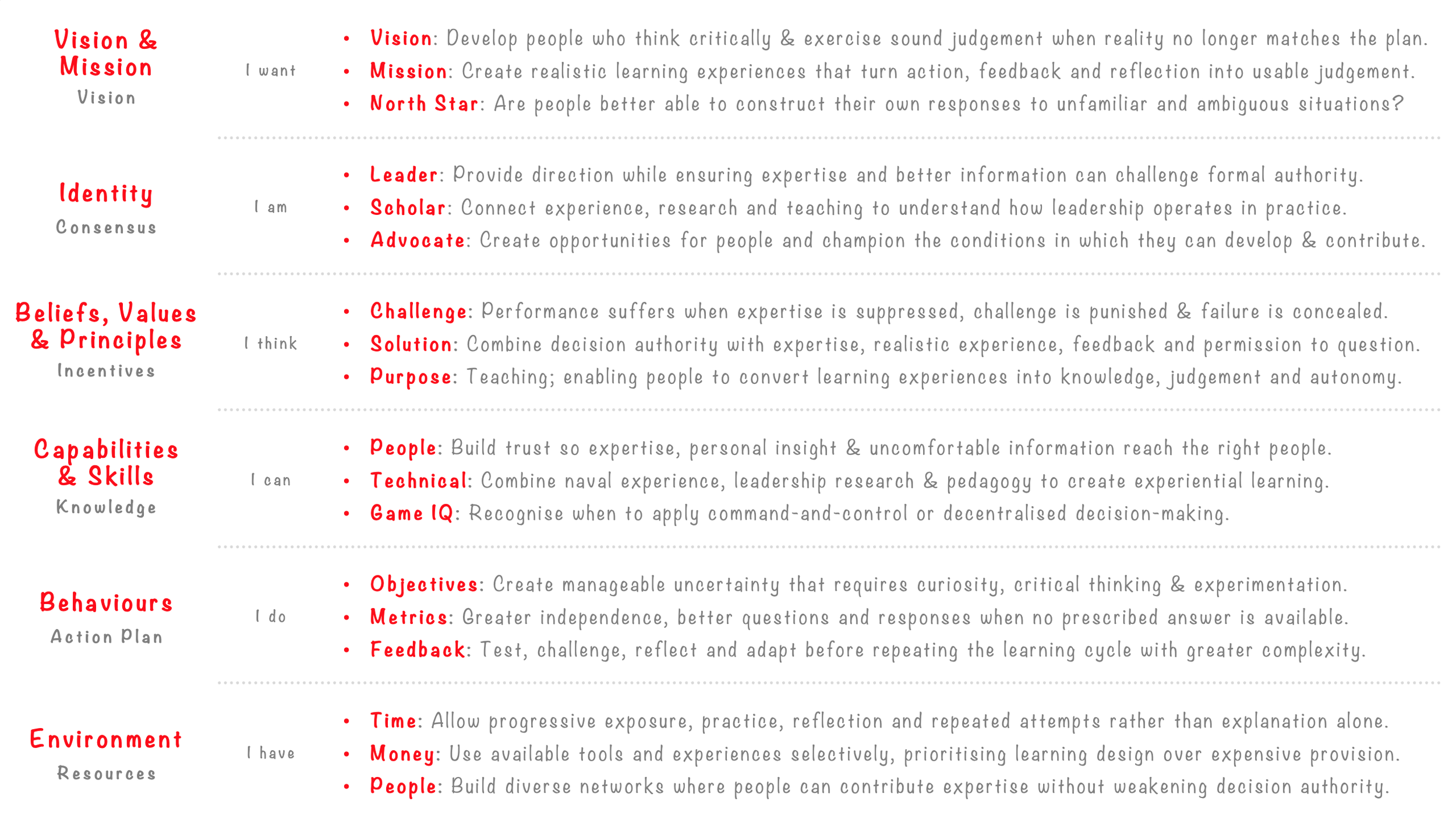
Source: Dr Matt Offord | Performance Architecture | Peak Performance Unlocked Podcast | CS2

Source: Dr Matt Offord | Performance Architecture | Peak Performance Unlocked Podcast | CS2
Call to Action
This episode is intended to be used. Viewers are expected to examine how readiness, knowledge and judgement are developed within their own operating environment and ask:
Where does my readiness depend on knowing the answer in advance?
Does the right knowledge reach the right person at the right time?
Where are people expected to adapt under pressure without enough opportunity to practise?
What am I treating as failure that should instead be treated as useful information?
Identify one area where your current readiness depends too heavily on prediction. Create an opportunity to practise without it. Capture what you learn. Review. Adapt. Repeat.
Extended Learning
If you wish to capture your own case study observations you can do so here: Personal case study review.
Guest Reference
Dr Matt Offord is the Associate Director of Learning & Teaching at the Adam Smith Business School, University of Glasgow. A former Royal Navy officer, his work spans leadership, experiential education, simulation, digital learning, AI and responsible leadership.
Royal Navy: Officer, EOD Diver & Team Supervisor, Submariner and XO of HMS Brocklesby.
University of Strathclyde: MBA.
Durham University Business School: PhD in Leadership.
University of Oxford: Royal Navy senior representative & Senior Research Fellow.
University of Edinburgh: MSc Digital Education.
University College London: PhD research in Education Pedagogy.
Follow Matt
LinkedIn: Dr Matt Offord