Is X (Twitter) an Organisational Transformation Showcase?
Time: 105mins applied study.
Why?
Elon Musk’s approach to turning Twitter from an ideological bot ridden financial car crash to a financially stable trustworthy global town square is fraught with opinionated controversy. It does seem, to me at least, that many of the commentators have little to no understanding of what’s involved in terms of time, money and skill to genuinely drive the level of organisational transformation Twitter requires, or what Elon is ultimately trying to achieve. If we lay out the facts as they stand, what can we learn from Elon changing Twitter to X that can be applied to our own organisational transformations?
What?
To better understand Elon's approach to transforming Twitter we must first take in to consideration the position Twitter was in when Elon declared his intention to acquire it in 2022. The previous board reported annual losses ranging from $200million to $1.1billion in 8 of Twitters previous 10 years, source: statista.com. They have also been found to actively suppress tweets containing scientifically proven facts in favour of fact-free ideological opinion. For evidence of fact suppression see episode #1258 of the Joe Rogan Podcast with guests Jack Dorsey, Vijaya Gadde and Tim Tool. This sets the stage as to why Elon decided to acquire Twitter. From here we will cover what Elon aims to achieve and how he plans to get there.
How?
Using publicly available information we will deconstruct Elon's proposed Transformation of Twitter to X. With the help of academic behavioural models we will answer 3 key questions:
What is Elon's expectation for Twitter? Revealing a precise & concise business strategy.
What is the effect on organisational competence? Revealing how few people are actually needed.
What is the effect on organisational performance? Revealing a self-selecting high performance culture.
Elon’s Expectation
I created this model based on the work of Tim Knoster, Dr of Education and Professor of Exceptionality Programs at Bloomsberg University of Pennsylvania. His research in developmental learning unveiled the correlation between the components of strategy and human fallout, which ultimately determines the level of success or failure in any endeavour. My version is an adaptation of the original for use in a business context by any individual, team or organisation in pursuit of a specific outcome. This can be anything from delivering a career defining presentation to leading an organisational transformation in a large enterprise. In the context of this case study we will use it to deconstruct map out Elon's Strategy for Twitter.

Source: Based on Lippitt 1987, Knoster 1991 & Kenny Wallace 2021
On Thursday 16th June 2022 Elon Musk met with Twitter employees for the first time. During this all-hands meeting Elon laid out his ambition for twitter. The transcript to this meeting is publicly available. a copy of which is below.
-
Twitter All-Hands Meeting 16th June 2022.
Source: Business Insider 17 June 2022
Parag Agrawal (AP), Twitter CEO: Elon, thank you so much for joining us. The company has been so eager to hear from you.
Elon Musk (EM): Absolutely, Parag. Thanks for having me. Glad to speak to everyone.
PA: Since we started late, I'm going to go right ahead and hand it over to Leslie.
Leslie Berland (LB): Amazing. Thanks, Parag. Hi ,Elon.
EM: Hi.
LB: Um, we have a lot to cover. So I'm going to ask you a question that usually comes at the end, will you come back for a part two at some point?
EM: Yeah. Absolutely.
LB: Ok cool we have some room. We're just getting started. I'm going to zoom all the way out and get to the reason we're here today – you love Twitter.
EM: I love Twitter. I want to be clear on that, I love Twitter. In fact I literally have tweeted I love Twitter.
LB: So tell us, say more, why do you love Twitter and why do you want to buy Twitter?
EM: Well um let's see. I feel like I learn a lot from what I read and see on Twitter. Um the pictures, videos, texts and memes that people create. I also find it's a great way to get a message out. If I want to say something and make an announcement I think Twitter is the best way to do that. It goes out to everyone. You know I made a joke already, but some people use their hands to express themselves. I use Twitter. I find it's um yeah the best forum for communicating with a lot of people simultaneously and getting the message directly to people.
In the past, in order for someone to read about something you had to issue a press release and hope the regular media would write about it and they wouldn't write about it in quite the way you'd like. I find those old style press releases quite strange, it's some overly flattering, vaguely, in fact quite propagandist thing, hoping the media writes something favourable and usually they do not. I think that's actually one of the biggest reasons for me using Twitter, so I can communicate directly with people and not through the lens of the media.
I think there's an important role for the media to play but for anyone who's read a newspaper, it's coming through quite a negative lens. So how many newspaper articles do you read that are positive and how many that are negative? It's obviously overwhelmingly negative and when you read about something in the news that you actually personally understand the situation, how many times has the media actually gotten it right? Not never, but I'd say almost never. So this is a way to communicate directly with each other and not through a negative lens. That's important for the world. I'm sort of waxing on about this but it's very important. And um some of my comments about Twitter being a digital town square, but really it's much more than that.
You can't have millions of people in a town square, you have millions of people on Twitter, which is incredibly important and essential for a functioning democracy. To function well, I think it's essential to have free speech and communicate freely.
The freedom of speech stuff, it's in the context of the law. So I'm not suggesting we just flout the law because we'd get shut down in that case. And I think there's also freedom of speech and freedom of reach. Freedom of speech is one thing. Anyone can go to Times Square right now and say anything they want. They can deny the holocaust ok? That doesn't mean that it needs to be promoted to millions of people. So I think people can say outrageous things within the bounds of the law but it doesn't have to get amplified and I think an important goal for Twitter is to try and include as much of the country, as much of the world as possible.
Currently it's a relatively small percentage of the world, a small percentage is on Twitter. Let's say 200 million users here, you've got 8 billion people in the world, that's 7.8 billion who are not on Twitter. That's a pretty big number. You want as much of the world on Twitter, you want to be inclusive as possible for the broadest demographic. In order for that to happen people must like being on Twitter. If people are, like, being harassed or they're uncomfortable they're just not going to use Twitter.
So we have to strike this balance of letting people say what they want to say but also making them comfortable on Twitter or they simply won't use it. It will be simply quite niche.
But I think there's also a lot that should be done. Enhancing the core technology and offerings of Twitter. Like right now if someone does a video, a content creator does a video, then they'll put that video on YouTube and just put a link to it on Twitter because they are able to monetize content on YouTube but not on Twitter. You want people to put content on Twitter or we have to be a place where content creators can monetize that. So they can post to YouTube and to Twitter but it's crazy right now that content creators will use Twitter to drive traffic to their YouTube videos because that's how they make a living. And that really should be on Twitter.
I want to address the reasons why people use Twitter and why people click away from Twitter and if we can address those reasons, they'll use Twitter more and get greater value from the service.
Think of it like WeChat in China, which is great now, but there's no WeChat equivalent outside of China. There's a real opportunity to create that. You basically live on WeChat in China because it's so helpful, so useful to daily life. I think if we achieve that or come even close to that with Twitter, that would be a success. Hopefully that's, well I really went there and I'm happy to elaborate on any of those points.
LB: No, that's great and we're going to go a little bit deeper on this. In terms of, you've really had a lot of thoughts about things that aren't going well with Twitter, barriers to what's possible… did that seed your desire to buy the company to fix these things? What's your thought process around that?
EM: Um, well, there's definitely an ongoing challenge with Twitter with bot accounts and spam accounts. There are quite a bit of scams on Twitter. It's been better but still quite a lot of that. There are also people, it may not be bots, but one person operating hundreds of accounts and trying to make them look like individuals but they're not. In order for people to have trust in Twitter, it's extremely important there's transparency. That's why I've said the algorithm should be open source so people can critique it and improve and identify bugs potentially. Transparency increases trust I think it's a very important, like, anything happening on an automated basis be open source, clear, and if there is any action taken on Twitter to de-boost or boost a tweet, that be identifiable in a tweet so people aren't ascribing malice where there is no malice.
But when it's inscrutable people don't know what to think and people sometimes think the worst when it's just not true. I think that trust is truly important and just for the usefulness of the system getting rid of troll farms and bots is incredibly important.
I have a thought in this regard, which is to, you know there's currently Twitter Blue, but if you're on Twitter Blue the system doesn't change. So if there was a little Twitter Blue authenticated, not like a celebrity, but authenticated by Twitter Blue payments. Piggybacking on the payments system to do authentication, a lot of people would be like, oh that's helpful. Some authentication to my name, that means I'm probably not a bot or spam or someone operating hundreds of accounts. That's like $3 a month. I believe that would be helpful. And also prioritizing comments and mentions and whatnot by who is verified in this broader sense of Twitter verification incentivized by Twitter Blue verified. Still full read and write access to the system, but essentially any tweets would be prioritized into who's verified.
LB: l have a couple of follow up questions on this, but given you mentioned trust, I wanted to ask an employee question around trust. Twitter has a lot of incredibly smart and talented people. What can we do to earn your trust and what are you going to do to earn ours?
EM: Um. I think you know, uh, trust is as trust does. So, I tend to be extremely literal with what I say. So things that I've said about Twitter I've meant in order for it to really go to the next level. The potential is there for Twitter to be accessible to an order of magnitude more people and for a lot more people to find it useful. 4 to 5% of the world optimistically is finding Twitter useful, maybe 50% of the world could find Twitter useful, so I'm going to take whatever actions lead to that, and um you know, I'm very much, in the sense of trusting, if someone is getting useful things done then that's great. If they're not getting useful things done then why are they at the company? So it's really just we need to improve the core technology, improve the design and so you know…
LB: So trust is building from that…
EM: Yeah, trust is not exactly the, if someone is getting stuff done great, I love them. If they're not then I don't like that. It's pretty straight forward.
LB: I'd love to stay on this topic of employees and how we work. So distributed work has been core to our strategy. Most of our people work in a hybrid model. About 1,500 people work remotely full time. You've sent communications to Tesla executives on remote work. Can you share what your point of view is on remote work and specifically for Twitter?
EM: Yeah, so Tesla makes cars and obviously you cannot make cars remotely. You have to make cars in a big factory, use the supply chain, assemble the parts and then transport the car to the owner. All these things have to be done in person. There are some roles at Tesla that can be done remotely, like software or design, and uh, so that's still a case where you want to aspire to do things in person but if someone is exceptional at their job, it's possible for them to be effective working remotely.
With Tesla I've simply asked for a list that a manager has to confirm that they're an excellent contributor and if they do they're allowed to work remotely. So it's pretty basic, I think.
There is a hit one takes remotely. It's hard to, if you, it matters to be in person at least some of the time. Even if someone is working remotely they've got to show up at least occasionally so that they recognize their colleagues so they don't walk down the street and don't even recognize them. That would not be good.
LB: I think this is super clarifying and resonates with us and it entirely comes with how we work so thank you. So I want to keep on the topic of employees. This is on the topic of compensation and benefits. Most people here are used to working for a public company. Can you talk about how you compensate folks at SpaceX as a private company. How does it work and what approach do you plan to take at Twitter as a private company?
EM: Yeah so SpaceX operates in the best of both worlds, where stock and options are given to everyone but we don't have all the challenges that come with being a publicly traded stock. It can be up and down from one day to the next and one is at the mercy of short sellers and class action lawsuits. It's like being in the public stockade.
SpaceX still has liquidity and every six months we have a liquidity event and people are allowed to sell their shares and that's worked very well for the whole life of the company. I think something like that would make sense at Twitter. So it will still be stock and options and everything, it will just be liquidity events twice a year.
LB: And thanks, so we're getting some real time feedback on the remote work response so I want to make sure I follow up. You're approach to remote work at Twitter, is what I'm hearing from you is that your in support of remote and distributed work that is productive and people show up when it's important?
EM: Yeah, the bias needs to be strongly towards working in person, but if someone is exceptional, then remote work can be ok. But basically if their work output is exceptional then remote work is fine. There is some communication impact that one takes when working remotely if you're with people and just a few desks away, it's very easy to communicate in real time. It's much harder to do that if you're in different physical locations. I do want to emphasize that. The bias is very much toward in person work. It would obviously be insane if someone is excellent at what they do but can only work remotely to then fire them. That would be insane. I'm not in Favor of things that are, like, mad. I'm in Favor of things that build the business and make it better.
LB: Question about layoffs, we've received several questions from employees about this. Can you speak to how you're thinking about layoffs at Twitter?
EM: Well I think it depends, the company does need to get healthy. So right now the costs exceed the revenue so that's not a great situation to be in. So there would have to be some rationalization of headcount and expenses, to have revenue be greater than the cost, or else Twitter is simply not viable or can't grow. It would be dependent on, but like I said, anyone who is a significant contributor should have nothing to worry about. I do not take actions which are disruptive to the health of the company so, you know, yeah.
LB: Connected to that you're obviously learning things as we get closer to this deal closing, what do you feel you have a good grasp of and what do you want to take a deeper dive on and learn?
EM: Well I have a great understanding of the product because I use Twitter everyday practically. I've got a good understanding of how it works from a product standpoint.
What I have less understanding of is, um, this bots, spam or multi user accounts -- basically anything that affects the monetizable daily user number, that's probably my biggest concern. Because that's really what drives advertising revenue as well as subscription revenue and really Twitter revenue is going to be subscriptions, advertising, I think payments would be an interesting thing to do as well. All of those things are only relevant for how many unique humans are on the system. So that's my biggest concern and that's what I've said publicly as well. Like, I said, I try to be as literal as possible, so, you know, yeah.
LB: As we think about serving customers all across the world it's clear and existential for us to service diverse communities. You've been vocal on a number of different topics on inclusion and diversity. Can you talk about your views and your commitment to a diverse and inclusive workplace and one where people can feel safe?
EM: So first of all, what I said earlier, there are 8 billion people in the world. I'm told there's 200 million daily users of Twitter, that's a 7.8 billion person gap. So we want at least a billion people on Twitter, maybe more, as many people as you can possibly get on Twitter. So that's the most inclusive definition of inclusiveness. That's all humans. That's important.
From a company standpoint, I believe in a sort of strict meritocracy. So, whoever is doing great work, great they get more responsibility and authority and that's that.
LB: I know in some of our conversations you've mentioned your I&D team at Tesla. We have an amazing I&D team here at Twitter as well, so we can continue the journey together. I want to come back to content moderation. A lot of what's allowed speech is awful here is the US – animal abuse, doxing, videos of sexual violence, etc, so allowing this type of content obviously could cause harm and make Twitter unusable. What is your approach to this content that is legal but problematic for people using the services?
EM: As I said earlier we should allow people to say what they want, post what they want within the bounds of the law, um but that's different from them being able to reach people that don't want to be reached with that content. So, if that content is offensive to people, those people will simply stop using Twitter. It's important to make Twitter as attractive as possible and really that means not showing people content they would find painful or offensive or frankly content they would find boring is not good.
I was talking about TikTok last night and TikTok does a great job of making sure you're not bored. It does make you feel like ADD, but next level. But TikTok does a great job of making you not bored.
I do find some of their videos offensive, I think, but they're not boring. The folks we reach, I want to make sure they see content that is entertaining and engaging and interesting, such that they want to keep using Twitter and use it more. That's essential to the growth of the service.
LB: One of our employees asked about people who use Twitter having the right and the ability to filter out content they don't want to see…
EM: To be clear, the standard is much more than not offending people. The standard should be they are entertained and informed. You could not offend someone but you can bore them and they won't use the service or they'll use it less. So that's why I use the example of TikTok where they just hone the algorithm to be as engaging as possible and I think we want to also be as engaging as possible, in a different way. TikTok is interesting, but you want to be informed about serious issues as well. And I think Twitter, in terms of serious issues, can be a lot better at informing people.
I do think it's important that if there are two sides to an issue to represent multiple opinions, but you know, to just make sure we're not driving a narrative and give people an opportunity to understand. Most issues in the world are complex they don't boil down to this is 100% good and this is 100% bad. We'd have a more informed public if they were presented with multiple sides of an issue.
LB: One point I want to go back to on the law and how that impacts content and moderation. As we think globally there are some countries that have laws that limit speech… Twitter is historically focused on what we can do so people everywhere can have their voices so how do you think about local laws and what that means?
EM: I'm in Favor of going as far as the laws allow. If say, Twitter employees would get arrested in a country if we didn't adhere to the law, I guess we adhere to the law or exit the country or something, but as much as we can enable people to have a voice and speak their mind, I think we want to do that.
LB: Can we talk briefly about your political views? How, if at all, do your political views influence the companies you run? How would it affect Twitter, if at all?
EM: Well my political views I think are moderate, at least as to, if you said what is the centre of political views in the country, I think I'd be pretty close to the centre. I voted Democrat in every election until a recent one this week, and um, I voted for Mayra Flores, who is a Republican, a Mexican-American and I thought was a good candidate. I'm in Favor of moderate politics, but allowing people to have relatively extreme views, to express those views within the bounds of the law. As I've said publicly, let's say the far left 10% and far right 10% were equally upset on Twitter, then that would probably be a good outcome.
LB: I want to talk about the business. You've spoken about incentives for advertising on Twitter, what role does advertising play in your planning for the future of Twitter?
EM: I think advertising is very important for Twitter. See, in terms of SpaceX, there's no need for advertising because the demand exceeds our production. So advertising is fundamentally a demand generator. Given at Tesla, demand is far in excess of production, there's no need for Tesla to advertise, but I'm not against advertising. I would probably want to talk to the advertisers and say let's make sure the ads are as entertaining as possible. And I think they're more effective if they're entertaining. Of course, I don't think it's good to allow any advertising of products that are, you know, bad products. Like, I was literally scammed. I bought this thing from a YouTube ad. I got it and it didn't work and I Googled it and it was like oh yeah, you get past the first results and it's like, yeah this thing doesn't work. I'm like why the hell is YouTube allowing advertising of scammy products? That's totally not cool.
But if advertising is entertaining, something you actually want, fulfilling to a Twitter user, then that's great.
LB: So we're gonna go over, is that ok?
EM: Yeah, that's fine.
LB: So I want to talk about Twitter and payments and understand your thinking there.
EM: Yeah, money is essentially a form of information. It's information that allows us to exchange goods and services and not have to barter and allows people to shift obligations in time. But money is fundamentally digital and has been for a while and, um, PayPal I think has done a great job on the payments front. I think it would make sense to integrate payments on Twitter, so it's easy to send money back and forth and if you have another currency as well as crypto. It is essentially whatever someone would find useful. My goal would be to maximize the usefulness of the service. The more useful the service the better, and if one can use it to make convenient payments that's an increase in usefulness. News, entertainment and payments are, I think, three critical areas. But it's really thinking about how to make Twitter so compelling you can't live without it and that everyone wants to use it.
LB: I want to stay on product. Around authentication you want to authenticate all humans, for those who benefit from anonymity can you clarify that and speak to that tension?
EM: I don't think it's necessary for someone to use their real name. If someone could do a payments based authentication I think it should be ok to not use your real name. So Twitter would know who you are from a payments standpoint but you wouldn't have to use your real name.
It's also, say if someone has different political views from their manager, let's say then they don't really want to get crossed wires there, and it would be better for them to have a pseudonym on Twitter, but it would still be authenticated in the back end. At no point would I suggest that you have to be authenticated in order to use Twitter. It would just be a prioritizing of authenticated comments and action on Twitter over unauthenticated, in order to combat bots and trolls.
Essentially it needs to be much more expensive to have a troll army whereas right now it's very inexpensive to have 100,000 fake Twitter accounts.
LB: You have certainly been very vocal on Twitter. You are very vocal on Twitter. You have also been critical of the company on Twitter which impacts conversations and impressions, even with partners. I'm curious to know the thinking behind the tweets, if you will.
EM: One thing about words is it's hard to convey tone so it's possible for people to take the words and assume they were said in an angry way or a vindictive way. I mean, hopefully you can tell by my normal tone, I'm not an angry person. I almost never raise my voice. Like, in a year I might not have raised my voice, literally. So sometimes people may think I'm yelling or screaming or something but I'm really not. So if there's some way to indicate tone, maybe emojis sort of do that, but I don't know. Maybe there could be like a, where you have an irony flag or something. This is an ironic tweet, or something like that.
LB: Spaces is a great product for you, as well as voice tweets. They would add colour, so maybe you could…
EM: Oh sure. I should. Maybe I could just say it. Or you could read and you can then see how I actually said it.
LB: On your role at the company, there's been discussion of will you be CEO, will you not. How do you anticipate your role influencing strategy day to day, the vision?
EM: I'm not that hung up on titles. But I do want to craft the product in a particular direction, so I don't really care, you know, about being CEO. In fact, I renamed myself Techno King with an official SEC filing…
LB: Yeah, we saw…
EM: Yeah, and our CFO was renamed Master of Coin, which I think is cooler than CFO. So, um what I really want to do is drive the product, improve the product and basically software and product design. I don't mind doing other things related to operating a company but there are chores. There are a lot of chores to being CEO. And I just want to make sure that the product evolves rapidly and in a good way and, um, I don't really care what the title is. But people do need to listen to me. If I say hey we need to improve the product in the following way and add these features then, like, I do expect that people will listen to me in this regard. That's what I do at SpaceX and Tesla.
I'm really just working with engineering and production. Sometimes it might seem like wow Elon is really out there a lot. I'm not. If you see how many actual interviews I do, it's quite a small number. But, uh, if I do a tweet they make an entire two page article about it. I'm actually quite internally focused at SpaceX and Tesla even though it might not seem that way. We're just evolving the rocket technology and providing global internet and StarLink and at Tesla it's about accelerating sustainable energy with electric cars and stationary battery packs and solar power. The fundamental good of Tesla I'd say is how many years did we accelerate the advent of sustainable energy, then the fundamental good of SpaceX is are we able to make life multiplanetary and thus improve the probable lifespan of consciousness?
What is the unifying philosophy, for me, it is: We should take the set of actions most likely to expand the scope, scale and lifespan of consciousness as we know it. And so that's what set of actions improve things at a civilizational level and the probable lifespan of civilization.
Civilization will come to an end at some point but let's make it last as long as possible. It would be great to understand more about the nature of the universe. Why we're here, the meaning of life, where it's going, where do we come from, can we travel to other star systems and see if there are alien civilizations? There might be a whole bunch of long dead one planet civilizations out there that existed five million years ago. If you think about human civilization… it's only been a million years, which is nothing. Earth is roughly one half billion years old. So all of civilization is a flash in the pan and we want to take whatever actions we can to expend that flash in the pan to hopefully be a one that lasts a long time.
LB: I can't believe I have to transition this conversation from aliens to, uh, Twitter...
EM: I'm not saying it's aliens. But yes, aliens.
LB: What does Twitter look like to you…
EM: I'll stop trolling people about aliens because people really think – I've seen no actual evidence for aliens. I get asked that a lot and I'd think I'd know and I've not seen anything. Yet.
LB: You heard it here everybody. Question about Twitter, when you look five to ten years from now what do you consider successful for yourself and in acquiring the company and the work we do?
EM: So I think success would be a substantial increase in daily active users. Can we get daily active users over a billion? That would be a huge improvement from where things are today and I guess broadly speaking, is Twitter helping further civilization and consciousness? You know, like, are we, well transaction's not complete so I shouldn't say we but, is Twitter contributing to a stronger, longer, lasting civilization where we are better able to understand the nature of reality? I would say my philosophy is one of curiosity of trying to understand the nature of the universe as much as it's possible to understand. And in order to do that, you must expand the scope and scale of consciousness to expand the life of consciousness. And so, I guess broadly speaking, it would be, has Twitter meaningfully improved the strength and longevity of civilisation?
LB: Elon, I know that we have gone meaningfully over, so thank you for the time, thank you for coming back for part two, thank you for continuing the conversation with all of us.
EM: You're welcome, It was a pleasure.
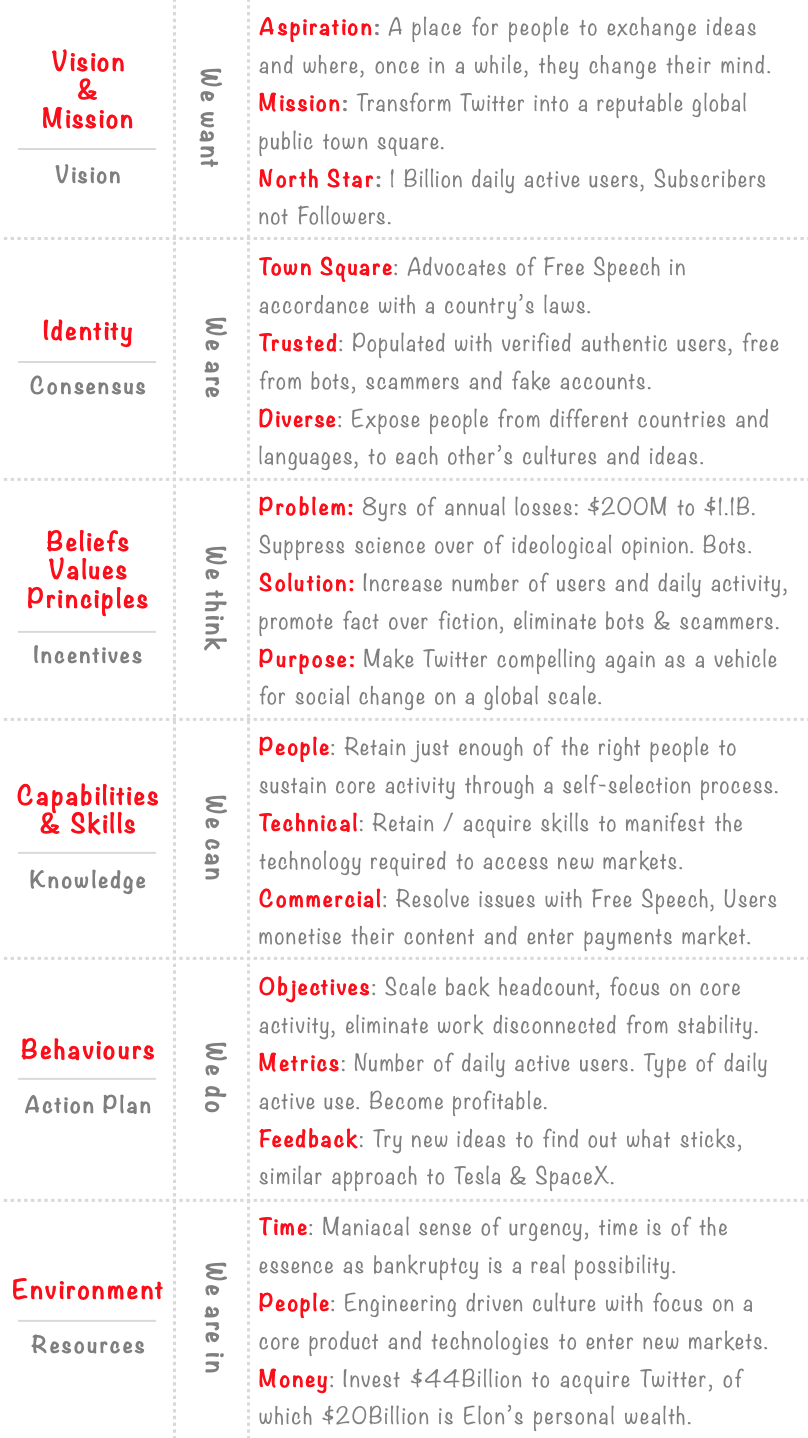
If we populate this model with key information from the meeting transcript we can create a precise and concise one page strategy document for Twitter, which looks like this:
Source: Elon Musk's Twitter Strategy, Kenny Wallace 2022
As you can see, we can very quickly demonstrate a path for Twitter to become self-sustaining while simultaneously eliminating bots, fake accounts, scammers, improve content quality and delivery. Users will get to monetise their content and Twitter can regain lost revenue streams by re-establishing trust with advertising partners. That said, to make an omelette you first have to smash the eggs. In Twitters case, what does that look like?
Organisational Competence
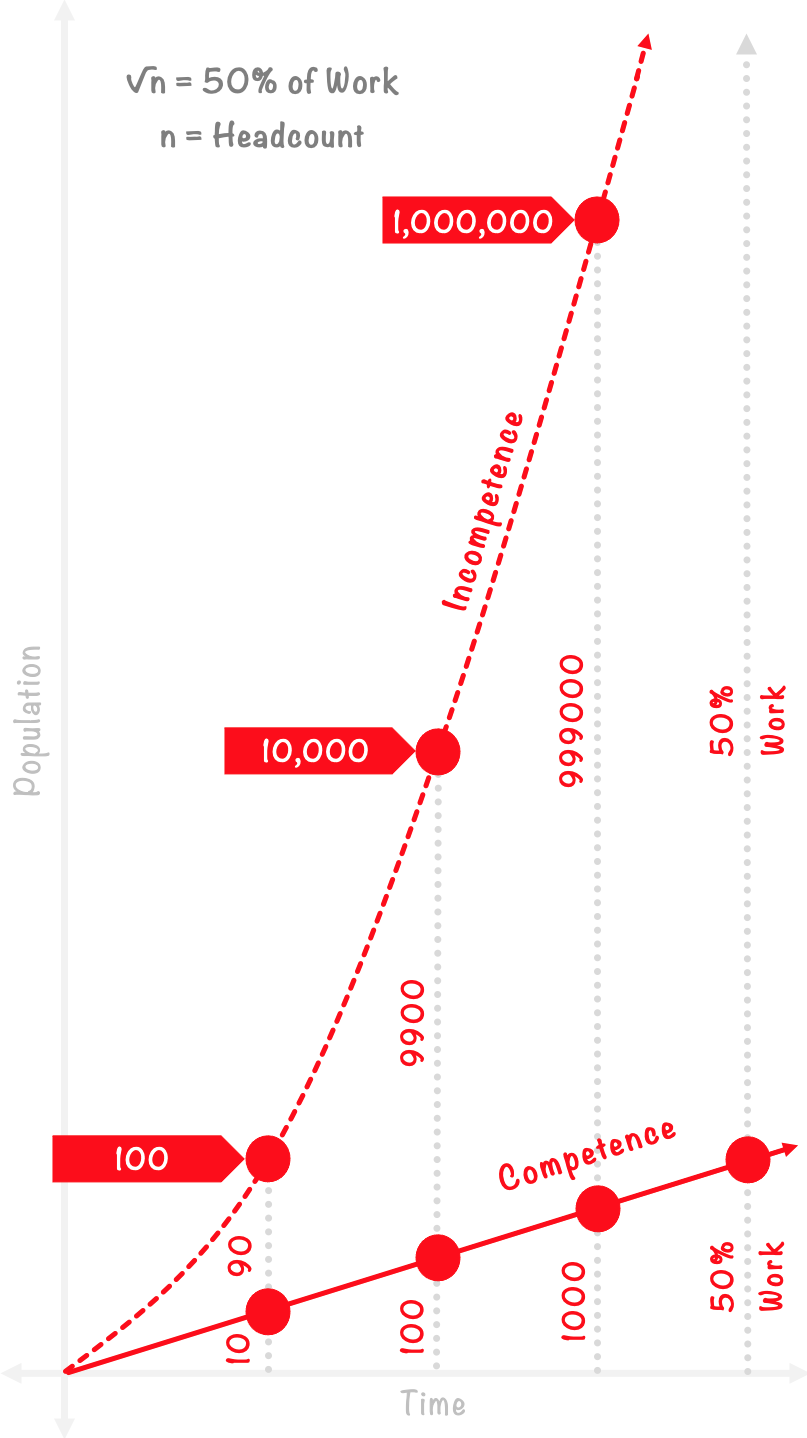
The model below is based on the work of Dr Derek J. de Solla Price, a Physicist and Mathematician at Cambridge University, who discovered a social phenomenon that occurs in any given population, which is the relationship between that population and its output. In mathematical terms it presents as the Square Root (√) of any given population (n) do 50% of that populations work, known as Prices Law or Price's Square Root Law. In the context of this case study we can use this equation to quantify the relationship between competence and incompetence.
Source: Derek J. de Solla Price 1965 & Kenny Wallace 2020
This model demonstrates in any given population Competence increases linearly and Incompetence increases exponentially, proving that as a business becomes larger it becomes less capable with every hire. To put this in financial terms let’s take a headcount of 100, and to keep things simple let’s assume they are each paid £10,000 with a total salary bill of £1million. The first 10 earning a total of £100,000 buys you the same output as the remaining 90 earning a total of £900,000.
We can use this inevitability to calculate the positive impact of removing the 90 poorest performers. This retains 50% of organisational productivity for only £100,000, providing a 90% salary bill saving and £900,000 which can now be meaningfully reappropriated elsewhere in the business.
On the 9th of November 2022 CNN reported Twitter had a headcount of 7500 prior to Elon’s acquisition. Prices Law demonstrates that 87 of the 7500 employees are responsible for 50% of the output. Twitter could lay-off 7413 people and still achieve half of it’s previous productivity.
On the 27th June 2022 Business Insider reported the typical salary range at Twitter to be $110,000 to $330,000, so for the purposes of this exercise let’s use an estimated median salary of $175,000 to further estimate Twitters total annual salary bill: $1,312,500,000, so just over of $1.3billion. Prices Law dictates Elon could save and reappropriate $1,297,275,000, just short of $1.3billion in salary alone and still achieve 50% of current output for a cost of $15,225,000. To reiterate: Retain 50% productivity for just over 10% of the cost in salary.
When combined with the previously mentioned pivot to focus operational excellence on a core product the required outcomes for success become eminently achievable. To better understand how to create a selection process to capture the 87 best suited to support Elon’s vision for Twitter I’m going to draw on my experience as a Paratrooper.
For context: The British Army’s Parachute Regiment, is a Tier 2 unit closely linked to UK Special Forces through the Special Forces Support Group (SFSG), principally 1st Battalion, AKA 1 Para. The Parachute Regiment also has The Pathfinder Platoon, which has a selection process similar to the more commonly known Tier 1 unit, the SAS. The gateway to becoming an operator in the Parachute Regiment, including any of it’s support units is a voluntary selection process known as P-Company. Each aspiring Paratrooper is free to choose whether to participate or voluntarily withdraw at any point.
The volunteers are expected to complete a series of intensely gruelling events everyday during a test week with very little recovery in between, and this is after already being deliberately worn down through a “build up phase”, during which many candidates will drop out. The already fatigued volunteers experience the compound effect of deliberate and rapid stress testing at their mental and physical limit. They also have the psychological hurdle of knowing they are immersed in a points based assessment scenario during which there is no feedback loop. You are neither encouraged or discouraged. It’s a hostile environment from start to finish with each volunteer ultimately at war with their own mind. It’s of no surprise P-Company has a high failure rate. A pass in this selection process is categorised as the bare minimum acceptable level of physical fitness and mental toughness required to meet the non-negotiable regimental standard.
At the end of P-Company the volunteers form up on the parade square, their names read out one at a time followed by an emotionless: Pass or Fail. There is no scale with percentages. You either met the standard or you didn’t. Those that pass are immediately presented with their coveted Maroon Beret.
P-Company is designed to achieve 3 key outcomes:
Self-select for a particular temperament suitable to fulfil the Parachute Regiments role.
Facilitate & cement relationships founded on trust through shared adversity & achievement.
Set the precedent for operational excellence within a collective under extreme duress.
Elon has created a voluntary selection process for recruitment & retention at Twitter to achieve 3 similar outcomes.
Organisational Performance
The model below is based on a matrix created by Dr Mihaly Csikszentmihalyi, Professor of Psychology at Claremont Graduate University, who was first to formally investigate the traits associated with high performance, which he collectively called Flow; A highly focused mental state conducive to productivity. I have modified it for a business context by looking at the relationship between Challenge, defined as: Degree of difficulty to be overcome, and Support, defined as: Available resources. Four organisational states emerge:

Source: Based on Massimini, Csíkszentmihályi & Carli 1987 and Kenny Wallace 2019
These four cultural archetypes also correlate with specific behaviours that can be measured in any individual, team or organisation:
Anxiety: Missed deadlines, avoidance of interaction, impacts employee sickness absence.
Apathy: Absence of enthusiasm or presence of indifference, impacts employee retention.
Comfort: Lack of activity and accountability, negatively impacts employee productivity.
Flow: Pro-active, self-directed, personally responsible, positively impacts all above.
If we combine this model with what we’ve learned about organisational competence and the selection process needed to find people with the most suitable temperament, we end up with a self-selecting group that can collectively thrive in the Flow quadrant, when almost everyone else would experience high levels of anxiety and/or apathy. We are not all programmed to like, want and endure the same things and thats ok.
Those that volunteer to remain at Twitter will most likely buy-in to the vision, want to be a part of realising it and go on to perform well in the new culture for how ever long they choose. These factors dramatically increase the likelihood of mission success. Those that don’t buy-in are free to leave at any time and choose another path better suited to their temperament. This is also ok.
Conclusion
So what?
Elon wants to create a trustworthy global town square with freedom of speech at it's core. To achieve this all work that does not contribute to this mission will be terminated. An operating model that can filter out fake news, fake accounts, allow users to monetise their posts, all with better security measures, will be adopted.
By eliminating all non-mission critical operations and creating a self-selecting high performance culture, organisational competence will be measurably increased while operating costs are measurably decreased. Prices Law indicates headcount be can reduced from 7500 to 87 saving $1,297,275,000, just short of $1.3billion in salary alone and still achieve 50% of current output for a salary bill of $15,225,000.
The selection process Elon has imposed ensures those who remain at twitter will most likely exhibit the temperament and competence to thrive in their new organisational performance culture. After all, the principles behind this are similar to those leveraged in Elite and Special Operations Forces (SOF), which is a tried and tested methodology for creating high performing teams.
Now what?
Assessing every decision based on whether the answer hinders or helps mission success is paramount as this prevents the pitfall of distractions that soak up resources in terms of people, time and money. Elon has applied this principle in every company in his charge:
PayPal: Paradigm shift in the financial sector in terms of payment speed and freedom to move money.
Tesla: Paradigm shift in our use of, and reliance on, fossil fuels by disrupting the automotive industry.
SpaceX: Paradigm shift in space exploration and the near realisation of humans as multi-planetary.
Each of these paradigm shifts has occurred within two decades from their point of origin. To achieve one in a life time is an astonishingly rare feat, never mind 3 for 3.
Starting with a clearly defined end in mind aids in the elimination of non-mission critical work. Assessing whether the proposed course of action is a liability or asset to mission success is easier and faster, it either lines up or it doesn't. In terms of operational activity knowing the end in mind aids recruiting as hiring and task assignment results in the right people working on the right things at the right time. Unlike Elon, this is where almost all senior leadership teams I’ve supported had initially fallen down. As they cannot define or articulate their end in mind they continually assign resources to activity that is of no benefit to what they think is an objective. I find mission statements are typically, at best, vague abstract aspirations.
This selection methodology is so effective that Elon has more on the way with Hyperloop, Neuralink and Starlink, the latter playing a significant role in providing a free-of-charge communication network to support the Ukrainian people to fend off Putin’s ongoing attempt to seize control and return to a Soviet like era. It’s not an accident this man is the richest person alive at the time of writing. Whether you love him or hate him his ability to conceive, execute and deliver projects at scale that spearhead global change is arguably unrivalled.
What next?
Now that you have a better understanding of Elon Musk's approach to transforming Twitter into X lets consider how we might use what you have learned:
Are you, your team, about to embarked on, or have already embarked on creating and delivering an Organisational Transformation of some kind; M&A, Scale-Up, Growth, Digital, Finance, HR, etc? If so, what considerations are you now aware of that you hadn't previously thought of?
As Prices' Law is essentially a mathematical equation that demonstrates how to achieve more with less; What work does this highlight in your own future or current organisational transformation that needs to be eliminated as it interferes with or even opposes mission critical activity?
Given the demonstrable effects of a robust selection process to acquire those with the temperament and competence to best ensure mission success; What steps will you take to recruit and build the team most likely to succeed?
Take your learning one step further and complete my Case Study Review. Capture your learning from this case study and commit to changes you deem relevant for your situation. A copy of your completed review will be emailed to you instantly.
If you are in the process of preparing to execute an Organisational Transformation, similar to this case study, then do consider working with me to either assess your Organisational Readiness or address issues that have come to your attention as result of this case study.